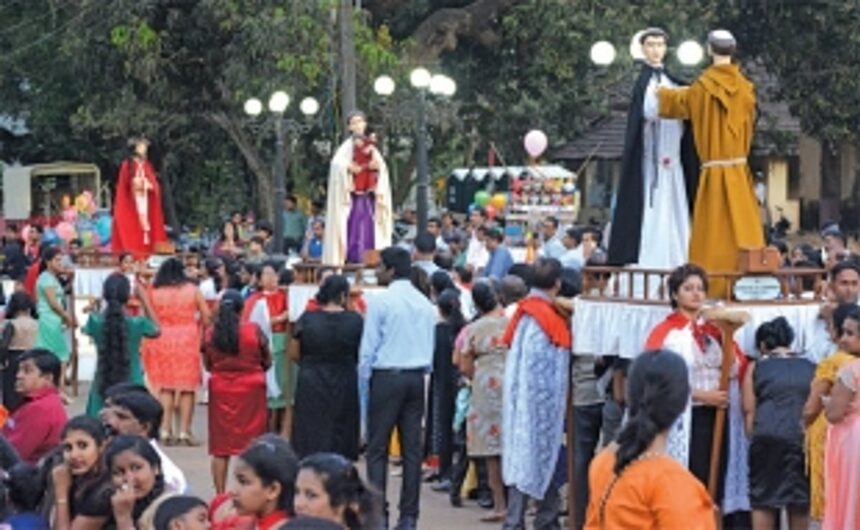
Irrespective of religion, thousands of devotees from different walks of life
thronged the village of Goa Velha in order to participate in the annual and
traditional procession of saints, popularly known as ‘Santanchem Pursanv’.
Around 31 life-size statues of saints were taken out from the church of St
Andrew, with a brief commentary provided on each of them.
The religious ceremony commenced with the
Eucharistic celebration and involvement of several priests of Goa Velha
deanery. The main celebrant, Fr Emidio Pinto, the parish priest of St Andrew’s
church, in his homily, urged the congregation to grow in holiness and embrace
eternal life.
“We are God’s chosen people and He invites
all of us to clothe ourselves in virtues, which include humility, generosity,
truthfulness, forgiving others and love. We are called to give up our sinful
life and live a new life by the power of the Holy Spirit,” Fr Pinto reminded
the laity.
Reflecting on the traditional procession
of saints, Fr Pinto said that all the saints led a good and holy life, and
after death, they are enjoying eternal bliss in the company of God. On the
aspect of miracles, he mentioned that only Jesus can perform miracles and the
saints can only intercede for all of us.
He said that at every step of life,
despite all obstacles, the saints did good and hence today they are in the
presence of God. “God is with us and the saints too are with us today. We need
to follow in their footsteps and proclaim the gospel by our exemplary life,” he
said.
“If we want to witness miracles, it is
necessary to remain in union with God. And if we trust in Jesus, then we too
will be able to see and perform miracles. Peter, Paul, Andrew and Philip made
Christ the centre of their lives and after surrendering themselves to Christ,
they tried to spread the word of God to others. God wants to encounter us and
deepen our relationship with Him,” he added.
“Mary Magdalene was a sinner, but she gave up her sinful life
and she was the first person to encounter Christ after His death,” Fr Pinto
revealed. “St Francis of Assisi belonged to an aristocratic family, but grew in
love of nature. We too are called to preserve and save nature,” he added.
“Like all the saints,” Fr Pinto said, “let us read the word of
God and live by the inspiration of the Holy Spirit. Let us make efforts to
change our sinful lives and live as new creatures,” he concluded.
Years ago, it was mostly men (the Confrares), who would take the
initiative of carrying the statues on their shoulders for the procession. But
with several men migrating overseas, there was a vacuum created and since last
year, the village women (the Confrares) actively assist in carrying the
statues.
Way
back when the procession of saints was carried out, the ritual focused more on
repentance and penance during the season of Lent. But as years passed by, the
spiritual dimension got lost among the Catholics and today it is considered
more of a feast than an act of penitence, considering the festive attire and
the colourful fair around the place.