Elsa Angel Rose
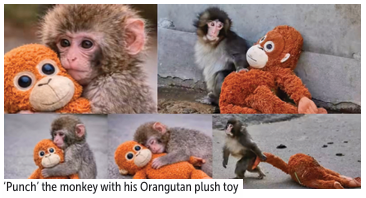
The cute little munchkin ‘Punch’ (monkey) has started making some really good friends, though some monkeys are still rude to him; the determined one does not give up (as he should). ‘Punch’ has been the talk of the town for the last couple of days. He is all over the internet, where the monkey is seen with an orangutan plush toy at Ichikawa City Zoological and Botanical Gardens in Japan. Initially, the internet was not happy to see this; people were mostly feeling subdued and empathetic towards him.

‘Punch’ was abandoned by his mother when he was born, which is a normal happenstance in the animal kingdom. But what surprised and raised intrigue in most people was his affection for and dependence on an IKEA toy (an orangutan plush toy), which was offered to him by the zoo authorities to help him get accustomed to life with the other monkeys in the zoo. Sadly, the other monkeys present were not making life easy for ‘Punch’. The monkey was seen everywhere with his orangutan plush toy. He was always trying to f it in with the crowd, but he often ended up feeling lonely. His only solace was his orangutan toy. Many people could relate to and feel for ‘Punch’.
DOLLS FOR EMOTIONAL SUPPORT AND NOSTALGIA
It was surprising and appealing at the same time to watch a macaque become close to a non-breathing thing. Equally at par with animals, and at times even more, humans connect with such soft, cute-looking stuffed toys. Among humans, young children playing with the same is considered absolutely normal, but perhaps if it is an adult, it might be considered an anomaly. A few people might keep such soft toys for emotional support or simply as a collection. “I have teddy bears, dolls, a monkey, and Piglet from Winnie the Pooh. I wouldn’t call it a collection. I would say I have kept them as they were gifted to me by people and family who were very close to me,” said Aishwarya Satardekar, a dentist based in Margao. When toys are gifted during childhood, keeping them close even after growing up makes them brim with nostalgia. “The soft toys I have are very special to me as it keeps the child alive inside me. Each soft toy has a short story behind it, including why it was gifted by the particular person,” said Aishwarya. Sharing one of her deeply personal anecdotes with her dolls, she said, “I have a doll and a chimpanzee, which I sometimes use as a puppet and talk to others. It makes people laugh and also creates a happy environment. During my childhood, whenever I had tough days, my dad would use the soft toys as a puppet and try to cheer me up. So, they have been emotionally supportive for me.”
SOFT TOYS AND THE STORIES THEY HOLD
Some soft toys offer more than emotional support; they serve as a testament to undying love for one another. “I have a soft toy that was gifted to me when I gave birth to my first daughter. It is now 24 years old. It is very dear to me. I first saw it at a Walkway, and while passing by, I happened to touch its nose. My husband noticed that and immediately bought it for me,” said Cheryl D’Souza, a homemaker from Reis Magos. The doll serves as a loving reminder of her husband’s thoughtful gesture. Cheryl shared, “Whenever I look at it, it reminds me of my husband’s enduring love for me. He has always paid attention to the little things I like and surprises me with them, which makes the toy even more precious.” For Cheryl, the eyes of the toy are the most attractive part. She said, “I believe soft toys have an innocent and pure expression, and that is what draws me to them.” The toy can be a source of emotional support when nothing else seems to calm a person, or it can be a reminder of how much people in your life love you, offering warm nostalgia and feelings of joy. Regardless of the reasons why one collects these cute inanimate objects, the purpose they serve in one’s life is special and meaningful.
DID YOU KNOW?
Punch’s attachment to his inanimate companion is more than just the focus of a heartbreaking video; it can also be related to the famous 1950s experiments by US psychologist Harry Harlow. His research became central to attachment theory, which stresses the vital role of the parent–child bond in development. Harlow separated newborn rhesus monkeys from their mothers and placed them in enclosures with two surrogate “mothers.” One was a wire structure shaped like a monkey that provided food and water through a feeder. The other was a soft, terry cloth-covered doll that offered comfort but no food or water. Many psychologists predicted monkeys would prefer the feeding wire mother. Harlow challenged this view, proposing that love, care, and emotional security are just as essential. The infants ended up spending far more time clinging to the soft cloth mother. Harlow’s findings demonstrated that emotional nourishment can be more important than physical nourishment, showing that comfort and affection form the true foundation of attachment.