
As morning dawned over Panaji last Sunday, DB Marg, one of the city’s major thoroughfares, became the
site of a number of activities, drawing Panaji’s citizens together during the
early hours of the day, to take a stand for the cause of inclusive streets and
sustainable modes of commuting. This event was the ‘One Planet Streets for All’
initiative – a public event organised by the Corporation of the City of Panaji
in association with WWF-India (World Wide Fund for Nature) and supported by
ICLEI-South Asia (International Council for Local Environmental Initiatives),
aimed towards the goal of ‘sustainable mobility’.
Sustainable mobility refers to modes of
mobility that do not negatively impact the environment, the promotion of which
is one of the major goals of the WWF globally, and WWF-India nationally. One
Planet Streets for All is a major aspect of this goal – it represents the
belief that roads are public infrastructure, and that everybody has an equal
right to use them, irrespective of their mode of transport, be it pedestrians
on foot or private car owners.
According to the WWF, mobility accounts
for about one-quarter of the global energy-related carbon dioxide emissions, a
major cause of air pollution, with much of this occurring in cities.
Furthermore, as per the 2017 Global Burden of Disease, approximately 1.1
million people in India die prematurely each year, from diseases directly
related to air pollution, thereby making it the fifth leading cause of death in
the country.
In Goa, as the organizers of the event
point out, more than 90% of the total number of registered vehicles in the
state are privately owned, thereby making Goa one of the states with the
highest car ownership density in the country. All other possible modes of
commuting such as walking, cycling, car-pooling and so on are recreationally
used, but are not the primary choice for mobility among citizens, largely due
to the fact that the space meant for more sustainable modes of mobility are
either encroached upon or reduced due to the increasing pressure of private
vehicles. It is clear that promotion of sustainable mobility is the need of the
hour.
But to bring about sustainable urban
mobility, a shift in mindset appears to be required, in which people would let
private motorized vehicle-use give way to sustainable transport modes and
better lifestyle choices, including the use of public transport, cycling,
walking or car-pooling. The direction of One Planet Streets for All is to this
end – to raise awareness and mobilize support from the citizens of the state
toward smart and eco-friendly mobility choices. To inspire them to give up on
unsustainable modes of commuting, in order to reduce their carbon footprint. To
address mobility and safety concerns for pedestrians and cyclists. And to ask
the city administration to adopt practices that would help make Goa
environment-friendly and sustainable in the long run.
Speaking about this initiative, Dr Suchismita
Mukhopadhyay, Associate Director at WWF-India says, “It is important for
citizens to make smart mobility choices in their daily lives. Simple individual
lifestyle choices such as taking public transport, cycling and walking for
shorter trips or even car-pooling can help decongest the roads, reduce
pollution and address climate change.”
The initiative is one aspect of a wider
agenda for sustainable mobility that has national as well as international
implications. Speaking about how this initiative came about, Saritha
Sudhakaran, an organiser of the event, says, “The WWF, in association with UN
plenary bodies, organises an international competition among cities, called the
One Planet City Challenge, of which a major theme is sustainable mobility. In
this competition, the city of Panjim is one of only three finalists from India.
So in connection with this global event, WWF-India together with ICLEI-South
Asia approached the CCP in Panjim to do a local event for awareness-raising,
that would tie into the theme of sustainable mobility. Drawing inspiration from
other sustainable mobility initiatives around the world, the One City Streets
for All initiative came into existence.”
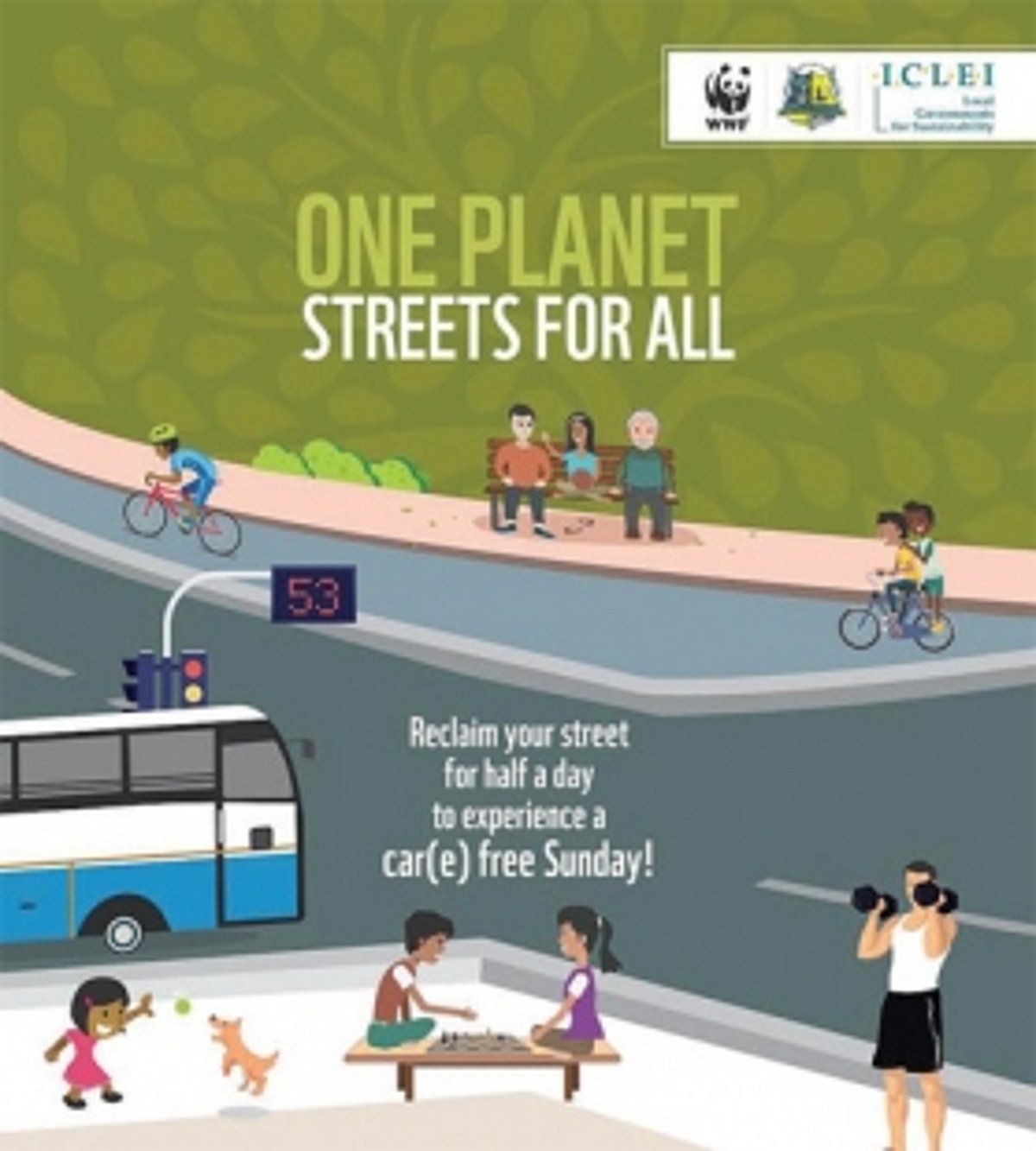
With registrations beginning at 6.30 am on May 6, the three-hour
event One Planet Streets for All included a range of activities which involved
all interested citizens, from the youngest to the oldest, and which held one
thing in common – geared towards encouraging sustainable mobility.
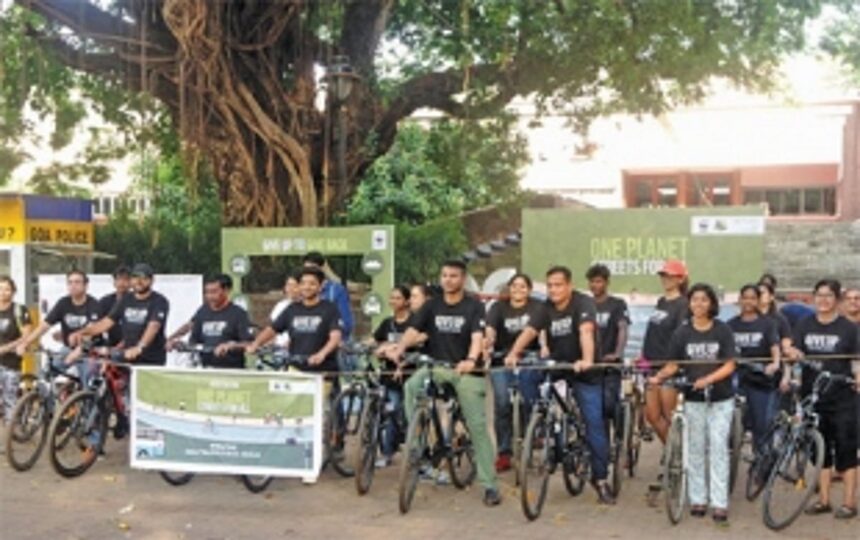
The major activity that kicked off the event was the 5 kilometre
long ‘Cyclathon’ that saw a large number of participants, including the Mayor
of the Corporation of City of Panaji, Vithal Dayanand Chopdekar who flagged off
the cyclathon and led his fellow cyclists –riding either their own bicycles or
those that were freely provided by the organisers. Speaking at the event, the
Mayor said, “This is a great initiative and the Corporation of the City of
Panaji is happy to be a part of it. We understand the need for walking and
cycling spaces in the city as part of the Smart City initiative. We will
endeavour to encourage this initiative and request more citizens, especially
children, to contribute to this cause and make our city pollution-free.”
While the cyclathon promoted cycling as sustainable mobility, walking
too was represented –a special walk around the Mandovi was organised by the
Charles Correah Foundation and led by Noah Fernandes, during which time
participants learned about the history of the city in terms of its development
around the river. “Rather than merely getting people to walk aimlessly, we
wanted to make it more interesting and purposeful, with Noah giving them
insight into the history and heritage of this city that has sprung up around
the Mandovi river,” adds Saritha.
Other activities included a session on Ashtanga Yoga conducted
by Geetanjali Lobo, as well as a karate demonstration by Sensei Joseph
Rodrigues and his students, who arrived at the venue Campal Gardens in an
appropriately sustainable manner – on bicycles. The demonstration was followed
by a workshop on women’s self-defence. Bookworm Goa, the children’s library,
was there to provide both entertainment and awareness to kids, with games like
‘Books Snakes & Ladders’, and on the spot reading opportunities. ‘Move n
Seek’, a game on sustainable initiatives from around the world, was organised
by Incollab.
Celebrating the ethos of the WWF-India’s Give Up to Give Back
initiative, the event asked people to make sustainable lifestyle choices in
their lives, like cycling, walking and carpooling, whenever possible and come
forward and take pledges to Give Up on unsustainable practices. To motivate
citizens more strongly in this regard, at Kala Academy was displayed a ‘pledge
board’ with the tagline “What do you pledge to give up?”
This isn’t the first time the citizens of Panaji have taken over
the streets for an environmental cause. The One Planet Streets for All
initiative is in a sense, a successor to the NoMoZo initiative organized in
Panjim city a few years ago, that had garnered plenty of attention – an
initiative in which every Sunday for a few weeks would see certain streets of
Panjim turn into ‘No-Mo-Zos’ (Non-Motorized Zones). The streets were cordoned
off to vehicular traffic, allowing pedestrian traffic alone, and providing a space
for citizens to come together to mingle, play, and engage in a number of
collective activities. Ideated by a citizens’ group called Aamchi Panaji,
working in collaboration with the CCP, the goal of NoMoZo was to address the
issue of traffic congestion in Panaji, and to educate citizens that the
solution to it is the promotion of more sustainable modes of transportation
through the development of public transport, dedicated cycle lanes and
pedestrian paths.
One
Planet Streets for All came about for a very similar purpose – geared towards
making the city of Panaji more environment-friendly. Having witnessed wide
participation by Panaji’s citizens, young and old, the organisers seem
confident that the city is getting on track towards the global goal of sustainable
mobility, that will benefit both citizens individually, and the planet on a
more global scale.