Taboo, shame, impure, hidden – these are words regularly associated with menstruation. A
biological process that affects half the population, an essential part of the
cycle of life has been layered with negative meaning, embedded with restricting
cultural codes and used as a weapon to isolate and shame women. Sadly, this
phenomenon is rife in India and surprisingly these biases and superstitions cut
across barriers of class and education.
As the film ‘Pad Man’ released in theatres across India,
featuring a leading Bollywood actor, the subject of menstruation received a
level of attention not previously seen in the country. Based on the true story
of Arunachalam Muruganantham, who invented a low cost machine for sanitary
pads, the film has been a welcome attempt at raising visibility and awareness
and making life a little easier for women in the process.
In the visual arts too, a couple of artists are doing their bit
to change perceptions. Sanctity, fertility, celebration and sisterhood are
themes that emerge from the works of artists Sonal Varshneya and Kausalya
Gadekar. It is their attempt to turn the prism and look at this subject in a
more positive light.
Lucknow-based Sonal Varshneya believes in the creative force and
power of the menstrual cycle, using it as a symbol of ‘shakti’ or womanhood
itself, in her show of etchings and mixed media – ‘Ambubachi’ – held at the
Museum of Goa, Pilerne in recent years.
The ‘Ambubachi mela’ is an annual Hindu festival held at the
Kamakhya temple in Guwahati, Assam. It is the celebration of the yearly
menstruation course of the presiding goddess of the temple, Devi Kamakhya, the
Mother Shakti. It is also believed that during the monsoon rains, the creative
and nurturing power of the menses of Mother Earth becomes accessible to
devotees at this site during the mela. There is no idol of the presiding deity
but she is worshipped in the form of a yoni-like stone instead, over which a
natural spring flows.
Sonal honours this unusual tradition with bold women figures who
unashamedly celebrate their natural menstrual cycle.
What was once considered sacred (and still is in some parts of
India) has become a taboo subject with an ‘unclean’ cultural construct through
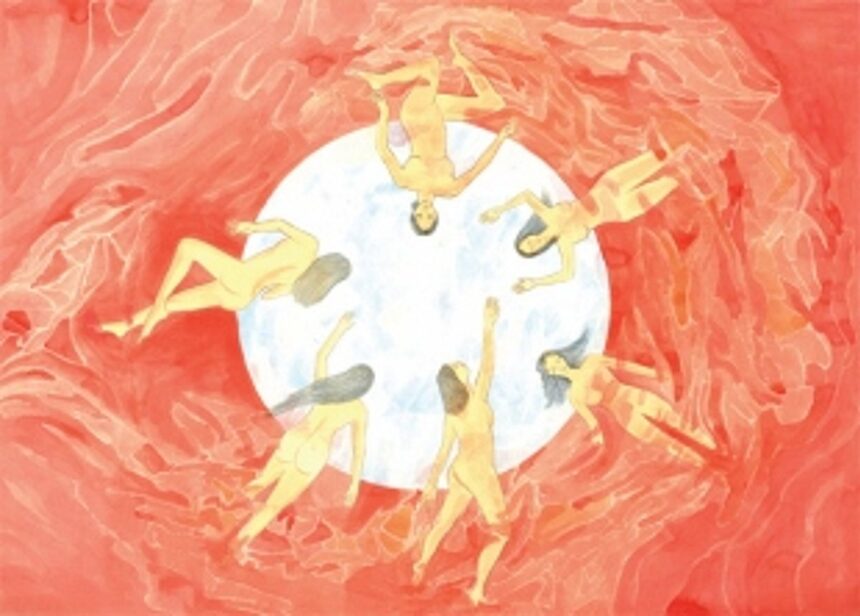
the years. In her recent show, ‘She’, held at The Cube in Moira, Goa-based
Kausalya Gadekar’s soft palette and gentle watercolours reclaim the sanctity of
the reproductive life cycle in a series that references ancient rituals and
practices linked to the cycles of the moon. In one beautiful image, a group of
women dance together in the moonlight – a practice menstruating women indulged
in to celebrate fertility and the cycle of life. Indeed, it boggles the mind
how society has taken a practice honouring community and togetherness and
turned it into one of shame and isolation.
Both artists work in a relatively small format yet explore big
issues of the public and the private, the sacred and defiled, the honoured and
the impure as well as patriarchal dominance and female subservience.
It
is really high time perceptions change and the stereotypes and absurd myths
surrounding menstruation are shattered. Let’s talk about it, period!