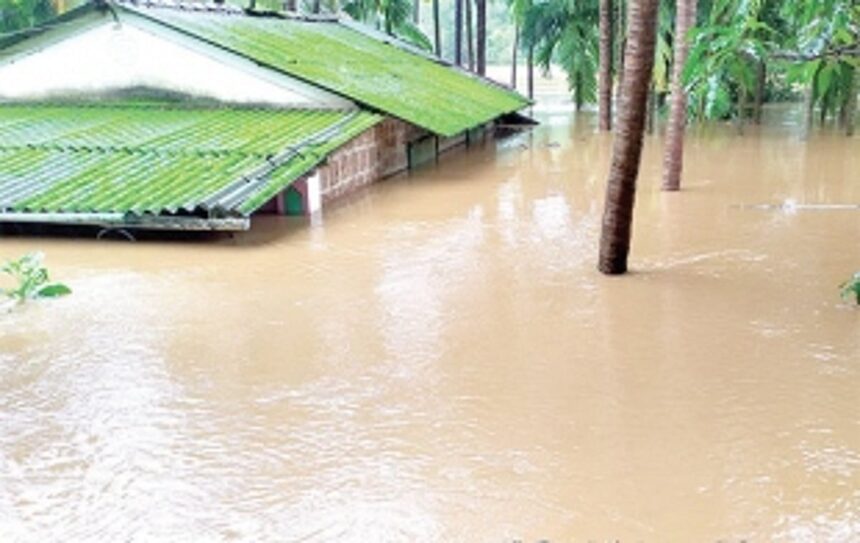
It has dominated the airwaves for the last twenty four hours at the very least. NASA
predicted that several Indian cities along the west coast could go under the
water due to rising seas levels. One of the towns named Mormugao which could
meet that fate. It has caused much consternation and generated much comment
amongst the general public. People involved in fighting for the conservation of
the unique eco-system of the state had much to say.
The granddaddy of them all Claude Alvares
the environmentalist who has been involved in the fight for a very long time
said the process of going underwater would start earlier and it would be
possibly complete in a hundred years. He said “Last year itself water had come
into the shacks. There are photographs, beaches collapsing, looking at
Sernabatim, Tiracol and Chapora river banks where water has gone over the
banks. We have foolishly not taken steps. We have a government of foolish people.
This is the political class we have. This is not their priority. They just want
the reins of the government in their hands.” This he said was the last thing
they wanted to talk about. Claude said it was important to remember that 18,000
hectares of Khazan land which was low lying would go first. A good proportion
he said was already damaged. People going to fish he said and mining companies
had caused harm. This land he said was the main bulwark against the water
coming in. He said much of that land would be swamped well before the hundred
year mark. In addition, in the open area the sand dunes had been destroyed.
Sand he said was a natural bulwark against water and now that was gone and the
sea could now come in with a vengeance. The ecology in Goa was in the worst
possible state and the state was actually taking steps to make it happen by
allowing projects to crop up in areas which were sensitive.
Another long time fighter Rajendra Kerkar
said the emphasis on development had taken precedence. He said “There is a
bleak future for Mormugao town as it is connected by airways, waterways and
roadways. There is a great deal of anthropogenic activities which have only
increased. There is no system by which sewage water is treated. All this is
adding to the problems. Sea water levels have already risen and this is visible
in certain places. Due to global warming the incidence of heavy rains has
increased. The town will not be in a position to accept the monsoon rain water.
Now even the slopes are covered with buildings which make it even more
vulnerable to natural calamities”. He said no mitigation measures had been
undertaken. The original name of this place he said was Morumgao which meant
laterite stones. This used to at one point in time ensure that water joined
with the ground water. All this had now collapsed due to the development
activities. Forest cover he said had to be increased otherwise there was no
hope.
Savio Correia, lawyer and activist, had a very precise response
to the situation. He said there was no doubt that climate change was real and
it was happening. Last month saw unusually hot weather in Canada and America.
Closer home floods and cyclones had become normal. Goa needed to start working
on avoiding this by protecting its natural coastal defences like sand dunes,
mangroves, khajans and wetlands. It was also important to identify the
flood-prone areas and flood-proof and disaster-proof any development thereon.
Speaking specifically about Vasco, he said “ Vasco Bay beach (Kharewaddo beach)
offers our only protection. It needs to be restored and rejuvenated. Likewise,
the Maimollem and Baina lakes are natural rainwater sponges. These need to be
conserved. Declaring them as wetlands and keeping a development buffer would be
the first step. New development in and along low-lying areas of the town needs
to be disaster-proofed.
Our ancestors had the foresight to conserve and protect our
natural barriers. I do not know if our future generations will carry the same
opinion about us”.
A social activist from Sada Mormugao, Parshuram Sonulekar
expressed his shock at what could possibly be in the offing. He said “ Look at
the present situation with sand dunes getting washed away at Kharewado beach
due to illegal dredging carried out by MPT right from 1976 till the date have
resulted in complete washout of Kharewado beach”.
Vasco town he said was the most planned town pre and post
liberation as the town had a big nallah to take out flood water and sea tides
but the Mormugao Municipal Council had not cleared this nallah as they were the
lifelines of Vasco during the floods in the past. He said “The low lying areas
of Mormugao Taluka such as Vasco town, Baina beach, Bogmallo beach, Vaddem,
Arrossim are at risk of being washed out within a span of 30-40 years. Geographically
Vasco and Baina had wet lands which were encroached by illegal construction.
The port expansion and unplanned development of the town will lead only to the
problem of the town. The government must appoint an agency such as NIO to study
this NASA report and try to find a way to avoid making this prediction come
true.”
There
could not be a more damning indictment of the policies carried out by the
political class over the last few decades. If this does not wake them up, then
Goa is doomed.