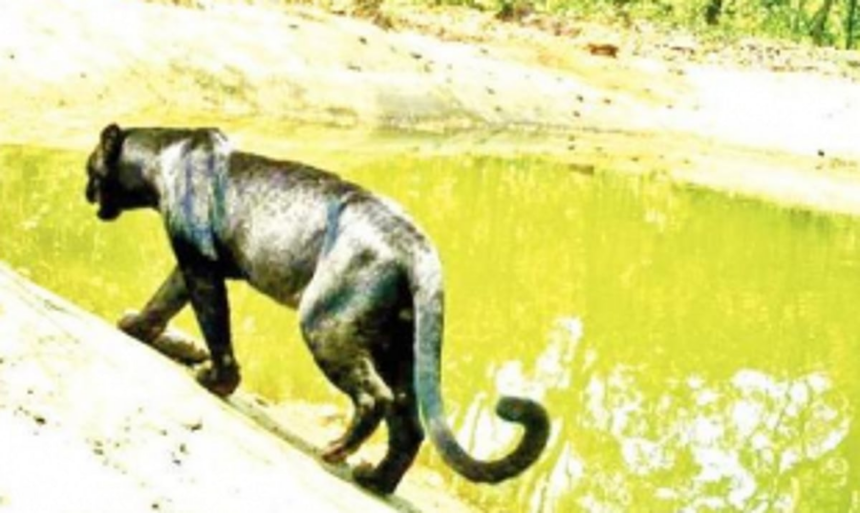
On Wednesday night, Chief Minister Pramod Sawant tweeted a picture of ‘a black panther’ at Netravali Wildlife Sanctuary on his personal twitter handle, terming it a great glimpse of Goa’s rich wildlife. Forest department officials said they were attempting to find out if it was a lone black panther or there were others too. While Goa is not new to black panther sightings, it is a first that a black panther has been captured by the camera trap method at Netravali sanctuary. Sadly, while the Chief Minister seemed excited about the spotting of a rare black panther, the Forest Department – headed by him – has done little to protect wildlife in the six sanctuaries of the State.
The black panther or black leopard is a colour variant of the spotted Indian leopards, reported from densely forested areas of South India, mostly in Karnataka. In India leopards are reported as nearly threatened species. Because those of the black colour are rare, this makes black panthers even more vulnerable to extinction.
Goa has reported sightings of black panthers since 2004, when the then range forest officer at Cotigao, Paresh Porob, had successfully rescued a female black panther at Kalashi in Loliem. In March 2011, a black panther was sighted by the ‘Vivekananda Environment Awareness Brigade’ in the small hours at Keri-Sattari. The forest areas here are known for their wild animals and these volunteers, who keep a track on the movement of big cats, sighted a black panther along the Goa-Karnataka border at Chorla Ghat. In January 2014, the big cat, responsible for attacking and killing goats of a pastoral family in Dapot, Canacona, was found inside a trap set by the Forest Department.
Of late, Goa has seen a gradual surge in spotting of wild cats. At the start of 2020 a tigress and three sub-adult tigers were killed in Golaulim, Sattari. Thereafter, a male tiger was spotted via camera trap. Activists say the spottings have been a result of a ban on mining activities. Interestingly, around 124 mines were operating in Goa in 2010 and none had the approval of the National Board of Wildlife (NBWL), though 33 were operating within a kilometer of the boundary of the nearest national park, sanctuary or protected areas. Most of Goa’s forests are outside the recorded forest areas, according to FSI’s 2017 State of Forest Report. The total forest cover in the State was recorded at 2,229 sq km or 60.21 per cent of the state. But the State Forest Department, in its records, has 1,224.46 sq km as government forests and another 200 sq km as private forests, which is less than half of what FSI claims.
In simple words, the State has paid little concern to its rich wildlife vis-à-vis mining. Despite wild cats spotted in Goa, the State has been dragging its feet in declaring Mhadei wildlife sanctuary as a tiger reserve. As per activists, the presence of wild cats in wildlife sanctuaries is a known and documented fact, which is reluctantly accepted by Goa Forest Department. Besides, the department has not taken serious and sincere steps to protect and conserve the wild cats. Unfortunately, more than two decade after declaring wildlife sanctuaries, they are managed on ad-hoc basis as there exist no management plan. It gives an impression that wildlife management appears to be a subject of least priority for the Forest Department
The chief minister may do well to take steps for delineation of sanctuary boundary and penalise encroachers. The government may also carry on a systematic survey of the sanctuary, estimating the extent of encroachment, if any, and the change in land cover since the declaration of sanctuary may be undertaken. If serious steps are taken to protect our forests, we are sure to see some more great pictures of wildlife on the chief minister’s social media handles in future.