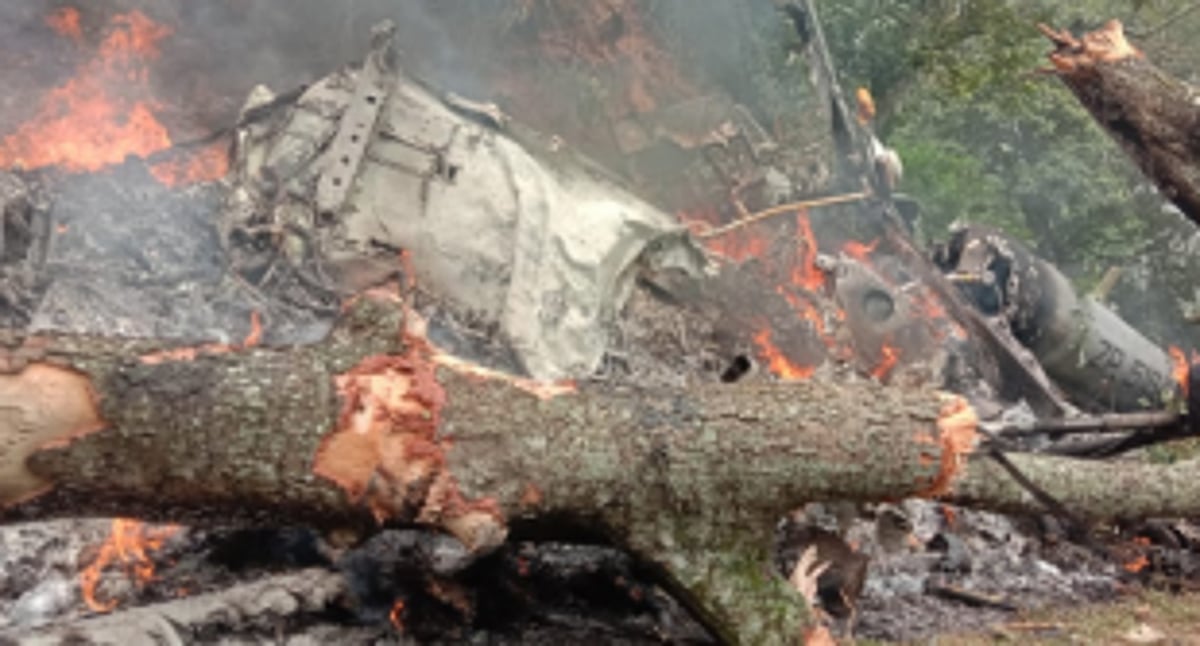
The nation salutes Chief of Defence Staff Gen Bipin Rawat and all those who died along with him in the helicopter crash at Wellington near Ooty. Rawat and the others served the nation and died serving it. Their sacrifices will not be forgotten. Gen Rawat was India’s first Chief of Defence Staff. The position did not exist earlier. His death, therefore, comes as a major blow to the Army, Navy and Air Force, which he led since his appointment as CDS in 2019. Before that he was the Chief of the Army and when the position of CDS was created, there was little doubt that he would be appointed to it.
Tributes for the general have poured in from India and across the world. BBC in an obituary said that Gen Rawat, who ‘sometimes set off controversies with his comments on political developments, had the reputation of an inspiring commander’. He definitely was inspiring. Officers of the armed forces have been vouching for that as have done the many decorations on his uniform. He had commanded units in some of the sensitive areas of the country and led by example whatever charge he held. His loss will be felt not just by the Army, but by the Navy and Air Force too.
The general who faced action in his long career in the Army died in an accident, when he was on the way to visit a defence forces staff college. The inquiry ordered into the helicopter crash that resulted in the death of Rawat and 12 others – only one survived – will establish the cause of the accident, but until then it will be mere conjecture to point out to any specific reason for the crash. The cockpit voice recorder of the helicopter has been recovered and that should give details of the conversations among the flying crew of the helicopter and perhaps some early leads as to what transpired during those fleeting moments before the crash.
What is known about the Mi-17V5 helicopter he group was travelling in and that crashed, is that there have been around half a dozen accidents of this particular craft type and the investigations into these accidents have uncovered various factors – from negligence of a crew member to lack of a fire-fighting system. It is too early to come to any conclusion as to the cause of this particular crash, but it has grabbed attention because of the people who were on board it. But, this brings a pertinent the question of whether the Chief of Defence Staff would be flown in a craft lacking fire fighting equipment.
Yet, it is also a sophisticated machine, perhaps one of the most such that the Air Force has, and retired defence officers have been making claims that this was a safe aircraft. Besides, surely before taking off there would have been an inspection far more thorough than usual of the craft, including it’s condition, maintenance records and the flying time of the crew. What then could possibly have gone wrong here leading to the disaster?
One has to also look at the high number of crashes of armed forces aircraft that have occurred in the country. According to reports emerging after this crash, there have been 43 aircraft that have met with accidents during the period 2014-15 to 2019-20. One reason often proffered is that of the aeging fleet, which means that the aircraft have to be replaced. The crash of the helicopter on which the Chief of Defence staff was travelling makes it imperative for the government to look closely at the issues that the aircraft of the armed forces are facing. It cannot be ignored much longer with mere inquiry committees looking into the crashes.