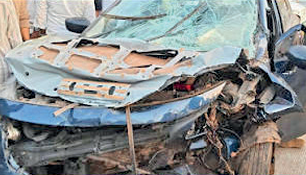
The decrepit state of public transport in India is driving up sales of private vehicles at an alarming rate. The country has become a popular market for foreign cars manufacture with sales steadily shooting up in the last couple decades. Today, the Indian auto sector is seventh largest in the world. According to business analysts, the total turnover of the auto industry is expected to increase further – going by the calculation, 7 per cent GDP growth usually results in 10 per cent increase in the demand of transport. Consequently, the country’s vehicle population is likely to touch at least 35 crore by 2030 from the present 18.6 crore, and by 2050, there will be approximately 61 million vehicles on the nation’s roads.
The failure on the part of the government to provide visible and alternate mode of rapid mass public transport system, people are compelled to buy more personal vehicles. Private vehicle sales are largely responsible for the spurt in registration of vehicles which touched an all-time-high of 1.96 crore in 2015 – that’s almost 53,720 vehicles hitting the streets everyday. The easier consumer credit offers after economic reforms has helped many nouveau riche to buy foreign cars. Official statistics revealed that, while the annual registration of vehicles was less than 10 lakh till 1993, registration continued to grow steadily after that with 2010 seeing a quantum leap. In 2014, the total registrations stood at 1.94 crore. The explosion on India’s roads seems to match the enthusiasm of car honchos who are looking at the country with fondness, terming it a ‘tremendous market’.
However, no one has time to think about the environmental degradation effects and the consequent health problems that are caused in an over-populated country like India. Big cities such as Mumbai, Delhi, Kolkatta, Chennai, et al, have already acquired critical levels of air pollution, uncontrollable traffic congestion and noise pollution. Yet, no attempt is being made by the authorities to control these hazards. Environmentalists have warned that the increase in carbon emission, is contributing to various respiratory diseases and cancers, besides global climate change.
In fact, ever since the economy opened up, the number of vehicles has been steadily increasing along with concerns about lack of urban planning, traffic mismanagement and lack of parking facilities. Despite this, the auto market in the country has shown phenomenal growth, as cars are increasingly becoming objects of desire than of utility. In other words, if someone wants to buy a car, they will go ahead and buy one – they won’t wait for the parking or the traffic scenario to improve.
Incidentally, India’s love affair with wheels is growing phenomenally. Car sales which stood at 2.5 million in 2012, have reached 4 million mark in 2016. India’s passenger vehicle production (including cars, utility vehicles and light commercial vehicles) have driven sales aggressively with exports too have hit the 7-lakh-unit mark on small cars in the last calendar year. Even the impact of demonetisation on car sales has been ineffective as a majority of companies opened the new year (2017) with a double-digit growth. Besides, certain segments of the auto industry like diesel cars and two-wheelers also did extremely well and the growth story continued. Over 75% of vehicles on India’s roads are two-wheelers – this segment is growing fast as price of two-wheelers is within common man’s reach and the transport cost per kilometer is less than what is charged by buses. The future of the auto sector is expected to be rosy as well according to reports that India’s passenger vehicle sales and production poised to grow between 14 to 16 per cent by 2022, reaching over 9 to 10 million units annually. In fact, with all the positive indicators supporting the growth and improved customer sentiment, Indian auto industry is poised for growth this year and might move further if GST reduces overall tax burden on the vehicles from next year.
What is propelling this roller-coaster ride is obviously the country’s 250 million strong middle-class populace which is on a consumption over-drive and impatient to flaunt that cool set of wheels. But it is the potential of the luxury car segment (cars costing upwards of 15 lakh) that have many salivating. Already, the luxury car market is a billion dollar business in India, fueled not just by demand in big cities, but also smaller towns like those in Goa.
As more choices become available and customers become discerning, rich buyers would soon be choosing fancy models, which may be good news for the economy. But the old bugbear of poor traffic infrastructure and chaotic urban planning will come back to haunt those riding high on fancy vehicles (and even those who aren’t).
Many ideas have been tried as possible solutions – like encouraging the use of bicycles and use of CNG to combat pollution, but these measures flopped miserably. Recently, the Union government has announced its plans to levy one-time additional ‘urban development tax’ on private vehicles to discourage their use in cities and towns that have been contending with growing rise of four-wheelers over the past few years. In addition, in the next five years, the Union Urban Development Ministry is looking at enforcing ‘congestion pricing’ – popularly known as congestion tax in cities and towns.
Indeed, urban areas have the maximum concentration of private vehicles. Urban transport management experts are of the view that mega cities have atleast 10 per cent share of total vehicles, of which 90 per cent are privately owned. The government expects the congestion tax measures will force people to shift to public transport mode and it will have a direct impact on the country’s crude oil import and reduction in vehicular pollution in urban centres.
(The writer is a freelance journalist)