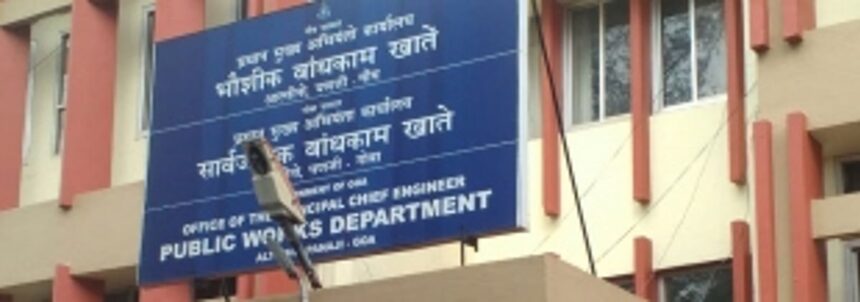
This monsoon, the Public Works Department has been in the eye of a storm due to its failure on all fronts – bad roads, erratic water supply, bad sewerage lines and bad conditions of government-owned buildings. The current monsoon, roads throughout Goa are in the worst possible conditions, with potholes on roads, some of which go almost a foot-deep. The issue had echoed in the recently-concluded Assembly session and PWD Minister Deepak Pauskar had assured the House that the roads would be repaired before Ganesh Chaturthi, but that assurance has remained only on paper.
Besides the road issue, the water problem has worsened as North Goa complained for two months of turbidity in drinking water supplied and shortage of supply. To make matters worse, the pipeline supplying water to Tiswadi and parts of Ponda taluka burst at Khandepar disrupting water supply to the areas for some 10 long days. Besides, the sewerage network for the entire State remains a distant dream, and government buildings, especially the government pool quarters are in bad shape, some having the appearance of immediately collapsing.
While the minister and his office claim things are slowly falling in place, Chief Minister Dr Pramod Sawant decided to take charge and seek an explanation from the minister and officials. He directed the department to have a parallel pipeline for all of Goa so that water supply is not disrupted in any circumstances. A relevant question here is, why spend crores of rupees for a new pipeline? Instead, the government should conduct an audit of the old pipeline and replace it where necessary. A new pipeline will not only cost crores of rupees, but will also rust if water is supplied through it only in cases of emergency.
While the CM has decided to take things in hand, we understand there needs to be a total overhaul of this department. Why is the department with a budget of over Rs 1,800 cr unable to perform and meet expectations? What is ailing PWD? Perhaps it is that being a government department it has its own deficiencies, due to which it cannot compete with corporations like Goa State Infrastructure Development Corporation or the IPSCDL. The rigid hierarchical structure of PWD appears to be its greatest drawback. In PWD hierarchy is structured in such a manner that every activity requires approval till the apex levels (especially Finance Department), contributing to delays and cost overruns. Also, PWD is bound by the works manuals, which adds to the rigidity in work and slows down the decision-making process.
One must understand that project execution often requires on-the-spot operational decision taking, which is seldom possible in PWD. As the people at operational levels are not empowered to take such decisions, time is often wasted in waiting for approvals. Also, the fear of vigilance inquiries often prevents employees from taking decisions. Besides, employees in PWD, especially those in the middle and lower level, suffer from low motivation. Apart from lack of exposure to different works, there is also a problem of lack of training which has resulted in stagnation of competence of many of the employees.
On the other hand, GSIDC and IPSCDL, which compete with PWD, enjoy financial, functional and administrative autonomy. As a result they are able to carry out their projects at a faster pace. Also, it has been pointed out that quality of work done by contractors empanelled with PWD, often are of a poor quality, the reasons best known to all.
In a rule-based organisation, adherence to rules gains prominence over achieving results. It also makes employees less accountable and less creative in their work. PWD, in its current form will be a misfit in the future. Some radical thinking is needed to transform the slow-moving cargo carrier into a bullet train.