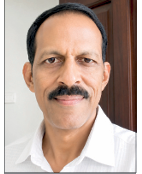
PETER F. BORGES
How many more cases must erupt before we admit that child sexual abuse in India is not episodic — it is structural? The recent Chitrakoot case has horrified the coun try. Allegations of prolonged abuse. Digital recording. Circulation beyond borders. The language sounds mod ern — encrypted platforms, international trails, cyber exploitation.But the truth is unsettling: this is not new. Decades ago, Goa wit nessed a case that should have permanently reshaped how we protect children — the Freddy Peats case. If we examine both cases honest ly, what we see is not coinci dence. We see repetition. Freddy Peats was not an anonymous predator lurk ing in alleys. He ran an or phanage in Goa for 19 boys from broken and vulnerable families. He operated under the façade of care, legitima cy, and trust. When he was convicted in 1996, it marked one of India’s earliest public exposures of organized pae dophilia networks within the country. But the crime alone was not the most disturbing as pect.The documentation records that attempts were allegedly made to suppress the case. Government agen cies tried to sweep it under the carpet, and there were accusations that legal au thorities conspired to deny justice and destroy evi dence. It required relentless legal persistence to secure conviction. That should alarm us. Be cause when systems hesi tate, predators gain time. Now consider Chitrakoot. Different state. Different decade. Different tools.But the anatomy remains chill ingly similar: • prolonged abuse • vulnerable victims • embedded trust • delayed detection • systemic gaps The Chitrakoot offend er allegedly used digital means. Peats operated in a pre-smartphone era. Yet both relied on the same foundational ingredients: access, authority, silence. Technology did not invent exploitation. It amplified it. One of the gravest myths we continue to nurture is that child sexual abuse is the work of rare monsters — isolated, abnormal indi viduals detached from so cial systems. The Goa docu mentation dismantled that illusion. It emphasised that paedophilia is not limited by nationality, race, or social background. Abuse is not imported. It is enabled. Predators do not look different. They blend into ordinary life. They op erate through legitimacy — charity, care, mentorship, religion, education.They do not begin by breaking doors. They begin by earning trust. Another uncomfortable lesson from the Goa case is that vulnerability is not incidental — it is strategic. The boys in the orphanage came from unstable back grounds. The documenta tion notes that socio-eco nomic weakness makes children easier targets. When children lack strong guardianship, economic security, or social visibil ity, predators exploit that vacuum. Chitrakoot echoes the same pattern. Abuse thrives where power is un equal.If we fail to address structural vulnerability, we silently assist exploitation. What is perhaps most so bering is that years ago, the Goa documentation warned that such rackets could evolve into commercial and organised networks oper ating internationally. That was before encrypted apps. Before cloud storage. Before dark-web marketplaces. The blueprint existed. We just did not transform the system fast enough. Today, digital abuse is not hypothetical. It is rampant. It is often invisible. It is un derreported. And it is grow ing quietly — including in Goa. Children are exposed to grooming, coercion, sex tortion, image-based ex ploitation, and peer-to-peer circulation of abuse materi al. Much of it never reaches police stations. Much of it never becomes an FIR. Many children never disclose it at all.Why? • Because shame silences them. • Because families fear stigma. • Because institutions fear reputation damage. • Because systems move slowly. So we comfort ourselves by saying, “There are fewer reported cases.” But fewer reported cases do not mean fewer cases.They often mean better concealment. Both the Freddy Peats case and the Chitrakoot case expose one foundation al failure: we are reactive. We act after exposure. We reform after scandal. We strengthen systems after headlines.Child protection in Goa and India still be haves like emergency med icine — intervention after injury. But abuse prevention re quires public health think ing — detection before dam age. If we do not shift from reaction to prevention, rep etition is inevitable. So what must change? • We need strict institution al screening and oversight in every child-contact environment. • We need robust digital forensic capacity at district levels. • We need fast-track investi gative systems that move at the speed of digital harm. • We need community-level vigilance mechanisms that protect whistleblowers. • We need child-friendly reporting platforms that children trust. • We need prevention education that empowers children with knowledge, not fear. • Above all, we need sus tained political will — not episodic outrage. And now we must ask ourselves — especially in Goa, which once learned this lesson painfully: Digital abuse is happening. It may not always be visible. It may not always be reported. But it exists — at scale. Do we ignore it because it is uncomfortable? Do we wait until another scandal erupts? Do we remain reactive — issuing statements after damage is done? Or do we finally invest in prevention before harm multiplies? Will we treat digital ex ploitation as a peripheral is sue — or as the central child protection crisis of this gen eration? Will we continue to believe that “it cannot hap pen here?” Or will we build systems strong enough to ensure it does not? The Freddy Peats case was a warning. Chitrakoot is another. The question is not whether we have been warned. The question is whether we are ready to act before the next child be comes the next headline. (Peter F Borges is an Assistant Professor of Social Work, Goa Univer sity and Founder, Human Touch Foundation and Former Chairperson of the Goa State Commission for Protection of Child Rights)