

If one takes time to see what is classified as a horror streaming mini-series on Netflix, one will be surprised if not terrified that it is nothing but a reality show depicting our present condition. It was released in August 2018 and is relevant for us today. The show ‘Ghoul’ recalls an Arab folklore monster and is manifesting how we are hit by monstrosity today. The web series takes up issues like rising nationalism, Islamo-phobia and the myth of urban naxals. The show is set in a dystopian future. The show informs viewers that it is set in a near future in a country which has been divided and destroyed by sectarian violence. In Ghoul’s nation (Ghoul does not name its country) those who dissent with the Government are classified as traitors/anti-nationals/demons. Bold cow vigilantism, crackdown on the intellectuals and human rights defenders and activists as urban naxals, as well as corporate-government nexus are daringly portrayed showing that the dystopian future that is broadcasted in the web series is our dystopian present.
One can see that terms like anti-nationals, urban naxals are normalised by the TV studios and politicians belonging to the ruling party in Ghoul. This portrayal is true of our society. We have begun living with demons. This engagement with the demonised other has disrupted the moral campus of our society. We seem to encounter demons/ monsters/ anti-nationals on daily basis. We can also find films like Buddha in the Traffic Jam which tried hard to picture intellectuals as urban naxals. Our political discourse being, thus, contaminated, we are ready to accept the intellectuals and Dalit and tribal activists as naxals. We can see how we are discursively produced through sinisterly constructed narratives. These narratives have a nationalist plot where the dissenters are pictured as traitors/demons/ monsters of the nation. Being subjected to this socially engineered narrative, we than give our consent to the arrest and imprisonment of innocent people who are framed as naxals, tukde, tukde gang etc. We can clearly see that Ghoul presents a profound critique of the current regime depicting a dystopian India that is exceedingly familiar to us.
The immanent critique that the flows from the web series that we are studying shows that it is an antidote to Bollywood movies like Parmanu, Gold, Satyamev Jayate , Raazi, Raid, Aiyaary, The Kashmir Files, etc. Positioning as fiction, Ghoul sets as a counter-discourse to a kind of blind nationalism that has taken hold of the showbiz industry today. Ghoul presents what goes on in a totalitarian police State and exposes how it is all rationalized and covered through rhetoric of nationalism. Ghoul poses uncomfortable questions to us. It becomes crystal clear that the entire dystopian saga is nothing but a portrayal of the present dark phase of our country. Ghoul is a cautionary tale showing us where we might be headed in future.
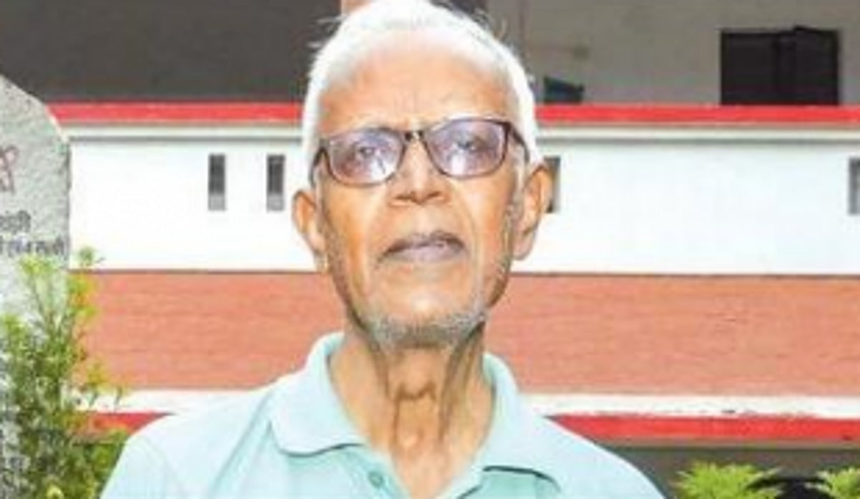
We seem to be living in a society that has created an ambient fear. What has happened to Fr Stan Swamy seems to indicate that we are living at a time of monsters. The 83-year-old helpless saviour of the tribals was falsely charged of national treason. Hence, was painted a demon. Today, it appears that he was a victim of a false indictment. It has come to public knowledge that all that was presented as evidence in the Court to arrest and jail Fr Stan was planted by hackers who even knew when he would be raided and hence were trying to delete their footprints one day before the raid. Arsenal Consulting, a digital forensics company has declared that evidence was planted through a malware called netwire. These findings seem to exhibit that we have entered a surveillance state and suggest that none of us are secure. The agency that framed innocent persons like Fr Stan has a double task. On one side they have to now find the hidden hackers who attacked the computer of Fr Stan as well as come to bottom of Bhima Koregaon violence.
We have to come to terms with the fact that someone powerful is preying on our national anxieties and imaginations. We have to resist with courage the fear that saturates our day to day living and silently prodding us on the path of violence. Maybe Barat Jodo Yatra is indeed timely. We have got used to living with demons. Maybe our belief in God is disrupted by this new found fondness of demons fuelled and sustained by our nationalist rhetoric. These demons are scapegoated as bearers of social, religious, economic and political anxieties. Beating the demon often gives us a sense of an upright hegemon who then has to create his/her own being by nullifying the existence of the demonised other. This happens because the demonised other who is perceived as a traitor/ anti-national monster is a fellow Indian who has all constitutional rights. Thinking through the prism of the spectres, we find legitimacy to trample on the rights of those demonised other and feel that we are doing the right thing. The political order that thinks that it is only the majority community that naturally belongs to India and the others have to be civilised into belonging smacks of the age old caste bias. We have to interrogate the compulsion that orders all demons to be expelled from society.
We have come to live our citizenship by making demons as a site of political engagement. This is why innocent persons like Fr Stan and others appear real demons of the nation. This perception seems to render the monster as an exception and we uncritically allow the suspension of the law. The demonised other is then thought to be outside law. The response to such a monster can only be given outside the law. We then naturally align ourselves to a thinking that seems to think: the demons being outside law are to be dealt outside/without law. This is why violence or denial of basic rights under detention becomes acceptable as the force of the law outside law. We can see how mob lynching as well as denial of a sipper for Fr Stan becomes acceptable to us as a normal actions. The engagement with the demons has drawn the worst out of us. Monstrosity has blossomed within us. The force of law outside/without the law seems to have become our weapon to fight the demons that are craftily let loose in our society. We are indeed living a dystopia.
(Fr Victor Ferrao is an
independent researcher
attached to St Francis Xavier Church, Borim, Ponda)


