The Coastal Regulation Zone (CRZ) 2019 is not yet in force, although it was validated two years ago. Although acclaimed as a unique piece of legislation, our authorities seem to be perennially dissatisfied with the ecological benefits it offers and the ecosystem services it provides the beneficiaries of the coast. Since its inception in 1991, CRZ laws have been decimated multiple times by issuing a series of amendments over the last 30 years. The latest (draft) amendment, dated November 1, 2021 deals with (among others) removal of sand bars in CRZ areas. Although the State of Goa has a valid but sketchy policy on river sand mining, the imposition of another amendment puts the conservation of coasts in serious jeopardy.
In a new draft notification of November 1, 2021, the MoEF has proposed further amendments in the Coastal Regulation Zone Notification 2019 with regard to removal of sand bars in CRZ areas, as described in Section 8 of the draft. In paragraph 10, after clause 10.3, the following paragraph shall be inserted: “10.4 Removal of sand bars in CRZ areas: The sand bars in the intertidal areas shall be removed by traditional coastal communities only by manual method (i.e. sand collection in non-mechanised dinghies or small boats using baskets/buckets by human beings) in various coastal States. The State government may permit such removal of sand in specified time period in a particular area along with specific quantity subject to conditions such as registration of local community persons permitted to remove the sand manually and shall be removed on yearly basis”.

There is no rationale why the new draft amendment insists on the “removal” of sand bars rather than “mining” or “extraction” of surplus offshore or estuarine sand. This issue merits a scientific thought. The term removal would mean eliminating the sand bar altogether and disposing the sediment elsewhere whereas mining would mean a systematic extraction of sand based on laid down guidelines. Moreover, disturbing the formation or stability of a natural body of sand that may form underwater is bound to have deleterious consequences on seabed morphology and marine life in particular. The notification has failed to redress, but instead has evaded, issues of ecological importance.
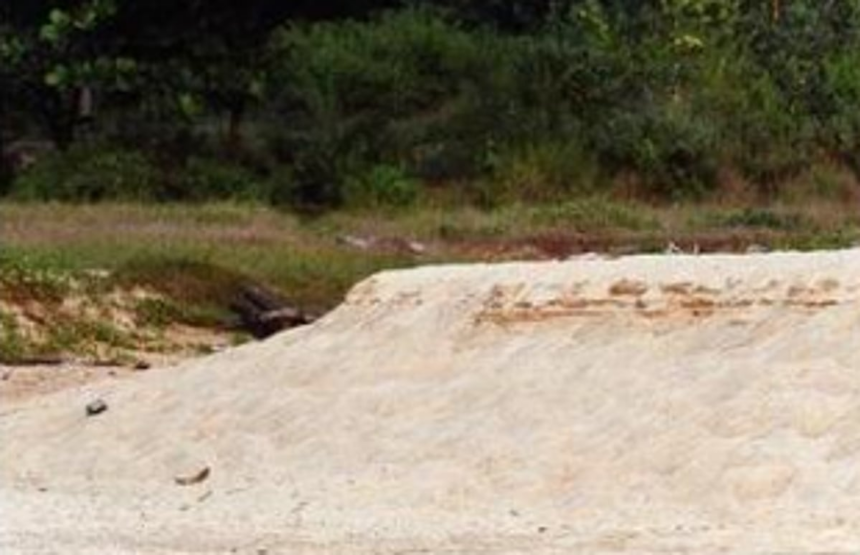
Sand bars by definition occur offshore, submerged permanently or exposed partially, but are mostly identified at the mouth of rivers in the form of linear elongated spits. Brought to the ocean by rivers, sand deposits are redistributed by the action of sea waves, tides and currents. The geological setting of the area largely controls environments of sand and gravel deposition along the coast and within rivers of Goa. Based on our field data, several sites with significant sand content can be identified: (1) Sand spits at river mouths occur at Tiracol, Chapora, Sal, Talpona and Galgibaga are characterised by large accumulations of sand in the form of elongated spits; sand brought by rivers and dumped into the sea is then transported by long shore currents and littoral drift. (2) Sand shoals within estuaries prominently get exposed at low tide at Chapora in particular, Sal, Talpona, Galgibaga and Maxem; coarse sediment is brought by rivers is dumped at the estuaries. (3) Sand around islands within rivers is a major component around several islands that have increased in dimension over decades. (4) Sand deposits along river beds due to deposition and accretion are observed along the axis/central parts of the river beds; the sediment load transported and brought down from the hinterland constitute these accumulations. (5) Gravel and pebbles in rivers are found in the rocky regions upstream. (6) Sandy beaches and dunes are exclusively composed of loose unconsolidated sand. However, since the new amendment only targets sand bars, it is therefore presumed that it refers to the spits exclusively.
The geological significance of spits needs proper understanding. We need to confirm whether spits should be removed or mined, which ones to consider first, how much sand to extract, and whether sand removal is to be done periodically or continually. Mining of river sand is a regulated activity and hence needs a comprehensive scientific study or an EIA. In Goa, a science based sand mining policy does not exist. Press reports indicate that the NIO has carried out specific investigations dealing with sand deposits within river systems but the results and contents of the report, meant for public good and judicious use of coastal resources, have remained a secret.
In summary, (1) Sand spits at river mouths are Nature’s playing fields as these features belong to the ocean domain; being highly dynamic, these geomorphic features keep changing form and shifting location in space and time; as such, any human intervention on such fragile estuarine ecosystems is bound to prove counterproductive. (2) There is no guarantee whatsoever that new sand will not return via the coast, considering the monsoon related strong wave activity; in addition, annual river discharge carries abundant sand. (3) Instead, the sand spit can be managed by simple eco-friendly methods; the growth of the spit can be restricted as desired. (4) Importantly, sand extracted from a spit has to be returned to the beach where it rightfully belongs. (5) Considering several such adverse cases, a new equilibrium may never be attained if this area is disturbed. Unplanned interference at an ever changing spit system will induce more harm than good. Therefore, a robust spit management scheme that involves training which in turn needs extraction of surplus sand is indispensable.
(Dr Antonio Mascarenhas is a former Scientist, NIO, Goa)