

The mammoth over-one-year-long protests led by the farmers of Punjab, backed by farmer unions from across India, were revelatory of how different, but also difficult, the farming situation is across the subcontinent. The protesters faced Delhi’s brutal winter as well as scorching summer out in the open, sacrificing lives in the hundreds, in their determined opposition to the new laws that facilitated the control of agriculture by the big corporates. The protests have now been called off, following the government’s withdrawal of the laws, and, while it is true that the withdrawal could well turn out to be just a pre-election gimmick, one hopes that the protesters, among whom are both landholders and landless labourers, will turn their attention to the contradictions at home. It is no secret that so-called ‘low’ castes continued to be denied their rightful share of land in Punjab, and forced to work as poorly-paid farm labour, thanks to violent opposition by dominant-caste landholders. How can a genuine fight for justice harbour such huge injustice within? The fight for an agriculture system that benefits the farmer must fight not just corporate profiteering, but the old casteist ways of doing agriculture too.
In Goa, meanwhile, the challenges before the farmer are different, but no less severe. Here, the biggest threat is not the corporate giants in the food business, but the real estate giants, again backed tooth and nail by the government. The challenges before the farmers of Taleigao village, in Tiswadi taluka, are illustrative.
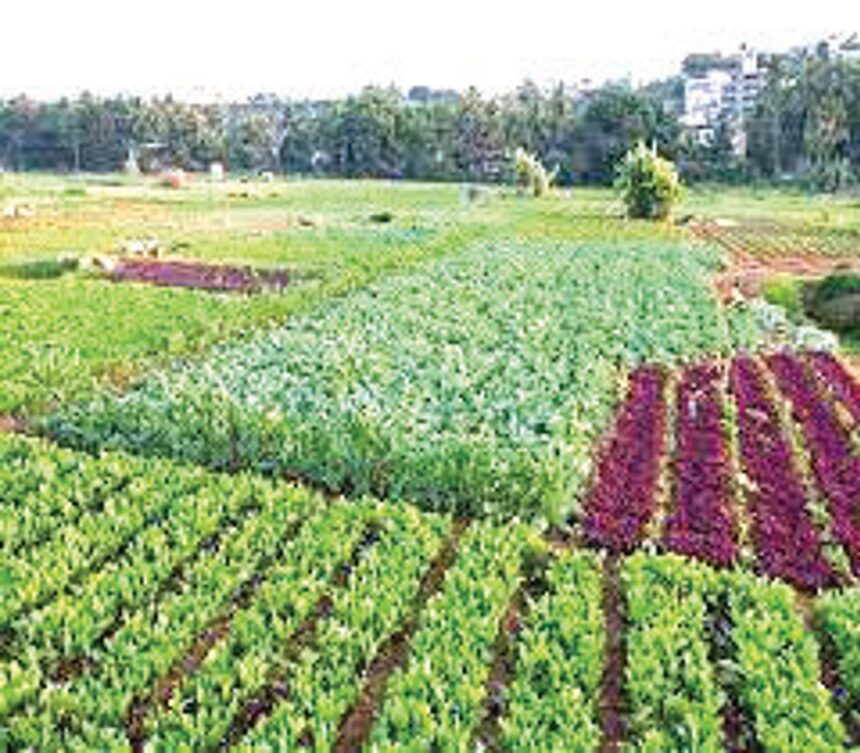
Many of the fields here have been held and cultivated by different Taleigao families for generations; some of them are Gaoncars, others are tenants – most belonging to tribal communities – of the Taleigao communidade, an institution whose earlier involvement in supporting agriculture has now shrunk to almost nothing. The fields, though, remain important, even vital, to many of the tenant families; even now they consume their own crops for 8-9 months of the year. Earlier, they would also sell their produce for over six months of the year. Some of the cultivators are interested in innovation, and have met with some success with broccoli and other new crops in recent years, after the monsoon paddy crop.
But things are becoming difficult. The intensifying climatic changes, especially erratic and destructive rainfall, ruining some crops and preventing others, are bad enough. On top of this ‘natural’ disaster, itself the result of the development policies of recent decades, are all the challenges of government-championed ‘development’. For example, buildings have been constructed in recent times adjacent to cultivated fields, but apparently without bothering about the safe disposal of their sewage. Raw sewage have been flowing into cultivated fields, destroying everything there; but the complaints of the cultivators go ignored. In fact, they say, this has been a classic way to grab land in Taleigao: build on one plot and send the sewage into neighbouring plots, till the owners of the latter sell cheap and leave. And guess who are the buyers?
Besides this, stagnant water pools have started appearing on the fields; which means blockages in the natural drainage system that sent water via creeks and streams into the river and sea. The local administration is once again unresponsive, despite complaints.
The groundwater table is meanwhile sinking, the result of the water tanker business that services the real estate developments taking over the village. The extraction of huge amounts of groundwater every day by these tankers was not even regulated earlier, till the farmers complained. Now, at least, water-meters have been installed and the government gets some (official) tax income, but ponds and wells are running low.
On top of all this, farmers are being forced to give up their land for utilities. E.g. one family lost cultivated land when the government acquired it to built a Sewage Treatment Plant (STP). They were paid a compensation of just Rs 40 per square metre. Similarly, land belonging to another nearby tenanted holding was recently acquired for a new panchayat building.
Now, nobody will question the need for public utilities, but why must they come up on farming land? There is, in fact, plenty of vacant buildable land, i.e. settlement zone land, right across the road from these two acquired plots. It seems almost unbelievable that, with settlement zone land right next door, the authorities should choose to acquire cultivated agricultural zone land from poor and marginal cultivators. But, when you look at it from their ‘development’ agenda, it makes total sense. Development, for them, means maximizing profit. Settlement zones are precisely for this profit-making, i.e. for the use of real estate developers, and not to be ‘wasted’ on non-profit-making (except to the extent of kickbacks in the building process) public utilities. Builders cannot take over tenanted land under the current law, so the government dumps public utilities on such land, uncaring that people are making a meagre living there.
There could, in fact, be one more reason – to discourage cultivation. For this development model, Taleigao – like much of Goa – is prime real estate, and every inch not yielding astronomical profits is ‘wasted’. Much better to stop cultivation completely, and then quietly make everything settlement zone.
And so the demands continue; now it is for land to widen adjacent roads. But the farmers are angry. Wide roads for whom, they ask. For builders, who sell flats for over a crore each? So, why should we give our land at Rs 40? We want a minimum of Rs 50,000 per square metre, or you can forget about our land.
Taleigao’s fights are happening across Goa. And they have to be fought. Land cannot be seen as anybody’s birthright, or caste-right, nor a source of obscene profits; it has to be seen as a way for people to make a living. These were the words of P. Sivakami, while speaking at the Ambedkar Memorial Lecture Series some years ago. And this is the heart of the issue, here and elsewhere. But who’s listening? Not this government, for sure.
(Amita Kanekar is an architectural Historian and Novelist)



