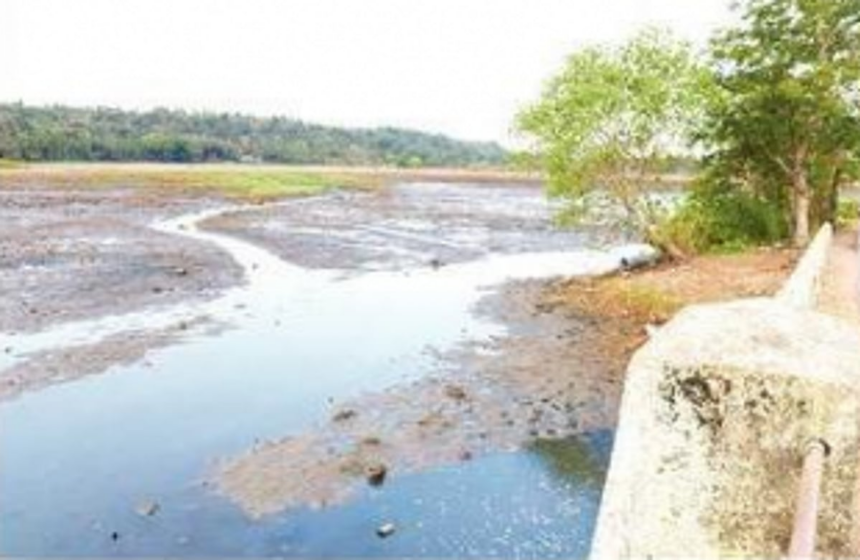
A characteristic feature of khazan lands is the occurrence of a shallow water table beneath the surface. As evidence and as observed in village fields, local farmers make small pits /hollows manually, from where water is easily collected and used for cultivation all the year round. In the recent past, issues related to potable water made some shocking headlines in the local press: “All’s not well with Salcete wells”; “Soon, drink at your own risk” was another; “Tidal water flooding makes life tough for Chorao locals” appeared last week. The Ramsar Convention, to which India is a signatory, does not seem to bother our local managers. Such a situation within the low-lying areas of Goa raises serious concerns about the state of Goa’s water reserves indicating that we are almost at the tipping point.
Two major factors directly contaminate and pollute ground water: (i) sewage that trickles into the underground aquifers due to anthropogenic activities, and (ii) sea water intrusion into the underground water due to incursion of river waters. As example: (a) Consider an area as Caranzalem where more than half the low-lying fields have been sacrificed for concrete edifices. Now, consider a tall building of 7 or 8 floors; the sheer height of the construction demands deep foundations, deeper than the level of underground water table. As such, all these skyscrapers are standing within ground water and below water table, almost all round the year.(b) Consider a project of 6 buildings of 7 floors each completed and located in a wetland. A total of 250 flats are occupied. Take 4 persons / flat; that equals 1000 humans. If each person produces 0.5 kg of excreta, we get 500 kg of waste/day. That works out to 15,000 kg of excreta per month, and consequently 180,000 kg of excreta per year! (c) Similarly, if each person produces 1 litre of urine, we have 1000 litres of urine per day, 30,000 litres per month and 360,000 litres urine per year.(d) Hence, in all, 180,000 kg of excreta and 360,000 litres of urine are flushed down by 1000 humans every year.(e) All above statistics represent a single cluster of buildings only. Finally, multiply these figures by 5, 10 or 20 such clusters of tall buildings proliferating in wetlands across Goa. The result: thousands of tons of raw human body waste are released directly into the ground water.
In 2003, water borne diseases struck areas around Panjim. Public health department (Tonca) confirmed that wells around Panjim are polluted. But government agencies are not ready to part with analytical data. Faecal matter is routinely identified in ground water as evidenced by bacteria ‘E Coli’ that originates from human excreta. Several press reports about sewage in Taleigao wells confirm that ground water is unhealthy for human use. Well water with foul smell was reported recently. It is a matter of shame to note that in Panjim-Taleigao-Caranzalem zone, sewage from anthropogenic sources appears to have contaminated the entire ground water system.
Scientific reports by NIO and Goa University scientists have confirmed that due to contamination, water resources around Goa are being rendered unsafe. University studies in Salcete had indicated extremely high bio-contamination of shallow ground water in the coastal belt due to bacterial contamination wherever the population density and the rate of urbanization is very high. Research by NIO scientists revealed that coliform bacteria counts in the waters of the Mandovi and the Zuari rivers exceeded 100 per ml. Such exceedingly high bacterial counts are unacceptable and, as such, make these waters unsuitable even for swimming or bathing. This pollution is caused primarily due to excessive land runoff containing raw sewage and faecal debris that actively support the proliferation of coliform bacteria. Reports from the Goa Pollution Control Board have further confirmed that almost all rivers of Goa contain water of sub-standard quality.
Transgressions of saline water into the khazans have been annoying since the last several years. Reports by the Central Ground Water Board indicate that the ground water quality poor at places due to the presence of chemical constituents more than the permissible limits. Maps published by the Board reveal that ground water in dug wells and bore wells in areas around Baga and along Chapora river is brackish to saline. High electrical conductivity, a measure of water purity, in near shore ground water is due to heavy contamination by salt water. Long and wide strips abutting the rivers show alarming signs of saline ingress. In south Goa, only coastal Salcete appears to be under the influence salt water contamination. In addition, to the salt water ingress due to natural and man-made causes, bore wells sunk all along the coastal belt by business agencies in particular, are also responsible for the drop in water table with a consequent pull of saline water inland, mostly affecting lowlands in near shore areas. High salinity due to sea water ingress is more prominent in land along the tidal river courses. In general, it appears that the saline intrusion effect in ground water is higher in north Goa as compared to south Goa.
In summary, (1) Quality of ground water beneath khazans is deteriorating rapidly.(2) Around Panjim and Margao, not a single traditional well contains potable water.(3) Presence of bacteria ‘E Coli’ makes water unfit for human consumption.(4) High faecal matter in coastal, river and estuary waters confirm that a colossal amount untreated human waste is released directly into the immediate surroundings. (5)In terms of salinity, the quality of ground water in coastal north Goa is a matter of concern.
(Dr Antonio Mascarenhas is a former Scientist, NIO, Goa)