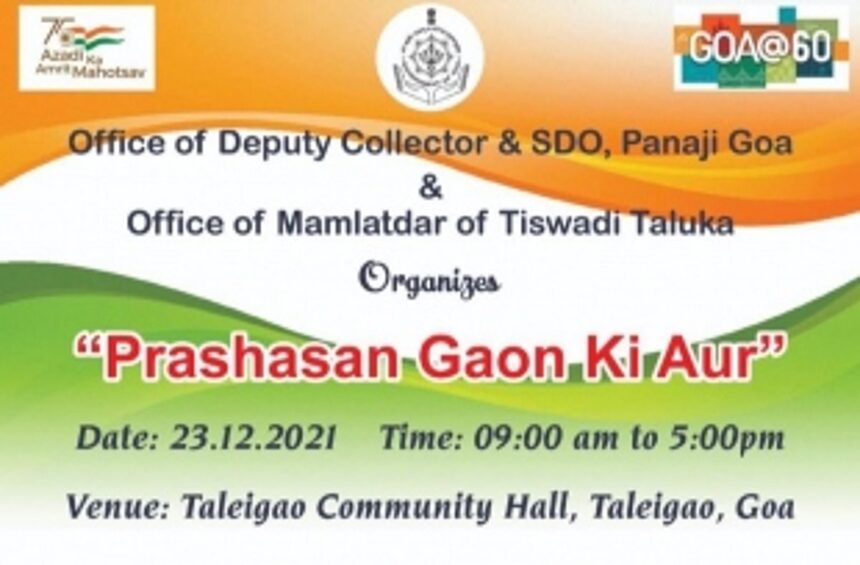
Prashasan Gaon Ki Aur (Governance at the village steps) could be very empowering, generally in Goa’s context, if only the Government really has the will power. But does it? I say generally in Goa’s context, because in other parts of India, possibly, people are under the crushing foot of a zamindar, who will see them seeking out the schemes to the peril of their housing and their livelihoods.
But I still say generally, because you still have places like Chandel, where such brute casteist power prevails. And in such cases, it might in fact be better for the concerned persons to come to places where they are out of the yoke of power of these large dominant caste landlords. I also still say generally because you also have locations where the baba of the village will have control over who really and effectively has access to the services at the village. It is like the village panchayat – one person with all the documentation may need to produce still more documentation, and someone with no documentation, or minimal documentation may get their house tax record transferred in a jiffy depending on the networks and links. Or depending on your power, like how things happened with the then Special Economic Zones (SEZs) in Goa.
And not to forget the patriarchs of the village, who will not be happy to see women availing of rights. Wonder if that is why there was no source at this ‘event’ that could explain remedies under laws like the Protection of Women from Domestic Violence Act, 2005, (under which the Block Development Officers are the Protection Officers at the taluka level) and the Indian Penal Code. Or no table that could tell you about the existence of a State Human Rights Commission, or a State Commission for Women, or a State Commission for Protection of Child Rights or a State Commission for Scheduled Castes and Scheduled Tribes.
But let us still look at what was the potential of the Prashasan Gaon Ki Aur (Village Step Governance) by looking at the case study of Taleigao, where this ‘event’ was performed. I got to know about it on the day of the ‘event’ itself, from the panch of my ward. What it turned out to be was that each Government office (though not every required Government office) was represented by a table and a few staff. Under the aegis of the Deputy Collector of the taluka, there was a display of forms that are required to be filled for services/schemes under each respective Directorate or Department.
This ‘event’ was not sufficiently advertised or hardly advertised. Consequently, many active and socially oriented people in the village who could have prodded others to go there, were not even aware of the same. But even if people did come, I am not sure what purpose is served by such a one-day initiative. What is the point also of coming to the door step on the eve of elections and on the eve of that proverbial ‘code of conduct’ driving you away, saying nothing can be done now (but if we are elected to power, you will be able to avail of those schemes!).
What was in fact functioning well was the Aadhaar card table, and the certification table, where certificates were being sought from the office of the Deputy Collector. This is understandable given the election season. And possibly the forms that were collected will in fact be filled with the assistance of ruling party candidates’ election offices, or people who are seen as ‘theirs’ will have the benefit of special attention once those forms are forwarded for the services. It seemed more like an election gimmick.
I thought of inquiring about the schemes available with the Department of Agriculture, such as for a well in the field. They directed me to the Water Resources Department, from whom one has to get an NOC. Super thrilled that at last there was a one stop shop, so to say, for all the services – a kind of convergence at the village level, off I went to the Water Resources Department table. They gave me a form to fill, which in turn required some documentation. This meant that I would have to get the documentation, and then submit it to the Water Resources Department, and then get the NOC and then apply to the Department of Agriculture along with documentation. Now the very purpose of village step governance is lost if the facilities are not in effect finally available at the village step. The silver lining, if that could be called one, was that the Government personnel present seemed very dedicated, and enthusiastically tried to explain things. However, not all tables had personnel, who were in a position to address the concerns of the villagers who came there.
There has to be a continuous village level governance, where these services are available. So that people can return and if there are any issues about coordination of services between one Department and another, they can be resolved then and there. So also, as regards any certificates required, the panchayat can issue the necessary documentation, if all compliances are in place.
All this can also happen under people’s watchful eyes, so that there is no partiality in the dispensation of services or schemes. But clearly, that does not seem to have been the motive. Don’t we remember how the ruling dispensation diverted all the forms to their party office everywhere, including Taleigao, when the Ladli Laxmi Scheme was first announced? Do they really want transparent governance? Someone came in asking whether the electricity department representatives were there, because he had got an excessive bill, but there was no room for this kind of grievance expression in the Panchayat inn, where this ‘event’ was being performed, if one may say so.
In other words, in a democratic set up, where good governance is sincerely meant, governance at the door step or village step, with options for people to seek it outside of these fora, is desirable. But it must meet the preconditions of creating an enabling environment for the people and not being a one-off event. It must also enable people to participate in governance, by enabling feedback of whether the schemes and legislation make sense, what are people’s concerns, or why are the target beneficiaries not able to avail the benefits of the schemes.
(Albertina Almeida is a lawyer and human rights activist)