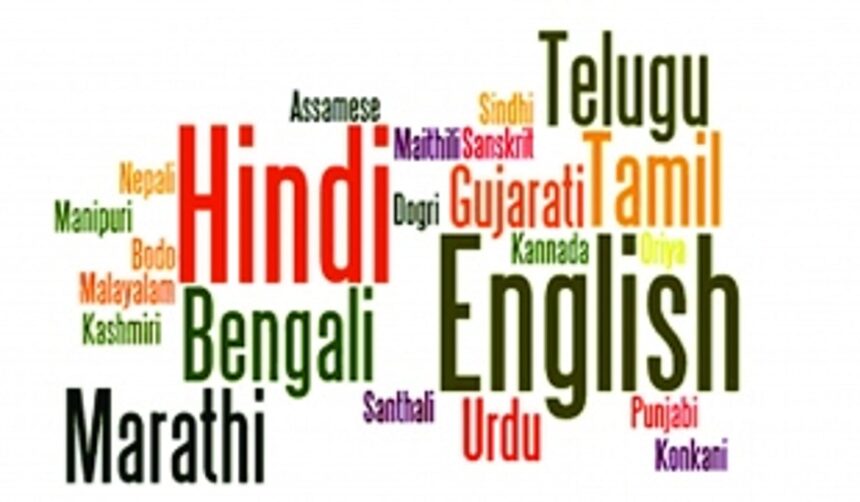
The last census tells that India has 121 languages that are spoken as mother tongues in our country. If we include dialects this number goes beyond a thousand. This astounding character of our country indicates our diversity as well as our layered history. Linguists attempt to manifest this history and open us an India through its languages. A new book in the field of linguistic anthropology claims to do exactly the above. Dr Peggy Mohan, a world-renowned linguist raises some hair raising facts of our past. She depends also on human genetics to work her story of India. Genetics of the Indian sub-continent indicates that we can see that the genetic pool of Indian women was rather constant and it is the genetic structure of men that has significantly changed and enriched. This can be studied because man offers either X or Y chromosomes while the women always offer the same X chromosome at the time of conception of a child. This means genetics have shown the spreading of the Y-DNA but not the mtDNA, the matrilineal mitochondrial DNA.
Dr Peggy Mohan’s new book, Wanderers, Kings, Merchants: The Story of India through its languages, stays in tune with the genetics of our people. Given the constancy of mtDNA and the fact that it was being studied first, several people had started saying that there was no migration happened into India. This narrative suited the right-wing and the upper caste who begin to drum up the so-called out of India migration theory. But now with the Y-DNA studies exhibiting changes, the Aryan migration theory into India has staged a comeback much to the dislike of its nay Sayers. Peggy Mohan builds her linguistics study on this new genetics and shows that we still have the residues of the Harrapan civilization in the languages that we speak.
Dr Mohan says that the wanders and explores were mainly male figures who took the local women in marriage. This practice can be certainly found in colonial Goa where the Portuguese married Goan women and developed kinship with the colonised people. She stays in line with the perspective that the Aryan migration happened for a long time through different groups coming into India at different times. This means India of that time was not a blank slate. It did have people and their languages. Dr Mohan says that language shifts did not take place with the men coming into India but they took place with their children.
Dr Mohan indicates that the original languages that were spoken by the women who married the migrated Aryans become scaffolding in which the sperm donating men brought their vocabularies. This means the older languages embraced the new words especially nouns into them Dr Mohan offers the analogy of bindi. She says the new words became the bindi on our beautiful foreheads.
Dr Mohan points out that there are still relics and remains of the Harappan languages that got absorbed into Sanskrit and Prakrits. Sanskrit has cases like Latin but does not have the gender of the verbs as Hindi does. She points out that the Hindi that we speak today does carry residues of the Harappan languages with the help of an example: ‘mai kati hum’ is said by women who is eating but when it comes to saying the same thing in the past tense, it becomes ‘maine kaya’ meaning eaten and not I ate. Surprisingly here is where the verb does not have to agree with the gender of the subject but goes with the object. We also have something of this sort in Konkani like other Indian languages.
We have traces of pre-Vedic languages in the languages that we speak today. There is another thing that she brings under the spotlight: The difference between ‘Hua and hogaya’ that one cannot find in Sanskrit. It is found in the south as well as the east of India even today. This indicates that we still think a lot like the Harappans. Maybe our operating system to use a computer analogy is Harrapan. The retroflexion includes ta as in Kuta and tha in Putha. This means our barakadi … ta, tha da dha na and ta tha dha dha na, ra, laa (the retroflexions) comes from the maternal stream into the Indian languages of today.
Retroflexions did enter the Rig Veda which was till then in pristine Sanskrit. This means the Brahmins kept introducing the retroflexion in their spoken language while attempting to keep their sacred book Rig Veda in pristine Sanskrit. Dr Mohan tells it all happened with the decisive battle between the several Vedic tribes which was won by one tribe that united all the tribes under the Kuru Empire. Thus to include the local kings into the system ruled by the Brahmins she says they used Rig Veda. It is at this point she says that retroflexion began to enter the Rig Veda. She also says that they had 22 versions of Rig Veda but all 21 have vanished. This means the final version of the Rig Veda has this new feature of having the retroflexion. The study of Dr Mohan opens new ground and is mindboggling as well as manifests some lost, forgotten facts and truths of our past that may rattle and disturb some. But we cannot run away from the facts of our past. They stay in us in marvellous and mysterious ways.
Dr Mohan has articulated a scintillating narrative of ways Indian social history came about right from the day the Vedic Aryans alighted from their Chariots to the arrival of Namboothiri Brahmins in Kerala to the persianised Turkic conquerors of the middle ages and to the British policy of favouring Hindi over Urdu and ends with the embracing of the dynamics of today between Hindi and Hinglish.
(The author is Professor of Rachol Seminary)