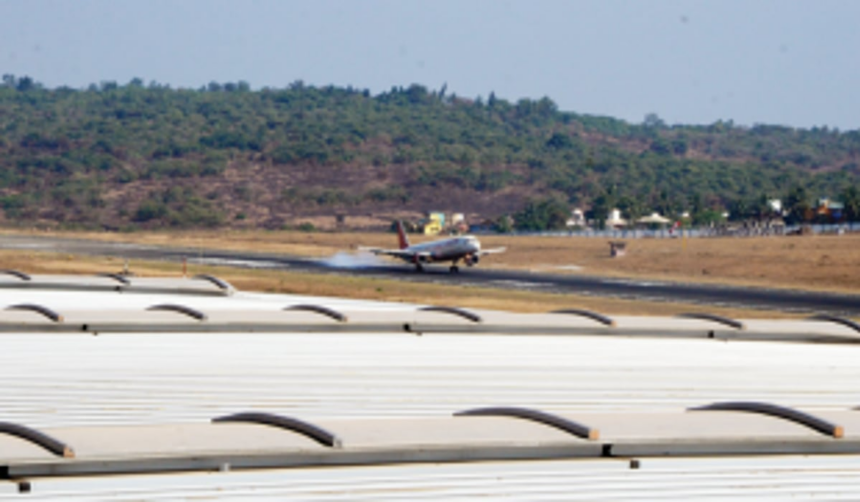
The recent news that Dabolim airport might not host international flights from December onwards has shocked many Goans; and once again called attention to the willful incapacity of the Goa government to protect the rights of locals in any way. According to a report in a national daily, the reason why international flights are going to be barred at Dabolim is because current global rules for such flights require airports to be licensed by the aviation authority of each country, i.e. the Directorate General of Civil Aviation (DGCA) in the case of India. This has not been done for Dabolim, the reason being that the airport here is in the hands of the Indian Navy. The DGCA and the aviation ministry reportedly approached the defence ministry for permission to license the three airports it controls (Goa, Pune and Srinagar), but without success. And the deadline for licensing is December 2021.
The Navy apparently is not bothered that Goans might now have to travel to other airports in India for international travel. But shouldn’t the Goa government be bothered? Goa and Goans have always been strongly connected to the world – long before the first international tourists even appeared here. The huge Goan diaspora, living all over the world but regular visiting and also supporting their native land in various ways, is well-known. Most Goans already find the current international flights to and from Dabolim too few and far-between as it is, resulting in loss of time, energy, and money while transiting from other Indian airports. And now even these few flights might stop.
The problem seems to be that, for the Goa government, anything the armed forces choose to do is fine. This could be seen in the recent incident in August when villagers of São Jacinto Island expressed shock at the sudden announcement that Indian Navy would unfurl the Indian flag on their island on August 15. Instead of trying to understand the reason for the locals’ opposition, CM Pramod Sawant tried to tar these locals with an anti-national brush, vitiating the atmosphere with ugly threats that his government would deal with “anti-India” activities with an “iron fist”. The Navy meanwhile announced that the August 15 plan was part of a nationwide programme of the defence ministry to celebrate the 75th anniversary of Indian Independence on every island across the nation.
The São Jacinto villagers clarified to the media that they had no opposition to unfurling the flag, but would rather do it themselves, as they feared that the Navy or the Central government might be intending to use the event to ‘capture’ their island. And, despite Sawant trying to create a nationalistic furore, the villagers calmed the situation down by deciding to hold the flag-hoisting event in collaboration with the Navy. It is notable, however, that Sawant’s nationalistic outrage was expressed in the case of a mere verbal protest by Catholics, the island being mainly inhabited by that community; it was, in short, a clear attempt to communalise the situation.
But the worry at São Jacinto is not without basis; it stems from the betrayal of the people at Goa’s Anjediva Island. The Indian Navy took over Anjediva in the 1980s, but only after they promised that people would be allowed on the island to celebrate the annual feasts at the two important Catholic shrines there. These celebrations have, however, not been allowed since 2005, despite protests from worshippers and despite Goa’s Manohar Parrikar becoming the defence minister.
Let us not forget that Dabolim airport was built and operated as a civilian airport till 1961, when Goa became part of India. It was handed to the Indian Navy in 1962, not only with the understanding that civilian flights would restart, but also – according to the BJP’s Alina Saldanha in her anti-Mopa avatar of a few years ago – only up to 1968. But the Navy has continued to hold on to it, despite having a huge set-up at nearby Karwar, along with Anjediva. The guest, in other words, is now dictating terms to the hosts. What will we see tomorrow – that the entire airport is restricted to only Navy use?
Some Goans have been accusing the government of exactly this – of intending to shut Dabolim for civilians, and thus build up air traffic for the infamous Mopa project. But, if Mopa is a gigantic land mis-appropriation and environmental disaster-in-the-making, what of Dabolim itself? Can the Navy justify the hundreds of acres they hold in Dabolim, plus all the other land they hold in Goa? There is a tendency among people to treat the armed forces as a sacred cow, as if they can do no wrong. But not only are they one of the biggest landowners in the country, they are also, reportedly, misusing this ownership. A 2010 audit by the Comptroller and Auditor General of India found many irregularities in real estate dealings by the Ministry of Defence (Firstpost, 20/7/2021) including discrepancies in land records, commercial exploitation of defence land, and blurring of responsibility and accountability. Examples of this abound, including the Sukna land scam in Darjeeling, the Santushti complex scam in the heart of Delhi, and the Adarsh Society scam in swanky south Bombay. Isn’t it time that Goa too looks at what’s happening with all the land they hold here?
As everyone knows, land is a limited commodity, and also crucial to survival, especially for food production, shelter, a healthy environment, and also infrastructure for public benefit. And Goa is a tiny place, with far too many profiteers eyeing the land – whether public entities or private, whether for lifestyle or power or investment. This hoarding and misuse of a vital source of life is nothing short of a crime against humanity.
(Amita Kanekar is an architectural historian and novelist)