The idea of protecting Goa as a separate geographical entity and retaining an identity, led to the Opinion Poll of 1967, with a result that ensured that Goa would not merge with any other State of the Indian Union. That is a decision taken half a century ago and now irrevocable.
For a land that had achieved its freedom from colonial yoke just five years earlier and was still attempting to discover the role it would play as a political entity, whether separate or otherwise, that victory was the first assertion of the Goan polity of their resolve to safeguard what had come to be known as Goan identity. But scratch the surface of identity today and that what remains of that resolve and that assertion of 1967 are just cold embers that the gusts of wind coming from across the country are swiftly blowing into the waters of the Rivers Zuari and Mandovi.
As Goa observed the 51st anniversary of the Opinion Poll, with a programme like never before that would have struck a chord with culture and heritage enthusiasts, in 2018 it struggles to discern the identity that it voted to retain in 1967. The words Goem, Goemkar, Goenkarponn are being bandied about, to the point of the phrase beginning to sound shrill, but it does little beyond that for the actual safeguarding of identiy.
The verbal assertions on Goenkarponn and the protracted writings dwell only on the need to preserve what constitutes Goan identity, with few steps taken to preserve the land or the identity that once meant more to the people, than the lip service it is getting today.
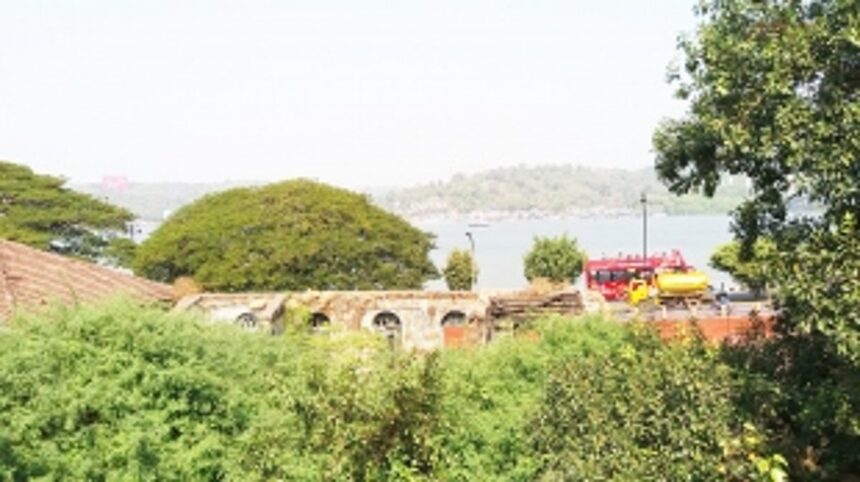
A graphic description of Goa as it exists today is perhaps best illustrated by the accompanying picture, taken from a restored heritage building in the Sao Tome area of Panjim. A close look at the picture shows some fishing trawlers in the background with a fast-speed modern craft rushing by in the River Mandovi. On the twin Patto bridges crossing each other are a double-decker hop-on-hop-off tourist sightseeing bus and a tanker carrying sewage, possibly from a hotel on the coast, to the sewage treatment plant in Panjim. In the foreground is a colonial-period structure in ruins engulfed by a few tree tops. Missing from the picture, and perhaps in perfect sync with the current situation in the State, is a barge carrying iron ore for export.
In 1967, the residents of the old building from where this picture was taken would perhaps have only seen a few fishing canoes and a solitary barge carrying iron ore to or returning from the Mormugao Port after have unloaded its consignment of iron ore from the hills of Goa. The picture shows the lopsided development in the State, how it has taken strides in tourism, but does not have the basic of a sewerage system. The building that is seen in ruins today, once housed quite a popular bar and restaurant that went up in flames a few years ago. The business establishment has shifted, but the building has not been rebuilt.
Will that be the fate of Goa? A place where identity mutates with the changing circumstances, and where the hallowed edifice that housed the original identity has been consumed by flames? The flames, in respect of Goan identity, would be changes in circumstances.
But hope flickers eternally, and resides in the hearts of Goans, emerging ever so often through actions and discussions. The few men and women, who on a Monday morning decided to claim the Opinion Poll for the ordinary citizens of Goa by inaugurating the plaque of the Opinion Poll Square, proved by their deed that the spark of identity that was lit during that fiery campaign can still light a flame.
The numbers of these men and women may be dwindling now, but even in a minority the fight to retain Goan identity and pride, finds warriors across the State, across communities, of varied ages, and even nations. For if on January 15, some warriors decided to take their battle to the streets, there are also quite a few of those who wage their battles through cyberspace.
On a Saturday evening, a day before the year 2017 petered to an end, a group of Goans – resident and non-resident – met in a club, and over tea and snacks discussed 51 issues facing Goa. While thousands of domestic tourists on Miramar beach, struck poses and clicked selfies against the background of the setting sun and the Aguada lighthouse, in a club across the street, the online discussion group Goanet and the US based Goa Sudharop had organised a meeting of their cyber families, breaking the virtual barrier to meet, to argue and to discuss in person.
The topics that came up that evening were many and diverse, but what keeps such groups active, even though some have never seen the face of the other who is responding to their posts, is the identity of being Goan that binds them, though they are spread across the world.
Yet, what is that what we call Goan identity or even Goenkarponn, to use a term that is currently very popular?
Goan Identity is yet to be succinctly and acceptably defined. The views on this are as varied as the personalities who speak on them, and many of them do it at length.
A tangible approach to retain this identity has never been formulated and even the contemporary watered down version of Goan identity that a handful are making attempts to preserve, is beginning to fast trickle towards oblivion. Merely nostalgia and sentiment does not constitute Goenkarponn, nor will it save it. The time is ripe to stem the dilution of Goenkarponn, to preserve what is left so that decades from now there, there still remains something of a Goa that those in 1967, in their best judgement, voted to retain for posterity, never once believing the prosperity would water it down so quickly.
(Alexandre Moniz Barbosa is Executive Editor, Herald)