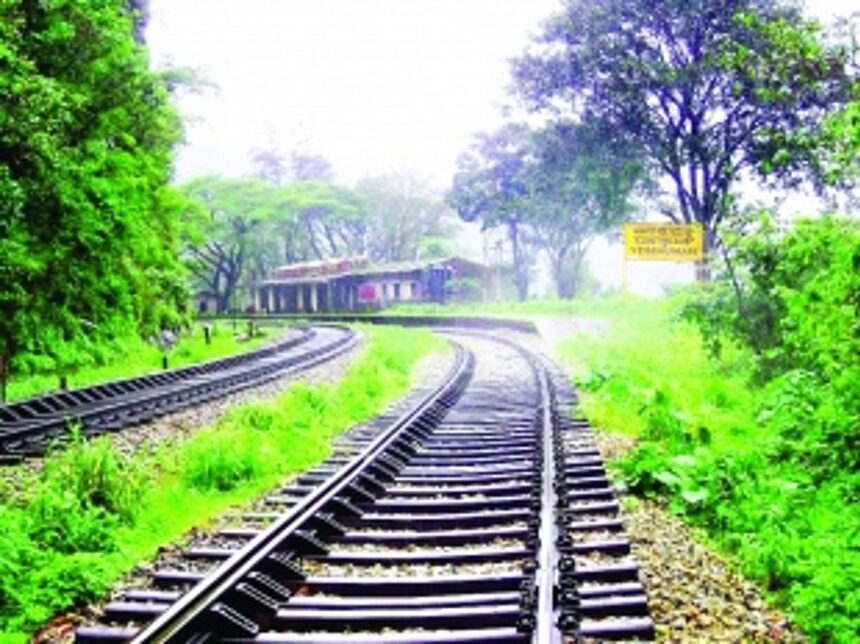
The recent news that bonded labourers were working on the infamous double tracking project of the Indian Railways through the Mollem forests should cause no surprise. The labourers were rescued from their abusive situation only because of complaints made by ARZ, a Goa-based NGO, and the efforts of an Adivasi organisation in Telangana. The Indian Railways now claim that the labourers were not bonded at all, but ‘only’ underpaid and ill-treated by their contractor. According to the workers themselves, the oldest of whom was 72 years, they were paid less than minimum wages, were prevented from leaving the job, and were forced to live right next to the tracks, without adequate shelter (in the monsoon) and without toilets either.
Who is responsible for this shameful state of affairs? The news so far is that the labour contractor has been arrested, but not anybody from the Railways. We are expected to believe that Railways were completely unaware that they were using underpaid and ill-treated labourers in their project, when the truth is that the Railways hugely benefit by this underpayment and ill-treatment. The law actually demands that they be held responsible for this abuse, as it is their responsibility as the principal employers to ensure decent and legally acceptable working and living conditions for labourers on their projects. But this never happens.
And nobody expects it either, because ill-treatment of workers is the norm in Goa. The sufferings of these workers are actually typical of the real estate industry, where subcontracting and sub-subcontracting is the norm, so that principal employers can claim innocence and ignorance, and get away scot-free even in massive man-made disasters like the Ruby building collapse in Canacona some years ago.
Nor are things better elsewhere. Look at the tourist industry, the other so-called economic lifeline of Goa. As a 2018 study pointed out, as many as 7000 underage workers were found in just the beach shack restaurants, including seven-year-olds, where they were overworked (sometimes working through the day and the night), miserably paid, verbally and physically abused, expected to sleep on the restaurant tables or on the beach, and poorly fed as well. The fishing industry also tells stories of poor living conditions, the holding back of wages on any pretext, and also abusive treatment during the Covid lockdown. The various lockdowns starkly revealed the ugly underbelly of migrant employment in Goa, where non-Goans in almost every field of work had to fight for even pre-lockdown wages as well as for basic shelter, with no support at first from the government.
Against this backdrop of everyday labour abuse, even by govt agencies and almost always of non-Goans (because locals will not accept it as quietly), the government now expects us to believe that it is actually genuinely concerned about migrant workers. This proposed legislation ostensibly grants anyone with 30 years residence in Goa, and living in a not-more-than-250 sq ft house built before 2019, ownership rights to that house. The vaguely-worded but evocatively-titled bill naturally led to an uproar of protest, since it appears to threaten the interests of the landowning sections and the real estate lobby, while completely ignoring the plight of thousands of Goans who have been struggling for rights to the land they have lived on for generations, who are unable to even repair or renovate their old homes, or pluck the fruit from their own trees, as the land is owned by others, from big bhatkars like the Ranes in Sattari to many Hindu temples.
Now, there is no doubt that access to decent housing is considered a fundamental right by all civilised societies, which should not depend on one’s wealth or background or place of origin. And there is no doubt that there are many migrants living and working in Goa for over 30 years without being able to afford a decent home. But, if the government was really concerned about this, surely it could take steps to ensure that everyone working here – even for one project, leave aside 30 years – is decently housed? Why bring in ownership of land, or a minimum residency period, and why use the sanskritised term of bhumiputras for such 30-year-long-residents?
Well, simply because the whole thing is clearly a fraud. This was obvious in the hasty introduction of the bill, its vagueness, and how it was soon declared as withdrawn. Perhaps the aim was to gain migrant votes in the upcoming elections, as alleged by some. Or perhaps it was to distract attention from the Mining Corporation bill, introduced at the same time by the government, as alleged by others. Or perhaps it was intended as another route for land-grab. As for its critics, i.e. those worried about injustice to the niz Goenkar, how about at least demanding land reforms in Goa, to ensure that all niz Goenkars get ownership of the land on which they have lived for generations, whether from comunidades or bhatkars? And how about also demanding housing reforms to ensure that housing construction is need-based rather than profit-based, before every last hill and valley disappears under swanky second or tenth homes for rich non-Goans, even as those who need shelter remain without?
For, let us not pretend that so-called bhaile labourers are the biggest threat to the survival of Goa and Goans. The real problem is this extractive and exploitative economy, in which privileged Goans are as invested as privileged non-Goans.
(Amita Kanekar is an architectural historian and novelist.)