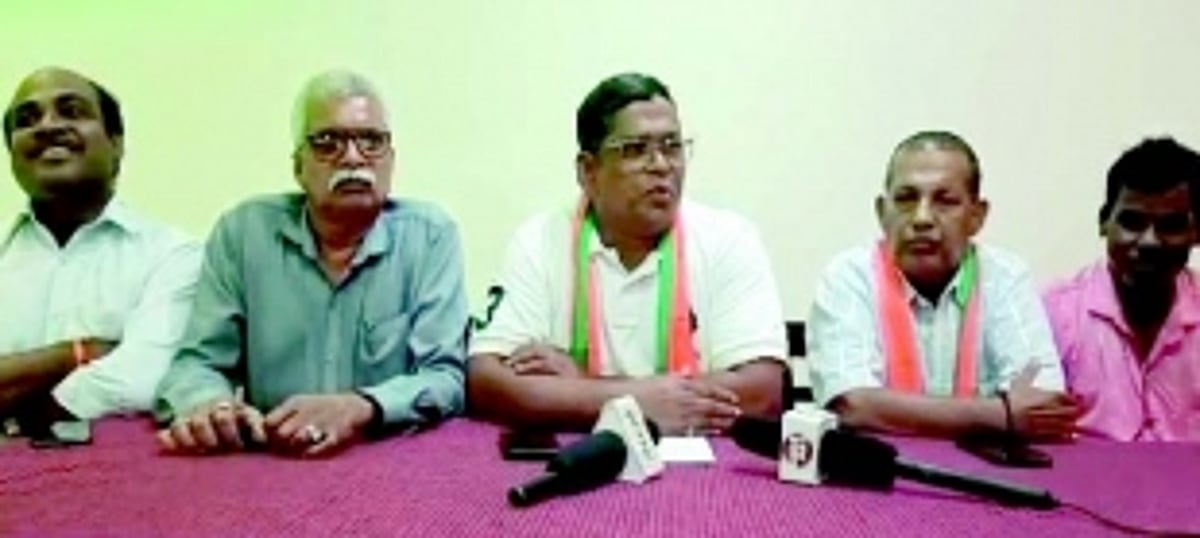
The horrors of Goa’s Electricity Department show no sign of abating. After five linemen were killed on the job last year – we have no idea how many more were injured or permanently disabled – one more lost his life about a month ago. Manoj Zamboulikar, aged just 34, was repairing a high-tension wire at the Housing Board Colony at Valshi, Bicholim, when he was electrocuted, so strongly that his dead body stayed in the sky, stuck to the wires. Locals were so horrified at the ghastly death, that they launched an on-the-spot agitation against the Electricity Department, demanding to know why the government cannot ensure that the wires are safe before work starts on them. They further demanded the resignation of the Power Minister, and even refused to allow the body to be removed from the spot till they were heard.
I have written about such deaths before, last year, when lineman Krishna Pawar was fatally electrocuted in November while climbing down an electric pole in Siolim after finishing his job. At that time, Power Minister Sudin Dhavalikar had made a big show about being grief-stricken – not enough, though, to take responsibility for the death, of course, and certainly not enough to resign his ministry in shame.
Instead, he talked about action taken (against two very junior nobodies), compensation for the family of the victim (but only some months after the death, i.e. when everyone would have forgotten about the incident), and investigation by a ‘high-powered committee’.
This time, with the public enraged, Dhavalikar did not dare to open his mouth. Instead, an investigation was announced by others in the Electricity Department. This was followed by a public statement by the Chief Engineer explaining that the cause of the death was the privately-owned inverters in residential and business premises which can reverse their power into the main system when the power there is switched off, unless they are also switched off. These privately-owned inverters require the approval of the Electricity Department, but people install them without bothering to take permission. In short, implied the officials, nothing much can be done about this situation. The Department was, meanwhile, doing all it could by training linemen in proper safety procedures and providing them safety equipment. They reportedly added that only – yes, only – 14 linemen had died on the job since 2019.
One wonders if the 14 mentioned include the 3 linemen killed (and 5 injured) in 2020, when a truck containing electric poles in which they were also travelling – linemen don’t get free cars like the Power Minister – turned turtle. But is there anything in this statement that’s worth reading? Private inverters have been blamed for linemen deaths all over India – and no government has shown any interest solving the problem. Why would they, when they are not even interested in simpler solutions, like providing protective gear? Zamboulikar was reportedly not wearing any such gear when he was killed. The Electricity Department would have us believe that he had been provided these, but does their responsibility end there? How was he allowed to climb up without his safety gear?
If Goa’s Electricity Department is full of hot air, it is only mirroring those above. Barely a month before Zamboulikar lost his life, the Central Electricity Authority had organized a big celebration (for the 4th year running) of Lineman Divas (Lineman Day) in Delhi, with the theme ‘Seva, Suraksha, Swabhiman’ (service, safety, self-respect).
Safety was the buzzword, with films on safety procedures, and exhibitions of the latest developments in safety equipment, along with speeches on the topic by ministers and top officials. On the ground however, as we can see with Zamboulikar, this celebration made no difference.
Working as an electric lineman is considered – everywhere in the world – to be one of the most dangerous jobs there are, even in the US and Europe, even when the most stringent safety protocols are followed, and the most protective equipment provided.
This mainly due to weather threats, lightning strikes, and human error. In India, we are the bottom of the barrel when it comes to following basic safety protocols for the benefit of workers, so what can we expect? According to a recent article by Orchie Bandopadhaya, in the British journal Safety Management, Indian linemen are regularly put at risk of death or serious injury while doing their job. First, because they are often not provided even the most basic safety equipment such as electricity-insulated gloves, safety belts to protect against a fall, and high-power torches (leaving them to use mobile phone lights instead). Second, although standard operating procedures have been developed to ensure safety while working on power lines, they are simply not implemented, nor is there supervision to ensure that they are. Thus, the very common ‘mistake’ where the electric supply is re-started before the work is finished, with disastrous consequences. Third comes the poor training and long hours of work of linemen, which means that accidents on the job will be more common. Linemen are in fact usually contract employees, which means they are poorly trained, poorly paid, and work for even 12 hours at a stretch. Finally, there are the private inverters and generators which are merrily proliferating across Goa and the country, with the official response being one of helplessness. Would the response be the same if there was even the smallest danger of Dhavalikar or one of his chief engineers getting electrocuted by a private inverter?
The result of all this is that hundreds of linemen die every year across India. So the death of Manoj Zamboulikar was not an accident, but just the natural result of the actual standard operating procedure of Goa’s Electricity Department.
Sudin Dhavalikar might seem to be the most shameless man in the world, but he is actually just one of many such fat-cats licking the cream of power, while condemning their underlings to face death every day at work. No surprises that, with this murderous work culture and complete lack of accountability at the top, the numbers of such deaths are not declining but on the rise.
(Amita Kanekar is an architectural historian and novelist)