

While still a student, Prof A P Kamat, who taught at the Dempo College of Commerce in Panjim introduced us to the concept of “Small is Beautiful” taken from the book of that title by E F Schumacher, and it stands firmly engraved in my mind. But when we are confronted with the reality of small Goa, we find that the smallness has been (ab)used to (mis)appropriate.
Starting with the Portuguese, and also reinforced post-annexation of Goa, Goans have enjoyed a sound health infrastructure and network. Due attention was paid not just to health and but also to primary education. But, slowly and surely, through crony capitalism, and now COVID cronyism, health has become a casualty.
Given the size, we should never have been in a position, for instance, of having to choose between economy and life. It is not as if a lockdown per se can salvage this situation. With boosting good immunity and other appropriate measures at the very initial stage, the pandemic proportions that COVID-19 took in Goa could have been avoided.
It was possible for a small State such as ours to introduce guarantees of social security, currently sadly missing for most marginalised sections of society. Otherwise, lockdown means no work and no work means no income, as the State has imposed no obligation on big business to pay irrespective of closure during lockdown. There has been a complete failure in formalising workers’ rights during COVID-19. At another level, there were bailouts for casinos, which are, in all probability, a major contributor to the second wave of COVID-19, apart from political gatherings for canvassing for elections to local self-government bodies.
We should never have been in a position of choosing whether or not to keep the borders open. If we had a sustainable economy, we need not have been in the unhappy situation of keeping the borders open for transportation of vegetables and other perishables, during COVID restriction periods. This would have minimised the spread of the disease, and would be totally manageable, but that would require an organised and committed governance, with due involvement of local self-Government bodies and the very local administrative infrastructure and personnel.
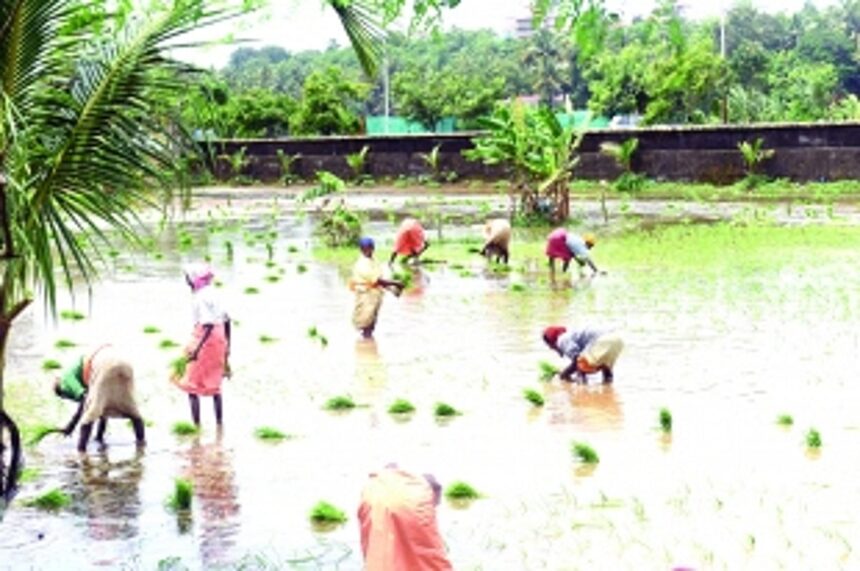
The people, especially the toiling people, are the wealth of Goa. The people engaging with the fields, ore, coastal wealth, livestock, and the cultural capital that comes from diversity, have been the real foundation of the economy. Not what the State calls the Gross Domestic Product, which invisibilises a lot of the work people do to keep the world going.
In the Government’s “Goa’s Economy in figures 2019”, for instance, the artists and artisans at various levels (including roof tilers, painters, tailors, beauticians, barbers), as well as domestic workers are simply invisible. Therefore, when lockdowns or curfews have been announced, there is no mention of what happens about the work that these toilers do, or what can be done to provide them a measure of special social security, during this time.
People’s work in engagement with nature could have continued to be the foundation of a sustainable economy. Not rapacious mining of ore, not a killer tourism, not corporate agri-business, not an opaque and unaccountable pharma industry. But mining if any with local people in the area as stakeholders, tourism with community participation and mindful of carrying capacity, tiller-driven organic agriculture, transparent and accountable pharmaceutical business.
We have appropriate and intermediate technology developed through years of tillers’ and artisans’ wisdom. We have the bandharas (small dams), fishing tools such as paghels, katarins, and kobulem, and engine-driven small fishing boats. But the fisherpeople have had to constantly call out LED fishing by mechanised boat operators, and seek its effective ban. Yes, Goa is not the outcome of an arrow thrust by any deity, but the result of the hard work of its tribal populations, its fishing communities, its tillers and its workers. But where is the official documentation of all these traditional methods and their evolution? Again, a default which could very easily not have been, given the size.
The world cannot rely on diminishing supplies of non-renewables, Schumacher had said. And how true he was. And yet governance in Goa has committed itself wholesale into supporting non-renewables through offering itself as a corridor for transportation of coal, even at the cost of being partitioned in the process.
That digital transformation is yet to happen is evident in the daily struggles of school-going children (and their parents) to log in, if at all they do have access to mobiles or laptops. When this access is missing, it adds another layer of problems, and is compounded by the lack of digital infrastructure that can enable the connectivity and consequent valuable access to health. What Goa needed was not a IT Park, but generalised access to electricity and high-speed connectivity. Once again, crony capitalism prevailed over justice and long-term planning.
Last but not the least, it is always expected that the Government should put its money where its mouth is or should be. Neither has there been a ramping up of infrastructure to ensure revenue generation from those sections of society that can afford to pay the taxes.
In other words, there is a critical need to reorient the economy and to be forthcoming with vibrant solutions by taking people into confidence, especially the marginalized sections of society – something so easily possible in a small state like Goa.
(Albertina Almeida is a lawyer and human
rights activist)



