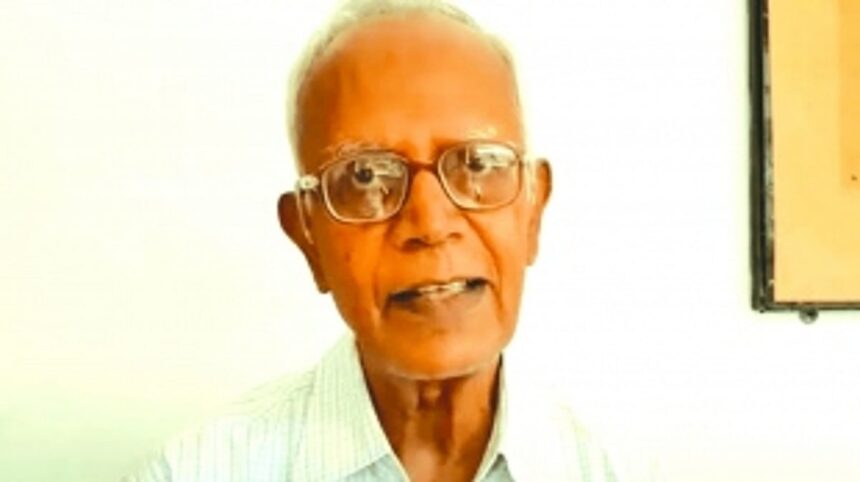
Stanislaus Lourduswamy popularly known as Stan Swamy died, of Covid on 5th July 2021, at the Holy Family Hospital, Mumbai. He initially tested negative in jail, where he was treated by ayurvedic doctors who, contrary to current rules, prescribed allopathic drugs for his multiple medical problems. He set a record for being the oldest person to be arrested for terrorism in India and die in custody.
A Jesuit priest, and a tribal rights activist for several decades, Swamy was born in Trichy, Tamil Nadu, studied Theology and conferred a masters’ degree in sociology in the Philippines. During further studies in Brussels, he met Brazilian Catholic Archbishop Hélder Câmara, and was influenced by his work with the poor in Brazil. He questioned the non-implementation of the Fifth Schedule of the Constitution, which stipulates setting up of a Tribes Advisory Council with members solely from the Adivasi community, for their protection, well-being and development. Swamy also founded Bagaicha, an organisation dedicated to uplift Adivasis, and formed the “Persecuted Prisoners Solidarity Committee” (PPSC) pioneering research on tribal undertrials in various states, often falsely accused of being Naxalites (3000 in Jharkhand alone).
In 2018, a case was registered against him in Pune, (he denied being in Pune at all) for inciting people with provocative speeches during Elgar Parishad organized by activists of Kabir Kala Manch. The police claimed his speeches triggered violence the next day near the Koregaon- Bhima war memorial. The case was taken over by the NIA, and Swamy was produced before the NIA Special Court, Mumbai along with 16 other accused on 9 October, 2020. Supplementary charge sheets were filed against him under various Sections of the IPC, including waging war against the Government of India, sedition, promoting enmity between different groups, statements conducive to public mischief, criminal conspiracy, and various sections of the UAPA. He was sent to judicial custody to Taloja jail, Mumbai. In a video circulated two days before his arrest, Swamy stated his arrest was linked to his work, which involved dissent against government policies. He said “What is happening to me is not something unique happening to me alone. It is a broader process that is taking place all over the country. We are all aware how prominent intellectuals, lawyers’, writers, poets, activists, students, leaders, are all put into jail because they expressed their dissent or raised questions about the ruling powers of India. I am not a silent spectator. I am ready to pay the price whatever it be”. From Taloja jail, he wrote “Many of the poor undertrials don’t know what charges have been put on them, have not seen their chargesheet and just remain in prison for years without any legal or other assistance.” The letter ended “A caged bird can still sing.”
Consider the “evidence” against him; pen-drives containing documents copied from his laptop, allegedly contained incriminating letters addressed to poet activist Varavara Rao. The pen-drives were analyzed by Arsenal Consulting, a highly reputed US tech company. Their report was sent to three other companies for verification by the Washington Post which ran the story. All of them concurred that the “incriminating” documents had been inserted into the computers of the accused by hackers. So vicious was the NIA, that they took 20 days to file a reply to Stan Swamy’s request for a straw to drink fluids. Due to Parkinson, he was unable to hold a cup steady. In contrast, Arnab Goswami’s bail application was heard by a SC in recess; bail was granted, because “every HC should exercise their jurisdiction to protect personal liberty”; otherwise “we are travelling on a path of destruction”.
In one week in June, three judgments related to UAPA were delivered, granting bail in two cases and an acquittal in a 9-year-old case in Nanded, because the court considered the charges were based on conjectures, failed to establish the authenticity of the accusations, and/or fundamental rights had been violated. Any wonder, that nearly 4500 FIRs (5922 arrests) between 2016-19, have resulted in a conviction rate of about 2.5%, and a pendency rate up to 95.5%. An order passed by Justices Siddharth Mridul and Anup Bhambani, in another case, made similar observations. The definition of terrorism in Section 15 of the UAPA is vague and used indiscriminately. The State is required to show why the alleged crime is a terrorist activity and not one that can be dealt with by laws under the IPC. The allegations must be backed by facts, and not based on speculation, or circumstantial considerations about political context. The courts may examine the evidence in bail hearings, and not blindly accept the charge sheets. Even so in one case, release of defendants on bail was delayed because after a year in custody, “their addresses had not been verified”. The problem is a judgment of one court may not bear on a subsequent court unless specifically raised.
The obvious intention is to destroy dissent using the convoluted process of the law rather than the law itself. Arrest the critic under some vague charge of sedition and let the process wreck the victim’s life by unleashing a flawed judicial system to do the damage by denying bail indefinitely. Swamy, was to be made an example of; a warning to others. John Dayal in an obituary, wrote, “In life and in his martyrdom, Fr Stan Swamy has become a beacon for all who struggle for human rights, especially the rights of the tribals and other marginalised people, and a role model for young men and women across the nation.”
The MOSHA duo, with their herd of fanatic followers, may have eliminated Stan Swamy; but will they ever succeed in killing the ideas he lived and died for?
(The writer is a founder member of VHAG)