Old trees cut, at the cost of micro-climate, global warming, and wildlife collapse. Schools closed, at the cost of children’s futures. Markets closed and shop shutters down, at the cost of vulnerable livelihoods. Street dogs disappeared and roadside cattle driven away, at the cost of their wellbeing, even lives. Normal traffic, public bus services, and even emergency traffic seriously affected, at the cost of time, money, health, and worse.
What does this sound like? Evacuation before some disaster, or preparation for some attack? No, no, just the Goa government getting ready for a one-day visit of the country’s Prime Minister (PM). And, in their usual commitment to the all-important tourist population, they announced that (amidst all the chaos and destruction, and whatever happens to anyone else), people going to the airport or railway station would not be inconvenienced.
Can the government explain why trees had to be cut and street dogs evicted? And how children attending school would harm the PM? Yes, the traffic on the roads might be higher as a result, but children going to school surely counts as essential traffic? Besides, many of them would be travelling in school buses, thus creating the least chaos when it comes to traffic. If anybody should have been asked to stay at home to avoid creating traffic snarls, one would surely start with the PM and his unending cavalcade of vehicles. But you can’t expect Chief Minister Pramod Sawant to understand this simple fact, not when he himself has hiked the size of his own entourage – to ensure he creates more trouble for others and thus proves his importance.
What was the purpose of the PM’s visit? Is talking about Viksit Goa (Developed Goa) so important that it justifies the loss of trees and wildlife, dogs and cattle, income and education, not to mention the huge amounts of money that gets spent in ferrying a VVVIP around the country? Because talking is what he did, besides completely unnecessary things like inaugurations and laying of foundation stones, most of them apparently online. Goa, he said, will be developed as a destination for conference tourism; its connectivity improved to make it a logistics hub, and, through the establishments of many institutions, also an educational hub. A super-duper hub of tourism, logistics, and education, that was his basic message. Seriously, couldn’t all of this have been said from Delhi?
Especially since most Goans are hardly going to benefit from this Viksit hub. The PM praised the state government for implementing all central schemes brilliantly – yes, the same state government which, after spending tens of thousands of crores of our money on infrastructure, and destroying the environment wholesale in the process, is simultaneously failing on every front when it comes to basic infrastructure for local communities. The government claims that Goa is ‘har ghar jal’ (every house has water, one presumes), when severe water shortages are becoming common in many Goan villages, from Pernem to Quepem, even as projects for ‘villas with swimming pool’ are cleared at lightning speed all over. Similarly, this self-proclaimed ‘Open Defecation Free’ state has families (Goan families, not the vilified migrants) all over the state who still do not have toilets in their houses despite repeated applications and complaints.
As for road infrastructure, where does one start? Everywhere you look, local communities are fighting against the swallowing of their land by prestigious national road projects which, according to the Chief Minister himself, have already cost the public a whopping Rs 20,000 crores. With the government slashing taxes on luxury cars, while ignoring the desperate state of public transport, we know who the new highways are being planned for. But when it comes to roads actually needed by the people, where is the government? Goa had no road good enough for an ambulance to approach the house of a Goan man, Mr. Paik Gaonkar, in the tribal village of Kazugotta in Sanguem, who suffered a heart attack on Republic Day last month. And no basic ambulance service either. Not only did the ambulance have to halt 2.5 kilometres away from Gaonkar’s home, the vehicle itself was not equipped with even a stretcher, leave aside other life-saving equipment. The grievously-ill man was carried to the ambulance in a blanket by family-members, and passed away by the time they reached the hospital.
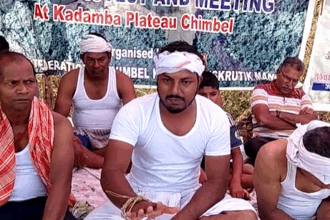
Kazugotta is not the only tribal village in Goa which still lacks motorable roads, say activists, who have demanded that the government explain where the hundreds of crores of rupees supposed to be spent on tribal welfare have gone. A new road had actually been sanctioned in Kazugotta for Rs 4 crores in 2013, but was never completed, despite complaints by locals. When villagers recently took up the issue with the authorities, they were told that the road would now cost 10 crores, and that it was hardly justified to spend that much money on a village of ‘just’ 150 people.
So, tens of thousands of crores are available for roads that locals do NOT want, but not even ten crores for a road that people desperately need. Goa also has helicopter cabs for the super-rich to hop from spot to spot, but no emergency medical services for locals. This is what CM Pramod Sawant apparently means by ‘purna swaraj’ – complete freedom for corporates destroying Goa’s environment, tourists consuming Goa, and for super-rich Goans like those who killed 3 people in Banastarim with their luxury SUV.
Goa’s connectivity is being improved, so the PM says. Yes, we cannot provide a basic road or ambulance service to a village of 150 Goans, but we are happy to hammer all normal life for the super-fast passage of his cavalcade, which incidentally always includes a top-quality ambulance – or two – whether he travels by road or air. This is actually a preview of the Viksit super-hub – international-quality connectivity for the moneyed and powerful, and disconnected locals.
(Amita Kanekar is an architectural historian and novelist)