Yet another mini general elections are over. Governments have been formed, chief ministers have been repeated, including the one in Uttarakhand who lost his own seat but was voted to office by his party’s high command, a novel development in the Bharatiya Janata party. But he is deemed essential in the BJP campaign for the real general elections in 2024.
The aberration, from the point of view of the BJP, was Punjab where Arvind Kejriwal successfully translated the anger of the population within the failure of traditional ruling parties, the Akali Dal of the Sikh farmers and the religious theological centres, the Bharatiya Janata Party of the urban traders and salaried people, and the various factions of the Congress who represented the smaller farmers, the Dalits of three communities and the remnants of the feudal princelings.
Kejriwal was not a new face to Punjab. He had first entered the campaign in the last assembly elections, winning as many as 20 seats. In this election, AAP won 92 of the 117 seats, stunning not just the other parties who lost every single one of their powerful leaders, but Kejriwal himself.
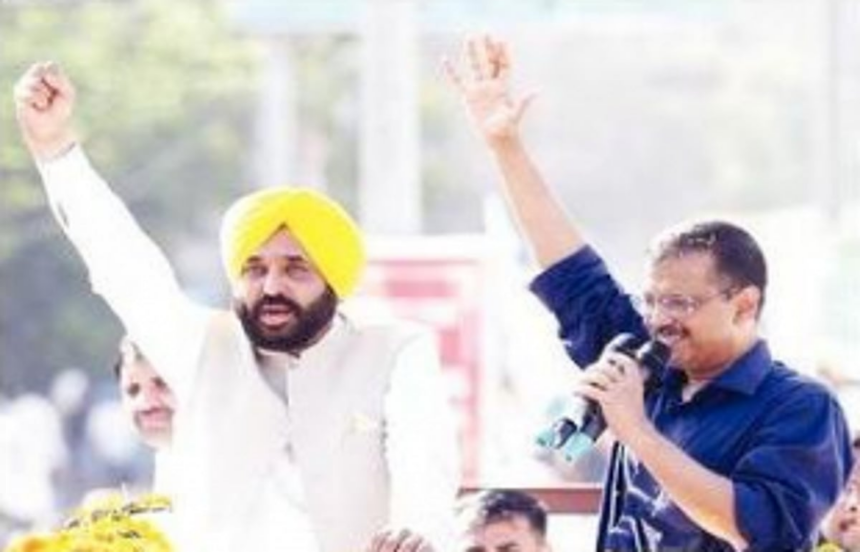
At one stage when it seemed the final vote surge depended on who would be the party’s face for chief minister, Kejriwal performed an electoral magic not seen ever before by the Indian electorate in any State. He declared the chief minister would be chosen by the people before the election through a mass vote using the ubiquitous mobile phone. The people did vote, choosing stand-up comic and two term member of the Lok Sabha Bhagwant Mann as their future chief minister. Mann has now been dutifully sworn in to head the State government at the ripe old age of 48 years.
Kejriwal has already set his eyes on challenging Narendra Modi in the 2024 general elections, and the prime ministership of the country. The man who has been pilloried as the B Team of the BJP-RSS for his hyper nationalism and populism targeting housewives, government employees and youth, thinks he will stun the political pundits once again.
This could be a pipe dream even for the very ambitious IIT Kanpur-trained engineer and former Indian Revenue Service officer who began his political career screaming against reservations which his group said were keeping away meritorious students from higher education and government jobs.
He then was part of the Indian Against Corruption movement against the Congress which was ruling at the centre and in the Delhi national Capital Territory. Launched with the full support of the RSS, and with persons such as Anna Hazare, Baba Ramdev and former police officer Kiran Bedi, IAC metamorphosed into the Aam Admi party. It shed the more visible men of the BJP, but retained its ethos of hyper-nationalism, worship of the motherland, the flag. The man and the party also supported the Ram Temple, promising free pilgrimages not just to Ayodhya, but to every other pilgrim centre from the north to the south.
He delivered some of what he proposed. He demolished the redoubtable Sheila Dikshit who in her four terms had rebuild Delhi from a sprawling post partition slum into a modern metropolis with the country’s first metro network, and a cluster of stadiums and major public works.
But being chief minister of Delhi officers very little in terms of real political power, other than access to the national media.
His first victory in Punjab in 2017 proved to him and his advisors that their amorphous, even apolitical mass of youth and service class, could feed on the hidden anger with mainline parties who did not have the courage to take major decisions lest they anger their traditional vote banks.
With the sweep in Punjab, holding on to Delhi in the last polls, and marking his footprint in Goa, Kejriwal has in just numbers of MLAs, taken his party past all the satraps of the south, and East. And while the regional patties of Tamil Nadu, Telangana, Andhra, Bihar, Jharkhand, and Orissa have absolutely no possibility of winning another State outside their own boundaries, AAP, like am amoebae, still has the potential in the smaller and medium States to be a challenger, possibly a winner.
He will enter the battle in Gujarat this year with renewed vigour. A decent showing there, and of he manages to beat the Congress to third place, will be just the morale booster he will need.
But the slip between the cup and the lip remains the lack of concrete development plans beyond slogans. The Delhi Model, as he calls it, is not easily replicated elsewhere. His promise, on which he has delivered, was for free public transport for women, electricity and water to the lower income group, and a string of special senior schools catering to the brightest among the city’s young. The rest is pure bombast, showcased by almost a hundred very tall flagpoles with huge Tricolours that are flood lit at night.
He is also hamstrung by Delhi’s unique structure which alternating Congress and BJP governments have come to realise cannot be changed. Police remains with the central government, and perhaps for the better for a politically antagonist state government could well paralyse even the Prime Minister’s office.
Kejriwal must depend on the new government in Punjab to keep AAP’s reputation not just in the State but in the country. The issues they face are gigantic. The State’s youth face massive unemployment and a connected link to drug abuse and smuggling. The smaller farmers are not beneficiaries of the recent win of the agitation powered by their more affluent neighbours.
A young and untried group of ministers will have to depend on the goodwill of the people, and non-interference of the Modi government if they are to succeed. It is anyone’s guess how long a honeymoon period will last.
(John Dayal is an author, editor and lives
in New Delhi)