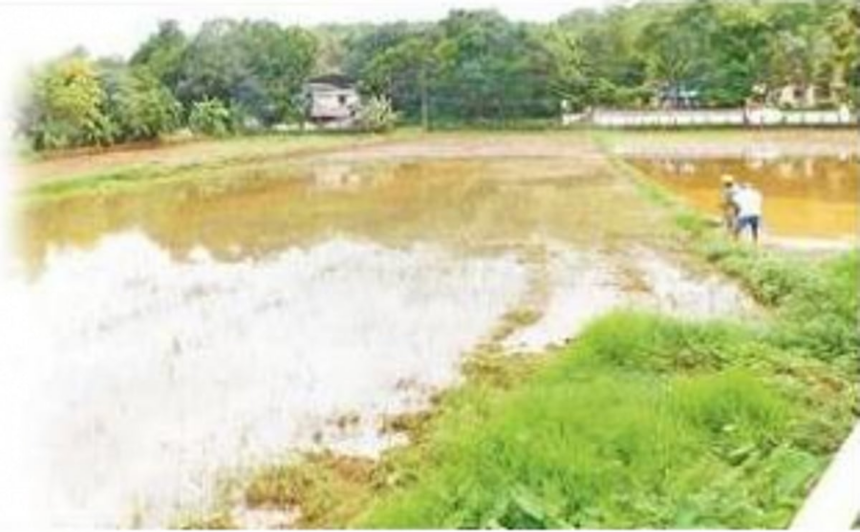
It is well known that the khazan lands of Goa are confined by a network of levees popularly known as ‘bundhs’ that defend these systems from external saline water incursion. At several places, these dykes are seen degraded due to natural causes, and elsewhere, found damaged or deliberately destroyed due to human actions. Although the age-old rubble/earthen mounds have withstood the test of time, we find many areas where urgent restoration efforts are called for.
Our government agencies as agriculture, public works and particularly the water resources (WRD) are bent on replacing traditional bundhs with hard structures. As such, concrete has now become the buzzword in the khazans of Goa.
The adverse impact of hard structures such as concrete embankments or sea walls on the adjacent topography or landscape morphology in general and the ecological security of the region in particular, is documented globally. Scientific research papers dealing with these topics have been published world-wide. In Goa, we have pointed out the negative influence by identifying site-specific issues, and why soft measures along with plantation programmes are more conducive to our river systems. But to no avail. There seems to be no respite in the concretisation of our river banks that abut khazans.
The intensity of detrimental impacts of concrete structures on and along river banks has been routinely reported: (i) Irreparable topographical alteration, damage to embankments which form a micro habitat for many faunal assemblages, (ii) Permanent loss of natural riparian faunal diversity, (iii) Damage to floral diversity during excavation, (iv) Effect on the avian refuge (potential roosting and nesting site for birds), (v) Negative influence on shoreline fisheries, (vi) Waves are reflected after hitting hard vertical walls, turbulence is increased manifold due to churning waters and, as a consequence, erosion is enhanced along such structures, (vii) Sediment is transferred into the river channel creating hazards to navigation, and consequently, the river intertidal area in front of these walls gets deeper, thus affecting the stability of structure itself, (viii) Mangroves get uprooted and disappear, leaving bare banks devoid of vegetation, and a permanent loss of inherent natural protection.
Specific examples where hard structures have created hostile conditions along khazans and the river side can be cited: At Nerul, upstream of the bridge, all mangroves along the concrete embankment have vanished within a year; the original intertidal stretch is now underwater even at low tide; despite the new wall, saline water keeps flowing into the adjacent paddy field, flooding the area which is now invaded by mangroves. At Penha de Franca, a similar situation can be identified; a stable mangrove bank is now occupied by an unwarranted concrete wall. Upstream of Baga point, the wall built through mangroves has taken a heavy toll on vegetation; the fringing mangroves are almost extinct. At Paliem, the need for the concrete retaining wall is not known; at present it appears there is more water within the wall as compared to the river; this accumulated water cannot find its way out into the river. In the course of time, a river gets converted into a canal of sorts. Such a scenario is observed between Siolim and Chopdem, as between Ribandar and opposite Chorao and Divar. Whereas the southern banks are concretised and bare, the opposite banks are intact and characterized by luxuriant mangrove forests.
Ideal eco-friendly management measures to restore river embankments (or to build new ones) along low-lying khazans would be as follows: (a) Exclusive use of dressed natural laterite stones, (b) Construct a concrete base only up to/at the lowest low tide level, (c) Build a stone wall of about 60 cm width with cement mortar, (d) The wall should not rise more than 30 cm above the highest tide level, (e) Adequate passages/gaps need to be provided all along, as spaces/crevices within individual stones are needed to entertain marine fauna, (f) A revetment with 45 degrees slope would be ideal, as a tolerable tilt will ensure the stability of the stone wall, as such a rough inclined structure would possess a greater capacity to absorb wave energy, (g) In case the river is dredged, part of the original sediment is to be re-dumped on or along the bank, (h) Plantation of fringing mangroves in the intertidal zone, and appropriate trees on the bank needs to be pursued aggressively.
Wherever concrete is used, medicine invariably turns into disease. In view of the above, it is felt and strongly recommended that: (A) The WRD urgently needs to form a R&D cell which should take into account the latest research in coastal management, particularly with reference to the eventual (and known) problems arising out of fixing river banks with hard structures. (B) The concerned authorities need to accept that coasts or river banks need to function naturally to maintain the sanctity of geomorphic features and to contribute towards eco-biological diversity. (C) Fixing of river boundaries with hard materials is rather absurd, as research has confirmed: (i) deepening of the intertidal strip due to induced erosion, (ii) disappearing of fringing mangroves, (iii) irreversible impacts on the biologically active riparian fauna, and (iv) in particular, the drowning of wild otters as, being land-based and semi-aquatic, they cannot climb vertical walls. (D) Eco-biological alternatives such as plantation of appropriate vegetation along banks of rivers are imperative. The role and functions of vegetal species in trapping sediment and stabilising banks or coasts is well studied on a global scale. (E) Conservation and restoration by adopting natural eco-bio-friendly soft methods should be the endeavour of WRD.
(Dr Antonio Mascarenhas in a former Scientist, NIO, Goa)