Chándor is a peaceful village situated in the Salçéte taluka of the Indian state of Goa. It lies in the south of Goa, along the southern bank of the river Zuari and western bank of river Kushavati. As one enters Chándor, one is awestruck by the sight of the magnificient Igreja de Nossa Senhora de Belém, standing tall amidst the Market area of Chándor. It is noteworthy that Chandor was the capital of the Kadambas until 1054, when they moved the capital to Govapuri/Gopakapattan (Goa velha). Govapuri was destroyed by invading forces in 1312, prompting them to move the capital back to Chandor, until it was sacked in 1327 by the Bahamanis. Adilshah took over Chandor in 1498 from the last Bahamani Governor, Malik einol moolk Gilani. Chandor then comes to the Portuguese in 1543.

During the morning of 18-Feb-2024, as the author was cleaning up his storage space, he came across a wall frame comprising of an intricately worked woodcut print of Saint Francis Xavior. The saint was represented in a manner very similar to the Baroque statue of the saint seen at them Basilica of Bom Jesus, in Velha Goa where he is shown holding a staff in his right hand and a crucifix in his left. As one enters the Basilica through its main door one can see this almost life size statue of the saint on the left side, just at the entrance. In the background of the saint was shown a healthy coconut plantation with the movement of trees, complimenting that of the saint. The lower portion of the picture had the text ‘SAN FRANCISCO XAVIER GOA’, and bore the name Ladis Da Silva, 84 at its right corner. The author instantly remembered seeing similar woodcuts with the same name, at the Casa Bragança Pereira in Chandor. Wasting no time he immediately got in touch with his dear friend Mr. André Bragança Pereira to check on any possible information about Mr. Ladis. ‘These are sketches gifted to my grand uncle, Mr. Álvaro Bragança Pereira’, he mentioned with a smile.
To the good luck of the author, his friend Mr. Ranjeev Fernandes from Cotta, Chandor, knew a Da Silva family from Cotta which he said could be associated with Mr. Ladis Da Silva. Mr. Ranjeev introduced the author to Mrs. Emma Da Silva who, to the author’s good luck happened to be Mr. Ladis Da Silva’s first paternal cousin. ‘My dad and Ladis’s dad were brothers!’, Mrs. Da Silva exclaimed. Further with a sense of pride she says, ‘Ladis was the best ever artist of his times who actually posted his works to Goa, for his friends’.
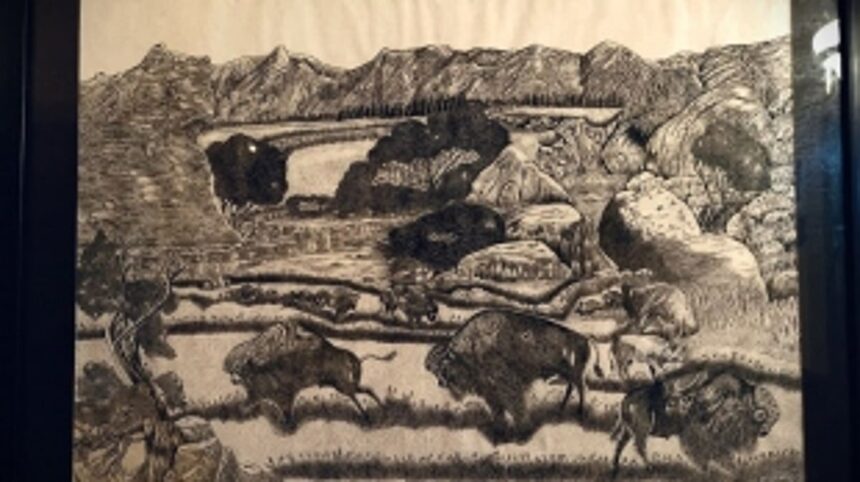
Mr. Ladis was born to Goan parents on the island of Zanzibar, off the coast of East Africa, on 11 April 1920, He combined in himself two notable accomplishments: he was a consummate artist who before World War II worked with oils and canvas, water colours and acrylics and later concentrated primarily on pen washes and renderings which appeared identical to woodcut prints. He was also a writer of note having published books and written extensively on his work. He was enrolled at the Sir Euan Smith Madressa School, Zanzibar, where he studied Gujarati, Marathi and Sanskrit. He then joined St. Joseph's High School for Advanced Studies under the Holy Ghost Fathers where he acquired his basics in art. In Zanzibar, he was the founder member of the Zanzibar Arts and Crafts Society with the support of His Highness, The Sultanate of Zanzibar, also known as the Zanzibar Sultanate, which was an East African Muslim state controlled by the Sultan of Zanzibar, between 1856 and 1964. As an assistant scout-master still in his teens he was asked to handprint the programs on the occasion of the official visit of Sir Baden Powell, Lady Powell and their daughters for the Great Jamboree in 1935. These programs have been preserved in the Scouting Museum in London. Emigrating to London in 1941, he founded the Goan Arts Society where he was elected as its President. He was a member of good standing, of the exclusively European "5 Arts Club", "The Indian Christian Arts Society" and "Paa Ya Paa", the Kenya National Cultural Centre. In Nairobi he held several solo exhibitions. His first exhibition was at the Parochial Catholic School Auditorium after the Second World War and his last at the foyer of the famous Donovon Maule Theatre on 30 January 1967. Several of his paintings were purchased by visiting tourists as they represented the wildlife of Kenya. Ladis Da Silva emigrated to Canada in 1968 where he specialized in the Native Indian and Inuit Art. His articles and detailed work which sensitively and accurately capture the spirituality and cultural traditions of the native people of Canada, have regularly appeared in the Toronto Native Times. He has published three non-fiction books containing his own illustrations, namely the Americanization of Goans; Legendary Chandor: seat of the Kadamba dynasty in Goa and St. Francis Xavier. His latest book captioned An Island Kingdom, an extensively researched work on the history of the Omani Dynasty in East Africa was published in the USA in 1989. Mr. Ladis was highly recognized for his special techniques which produced an almost photographic effect in his work. While in Kenya, he was influenced by Bruno di Sorpa, a renowned Italian artist, but during his early formative years, it was his parent’s encouragement that spurred him on. He did extensive work on calendar designs, African scenes, wildlife and churches of Goa and Canada. He was commissioned to do wildlife scenes on lamp rice parchments which were purchased at the ‘Tree Top Hotel’ by movie stars from the Hollywood industry. Mr. da Silva devoted his spare time to the service of the church, senior citizens, the sick and the youth. He was the member of Amnesty International championing, the cause of the prisoners of conscience. Ladis passed away in 1994, in Toronto, Ontario, Canada leaving behind three daughters, the eldest of which is a writer. Indeed, a great personality like Mr. Ladis and his contributions to society deserve to be remembered and acknowledged in the generations to come.