SHASHWAT GUPTA RAY
As the world marks World Health Day 2026 today with the theme ‘Together for health. Stand with science’, a recent study from Goa Medical College underscores the urgent need for evidence-based, community-level interven tions to address depression among the elderly. The study, conducted by researchers from Goa Med ical College (GMC), finds that health issues, coupled with financial dependency and loneliness, make senior citizens particularly vulner able to depression. Titled ‘Assessment of depression and quality of life among elderly in a ru ral area of Goa’, the study — published in the Indian Journal of Social Psychia try — assessed the preva lence of depression, asso ciated factors, and quality of life among elderly in dividuals in a rural Goan setting. It was authored by Dr Jennifer Mendes, former Assistant Lecturer, Department of Communi ty Medicine, GMC, and Dr Hemangini K Shah, Associ ate Professor in the same department. Speaking about the find ings, Dr Mendes said, “Old er adults are prone to im mobility and dependency, making it more challeng ing to diagnose and treat depression.”

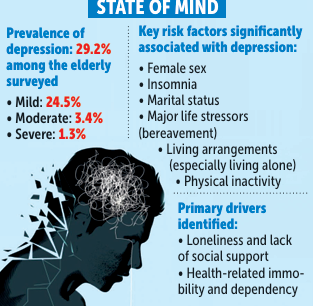
Living alone, stressful life events, lack of social support systems, loss of a loved one, lower socioeconomic status, and the presence of comorbid medical conditions are some of the risk factors for depression among the elderly,” Dr Mendes added. Previous research estimates the prevalence of geriat ric depression in India at 34%, while the National Mental Health Survey identified an approximately 85% treatment gap for depression in the general population. Under the guidance of Dr Shah, the present study was undertaken to estimate the prevalence of depression and assess associated factors and quality of life among this vul nerable group, with the aim of enabling early support and promoting healthy ageing at the community level. Elaborating on the findings, Dr Mendes said, “The prev alence of depression in the current study population was 29.2%. The majority (24.5%) had mild depression, some (3.4%) had moderate depression, and a small proportion (1.3%) had severe depression.” Among the variables analysed, depression showed a sig nificant association with sex, self-reported insomnia, mari tal status, presence of major stressors, living arrangements, and physical activity.
However, no significant association was found with age, religion, education, current working status, socioeconomic status, financial dependence, self-re ported chronic diseases, or addictions. “In this study, 29.2% of the population exhibited depres sive symptoms, mostly mild. Factors such as insomnia, phys ical inactivity, and major stressors like bereavement showed a strong association with depression, and affected individu als reported a poorer quality of life,” Dr Mendes added. She noted that a limitation of the study was the use of a screening tool rather than a diagnostic instrument to detect depression. Accordingly, participants exhibiting depressive symptoms were referred for evaluation and further manage ment by mental health professionals. On the implications of the findings, Dr Mendes said the study enabled researchers to screen vulnerable elderly indi viduals for depression and assess their quality of life. “We also conducted various Information, Education, and Communication (IEC) activities to raise awareness about elderly mental health and the services available to ensure better care and quality of life,” she said.
Emphasising early detection, Dr Mendes added, “Recog nising depressive symptoms at an early stage is the first step towards managing depression. This must happen across multiple settings — homes, workplaces, educational insti tutions, healthcare facilities, and communities — through informed and trained personnel. It is equally important to raise awareness among family members and the wider com munity about symptoms and available treatment options, so that timely interventions can improve quality of life.” She further noted that, as a cross-sectional study, it cannot establish causation, and that longitudinal research would be needed to determine temporal relationships.