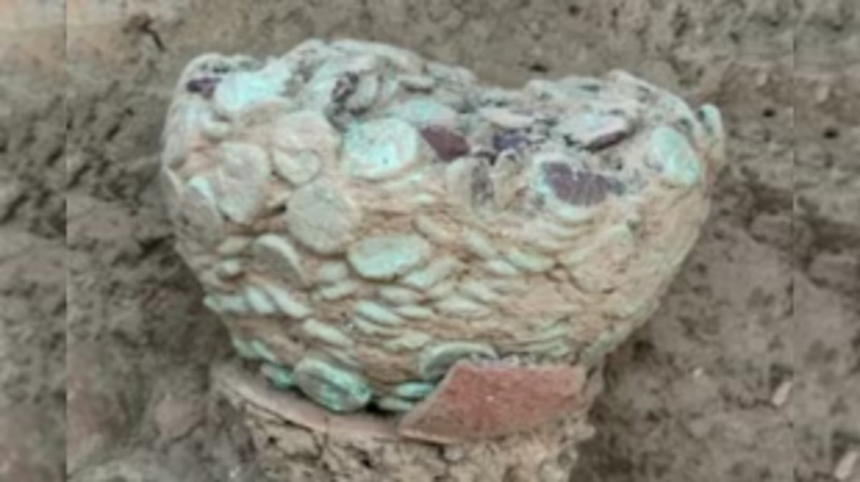
In a groundbreaking archaeological discovery, a team led by Sheikh Javed Ali Sindhi unearthed a fascinating cache of 2000-year-old copper coins within the remnants of a Buddhist shrine at the historic site of Mohenjo Daro in Pakistan. Believed to hail from the era of the Kushan Empire, these coins shed light on the widespread popularity of Buddhism during that time.
Situated amidst the extensive remains of Mohenjo Daro, a site dating back to approximately 2600 BC, the Buddhist temple, or stupa, stands as a testament to the rich history of the region. Sheikh Javed Ali Sindhi, an archaeologist and guide, revealed that the stupa was constructed 1600 years after the fall of Mohenjo Daro.
Following the collapse of a wall at the site, Sheikh Javed Ali Sindhi and his team embarked on excavations that led to the discovery of this remarkable trove of coins. The project was overseen by Syed Shakir Shah, the Director of Archaeology. The coins, exhibiting a greenish tint due to copper tarnishing over time, have formed a circular mass weighing approximately 5.5 kg after decades of burial. Estimates suggest that there may be between 1,000 and 1,500 coins, some of which were found independently.
Notably, these coins feature standing figures on their exteriors, believed to represent Kushan kings. Sheikh Javed Ali Sindhi emphasized that these coins are the first artifacts excavated from the stupa since 1931 when British archaeologist Ernest Mackay discovered over 1,000 copper coins. Additional coins were also found in the stupa during the 1920s.
Mohenjo Daro, once the largest settlement of the Indus Valley Civilization, saw a mysterious abandonment around 1700 BC, along with other settlements of the civilization. The recent discovery adds a new chapter to the enigmatic history of this ancient civilization. The uncovered coins will undergo meticulous cleaning at the archaeological laboratory, providing further insights into the cultural and historical significance of this remarkable find.