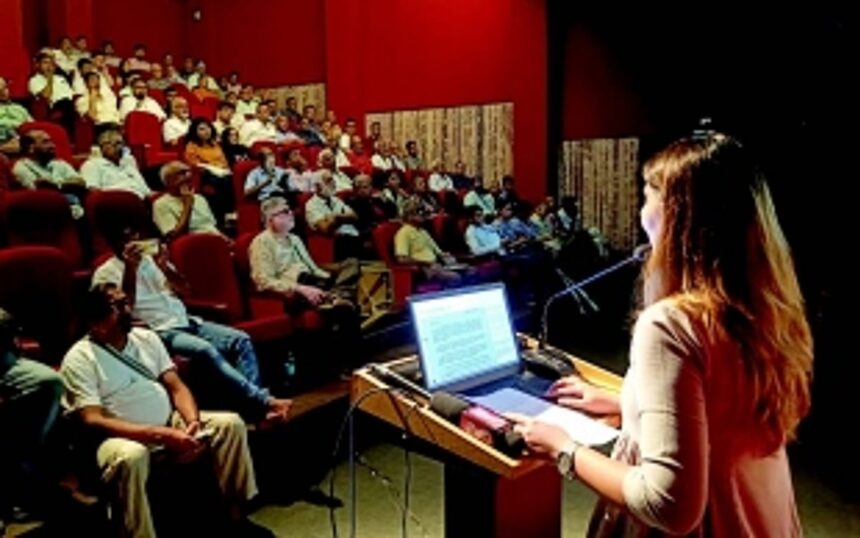
MARGAO: A packed public meeting at Gomant Vidya Niketan in Margao shed light on the State government’s mishandling of the Kala Academy (KA), once celebrated as India’s premier cultural institute. The presentation meticulously outlined the extensive damage inflicted upon this revered institution, leaving attendees visibly outraged and acutely aware of the urgent need to address KA’s structural and aesthetic issues.
The meeting showcased a range of impassioned responses from Goa’s artistic community. Saiesh Poi Panandikar, a prominent artist, likened the Kala Academy’s current state to “an act of murder”. Tiatrist Francis De Tuem provided a moment of levity with two satirical songs that highlighted the renovation’s shortcomings. He humorously recounted how, despite the crores of rupees spent, a light rain caused roof leaks that disrupted a tiatr show, and even attracted an unexpected serpentine visitor to the auditorium.
Political figures also weighed in on the controversy. Leader of Opposition Yuri Alemao called for a thorough inspection with the PWD and criticised Art and Culture Minister Govind Gaude for questioning the credibility of the late Charles Correa, the Padma Vibhushan-awarded architect who designed the Academy. Goa Forward Party (GFP) President Vijai Sardesai, whose party had previously approached the High Court over the issue, revealed that the State government had undertaken the renovation without a proper tender process. He urged the Charles Correa Foundation (CF) and the artist community to join their High Court petition.
At the forefront of the event organised by artistes’ collective Kala Rakhonn Mandd, was the presentation of Tanvi Karia, architect and CCF Convenor, who detailed KA’s tumultuous journey.
Karia explained that the troubles of Kala Academy (KA) date back to 2004 when Goa first hosted the International Film Festival of India (IFFI). Since then, the building has undergone a series of hasty renovations, often in anticipation of specific events. These rushed jobs led to structural issues.
Karia emphasised that while buildings typically require waterproofing maintenance every decade, KA’s upkeep had been inconsistent at best. Notable problems surfaced in 1996 and 2004, with some degree of maintenance carried out each time. However, the situation took a dire turn in 2019 when the Goa government announced plans to demolish the open-air theatre.
In January 2020, CCF reached out to the government, offering assistance in preserving the building. They even brought in Professor RG Pillai from IIT Madras, who provided valuable suggestions for conservation. Despite submitting a comprehensive proposal, the government ignored their input.
The architect also highlighted that the government’s appointment of a consultant without transparency was concerning. Karia stressed that historically, under former Chief Minister Pratapsingh Rane’s chairmanship, any renovation always involved an artist stakeholders committee before work began. This crucial step was notably absent in the 2021 project.
Karia then shared CCFs opinion on the quality of the current restoration. She didn’t hold back in criticising the poor quality of finishes, construction, and detailing throughout the complex. From bad levelling of steps and ugly air conditioning sheds on the roof, the list of issues seemed endless.
Of particular concern was the KA renovated auditorium itself. Karia pointed out the thin, inadequate carpeting that failed to dampen sound properly, the ugly laterite bands that marred the aesthetics, and the new roof panel disrupted the original design. Even more troubling was the insertion of massive ducts that significantly reduced the backstage area, impacting the functionality of the space for performers.
The murals, once a defining feature of the academy, had not escaped the renovation’s heavy hand. Karia lamented that their colours had been completely changed, altering the artistic intent and cultural significance of these works.
Karia presented the CCF’s recommendations for moving forward. She called for the immediate establishment of an advisory council comprising primary users of the facility. This would ensure that future decisions would be made with the input of those who understand the building’s purpose and needs best.
Other speakers echoed Karia’s sentiments, highlighting how KA, a symbol of Goa’s rich cultural heritage, had suffered from gross mismanagement.
Event producer Francis Coelho lamented the destruction of KA’s once world-class acoustic system, describing the current system as a problematic, cheap imitation that disservices performers.
The speakers said the problems have compromised KA’s safety as well, which is a risk for visitors too.