SHASHWAT GUPTA RAY
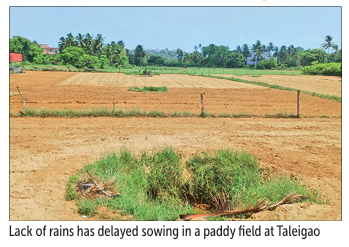
While monsoon showers remain elusive, Goan farmers and agri cultural experts fear that a combination of delayed rains and the threat of late-season flooding could cause significant damage to the local paddy harvest. Namita Namdeo Khan deparkar, a farmer from Chorao, along with fellow farmers from the area, has tilled her fields and kept paddy seedlings ready for sowing. But there is no wa ter in the fields due to the lack of rain. “There are many pad dy fields here. By now, we should have started trans planting the paddy seed lings. But there has been no rain, leaving our fields dry. We have already lost 15 days of this year’s Kharif season, and there is still no sign of rain.

Moreover, we don’t have any other source of irrigation, such as canals, so we are completely de pendent on rain,” Khande parkar told O Heraldo. She said that if the rains do not begin soon, the seedlings will dry up, caus ing substantial losses to her and other farmers in the area. She is also worried about the destruction that a late surge in rainfall could bring. “Right now, conditions are dry. Then, suddenly, we may receive the entire sea son’s rainfall within three or four days. That is equally harmful to our crop,” the farmer said. A similar situation prevails for Krishna Ta lavnekar from Dhargal. He, too, is waiting for the rains, but there is no sign of favourable weather con ditions yet, and he has no option but to wait and watch. “There is no sign of rain. By this time, we should have received enough rain fall to begin the sowing season. If the rains don’t start in time, our paddy seedlings will be destroyed. We don’t know what to do in these circumstances,” Talavnekar said. According to Stanley Fernandes, co-founder of Goencho Xetkar, an organ isation that assists in farm mechanisation, the 15-day delay in the Kharif season is expected to result in de layed sowing and flowering of the paddy crop. “There will be an adverse impact on the paddy crop if the rains are delayed further.
However, the staggered sowing pattern in Goa may reduce the impact. For example, sowing in Salcete and Tiswadi begins in June, while in Bardez it starts in July. Technically, Bardez should not face an imme diate problem. Also, South Goa has water catchment areas and canal irrigation facilities. The problem is likely to be felt most in Tiswadi taluka,” he said. He added that it is clear that climate change is taking a toll on local farming cycles. “Given the potential for a double whammy of a delayed start to the Kharif season and erratic late-season rainfall, it is imperative that the impact of climate change is taken se riously to protect our agricultural output,” Fernandes said. Manohara KK, senior scientist (Genetics and Plant Breeding) at ICAR-CCARI, said that while the total volume of rainfall in Goa is generally sufficient, its distribution is critical, particularly during the flowering and initial estab lishment stages of crops. “Last year’s rainfall of 4,500 mm caused significant prob lems due to water stagnation; a more moderate 3,000 mm would be ideal for a healthy harvest. We have already lost the first 15 days of the season. This is especially concerning for low-lying khazan areas, where rainfall is necessary to dilute the accumulated salt levels in the farmlands,” Manohara said. He said the season could still recover if continuous rains are received during the second fortnight of the month. “However, if the dry spell continues for another week, it will pose a serious challenge to the State’s agricultural out put. Given that nursery sowing is currently underway, the next few days are crucial,” the senior scientist said.
When asked about the government’s preparedness in the event of crop failure due to delayed and deficient rain fall, as predicted by the India Meteorological Department (IMD), Director of Agriculture Sandeep Faldessai said that while it is still early days, the government has made provi sions to tackle any eventuality. “The government has directed the Water Resources De partment (WRD) to release water through irrigation canals to support puddling activities in areas where these facilities are available. Additionally, the government will arrange irrigation pumps to draw water from sources such as wells,” he said. In the event of delayed sowing due to the late onset of the monsoon, the Directorate is prepared to procure short-du ration paddy seed varieties that mature in 90 to 95 days. “Since we typically receive rainfall by June 10, technically the monsoon is delayed by only five days. We are currently expecting the rains to arrive by the end of this week. How ever, given the concerns over drinking water levels in the dams, the release of water for agriculture will be limited to a short period to facilitate initial sowing. We anticipate that once sowing is completed, subsequent showers will be sufficient for the seedlings to survive,” the Director said.