PONDA: Sudesh Narvekar has donated blood 106 times from the age of 20, earning the moniker “Blood Man of Ponda”.
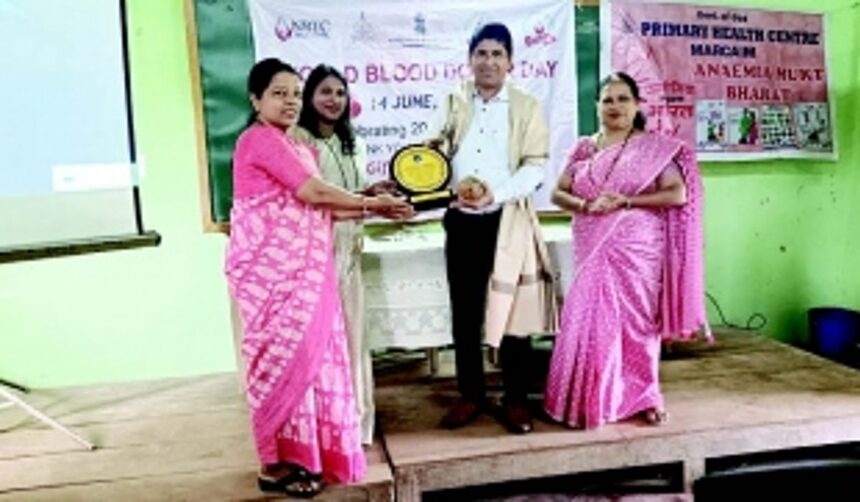
On World Blood Donor Day celebrated on June 14 Narvekar was honoured at an event jointly organised by Marcaim PHC and Navdurga Higher Secondary School, with dignitaries emphasising the crucial role of blood donation in saving lives.
Narvekar shared his story, recounting how, he witnessed a life-threatening situation where a patient needed an urgent blood transfusion following an accident in Borim, when he was 20 years old.
Not only did he transport the injured person to GMC, but he also donated his own blood, marking the beginning of his lifelong commitment to blood donation.
He described the gratitude he received from the patient’s wife as a turning point in his life.
Narvekar, now a social worker and founder of Sarthak Foundation, has organised around 250 blood donation camps with the help of his colleagues.
He expressed deep appreciation for his team’s tireless efforts, noting that their contributions have been pivotal to the foundation’s success. “Even today, if a patient needs blood, ‘Sarthak’ is contacted,” he said.
Addressing the youth, Narvekar stressed that blood donation is the best form of giving, as it directly saves lives. He debunked myths about blood donation, explaining that the body quickly replenishes donated blood and that new blood forms after every donation.
Encouraging young people to donate every 90 days, he urged them to overcome their fears and take pride in saving lives through blood donation.
Seema Sawant, Principal of Navdurga Higher Secondary, along with Dr Sonia Kanekar and Dr Deepali Naik, were present on the occasion.
Sawant highlighted that the school organised the programme to inspire young students to donate blood for societal benefit, stressing that today’s youth, often distracted by mobile phones and other addictions, need role models like Sudesh Narvekar.
Surge in accidents and cancer cases HAS raised need for blood donation: DHS
PANJIM: Rise in accidents and cancer cases has led to increase in need for blood, Director of Health Services Dr Rupa Naik said here on Friday.
She was speaking at a State-level
‘World Blood Donor Day’ which was celebrated by the Goa State AIDS Control Society (GSACS).
“Although our requirement is 20,000, we have exceeded 28,000 units of blood per year. One blood unit can save four lives. It is a very important development now, considering that road accidents are very common in Goa. You hear it, and you read it in the newspaper. Polytrauma is caused where a lot of blood is lost. Cancer cases are also on the rise in Goa. Dengue
disease requires blood. Hemophilia, where plasma is needed.”
The celebration of ‘World Blood Donor Day’ completed 20 years this year. The event was held at the Secretariat, Porvorim.
This year the theme of the celebrations was ‘Celebrating 20 years of giving: Thank you blood donors!’ One of the objectives of this year’s campaign was to thank and recognise voluntary blood donors who have contributed to the health and well-being of people.
It highlighted the importance of donating wherein one blood unit can save four lives.
On the occasion, a blood donation camp was organised by the Goa State AIDS Control Society allowing donors to donate their blood. The camp was started way back in 2004, with no donor willing to donate their blood.
On the occasion, the DHS urged the youth to create more awareness and donate more blood that can save multiple people’s lives.
“Looking back in the 20 years the journey has been very successful. The mere presence of the youth speaks about the success of the function. Twenty years back nobody wanted to donate their blood, giving numerous excuses. So the success of the programme shows that the awareness for this generation is very important,” said Dr Naik.
Further the director of health services spoke about the progress made in the private as well as government healthcare sector through this programme.
“Five blood banks have been made available with good laboratory equipment to separate the components so that no blood is wasted. Not only in terms of equipment but employment of human resources also,” she said.
In a significant step towards progress in health care, fourth generation testing of HIV AIDS, Hepatitis B and C was also being advocated through the camp.
Senior Pathologist, North District Hospital, Mapusa, Dr Varsha Munj in her keynote address, informed that voluntary blood donation had increased from 53.4 per cent in 2005 to 74 per cent in 2023 in the State. Project Director of GSACS Dr Lalitha Umraskar and Assistant Director of VBD Vijay Jagtap, among others were also present.