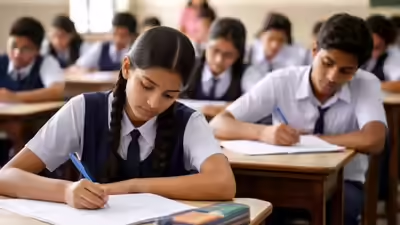
The Central Board of Secondary Education (CBSE) has announced a one-time relaxation for students currently studying in Class 9, easing concerns over the implementation of the three-language formula under the National Education Policy (NEP) 2020.
The revised guidelines come after schools and parents raised objections to the board’s earlier directive, which required all Class 9 students to study three languages from the 2026-27 academic session. CBSE said the exemption has been introduced to ensure that students already admitted under the previous language system are not academically disadvantaged during the transition.

What changes for current students?
Under the updated guidelines, current Class 9 students who are studying two non-Indian languages, such as English and French, can continue with the same combination by adding one Indian language as their third subject. However, this additional language will be assessed only through internal school evaluations.
CBSE clarified that these students will not have to appear for a Class 10 board examination in the third language when they reach the 2027-28 academic session. The same transitional benefit will also apply to students currently studying in Classes 7 and 8.
For the present Class 10 batch, the board confirmed that there will be no changes. These students will continue under the existing two-language scheme without any requirement to study a third language.
Full implementation from Class 6 onwards
CBSE’s revised guidelines state that students entering Class 6 from the 2026-27 academic session onwards will follow the three-language policy in full. They will study three languages, with at least two being Indian languages, and will eventually appear for a board examination in the third language when they reach Class 10.
To support implementation, NCERT will provide dedicated textbooks and learning resources in all 22 scheduled Indian languages. Schools have also been permitted to use flexible teaching arrangements, including retired teachers, virtual classes and collaborations with nearby schools, to address teacher shortages.
The revised policy also provides exemptions for Children with Special Needs, foreign students returning to India and CBSE-affiliated schools located outside the country.
The three-language policy is currently under challenge in the Supreme Court, where petitioners have raised concerns over infrastructure, teacher availability and the preparedness of schools. The matter is expected to be heard in the second week of July.