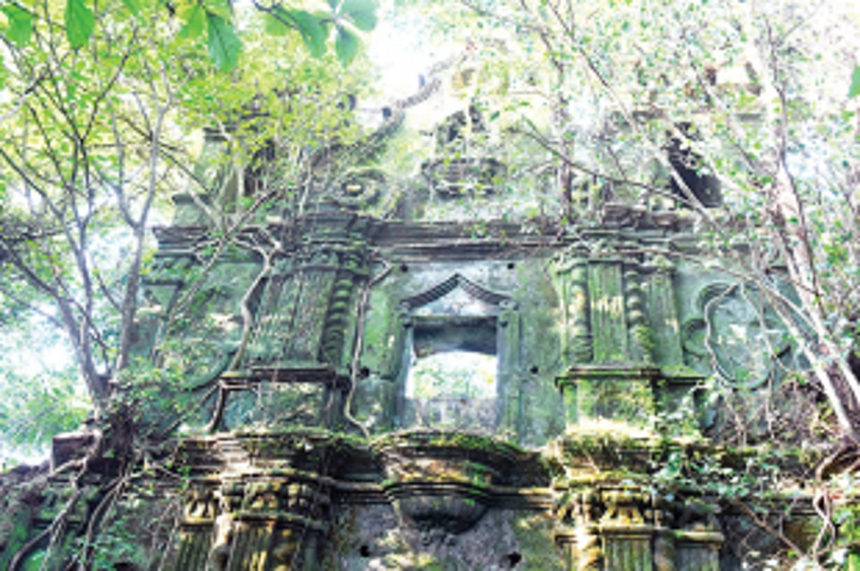
PANJIM: The residents of Chimbel under the banner of the Mount Carmel Conservation Association of Chimbel (MCAC) on Tuesday strongly objected to the plans of the Provedoria to begin construction of a new block over the State protected ruins of the Church and Convent of Mount Carmel.
At a media briefing, MCAC expressed shock at these plans despite the Government having earlier declared the site as Historic and of aesthetic importance under the Goa TCP Act, 1974 in December.
They feared that Provedoria’s construction plans would destroy the ruins and that it’s allegedly a complete violation of the law.
“In the 1980s, a block was constructed to house the inmates of the Provedoria’s old age home. The old convent building was abandoned and the two wings were demolished in the 1990’s leaving the structurally compromised church standing precariously which collapsed soon after leaving only the facade standing among the ruins,” MCAC members explained.
They pointed out that due to the efforts of the residents and professionals from across the State who mobilized themselves to protect these unique ruins, the TCP Department amended the list of protected monuments in Goa for the first time since 1984.
They explained that the the Provedoria compound has over 35,000 sq mtrs of land and the ruins occupy an area of about 6,000 sq mtrs with an additional area in front of the ruins encompassed by a heritage wall. They said, through St Cruz MLA Antonio Fernandes they had requested Provedoria to plan any new construction away from the ruins so that the sanctity and heritage value of the site is preserved.
Adding that the residents have always had good relations with the Provedoria, since the 1950s, MCAC members appealed to the Chief Minister, their MLA and sarpanch, to protect this historic site and carry out any new development on the site sensitively.
They have also appealed that the gate, which was earlier used as the exit from the church and convent premises, be kept open as tourists have to trespass from the adjoining property.
“The site thus has outstanding social, cultural and heritage value. The old complex, especially it’s intricately carved facade, is a rich example of Goan Mannerist architecture, and is an important marker to trace the evolution of Church Architecture in Goa,” MCAC members concluded.