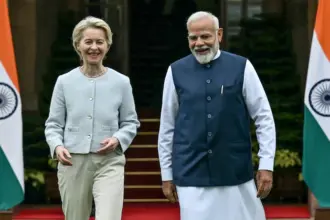
PTI, New Delhi: Prime Minister Narendra Modi on Saturday made a strong pitch for use of local languages in courts to make the common man feel connected to the justice system, and also said he has set up a group to examine having simplified version of laws as well that is easily understood by the masses.
In remarks that came before Modi’s call at a conference, Chief Justice of India N V Ramana also said the time has come for the legal system to introduce local languages in courts. The CJI later told a press meet reforms such as introduction of local languages in courts cannot happen in a day, and these things take time due to logistical difficulties or other hurdles.
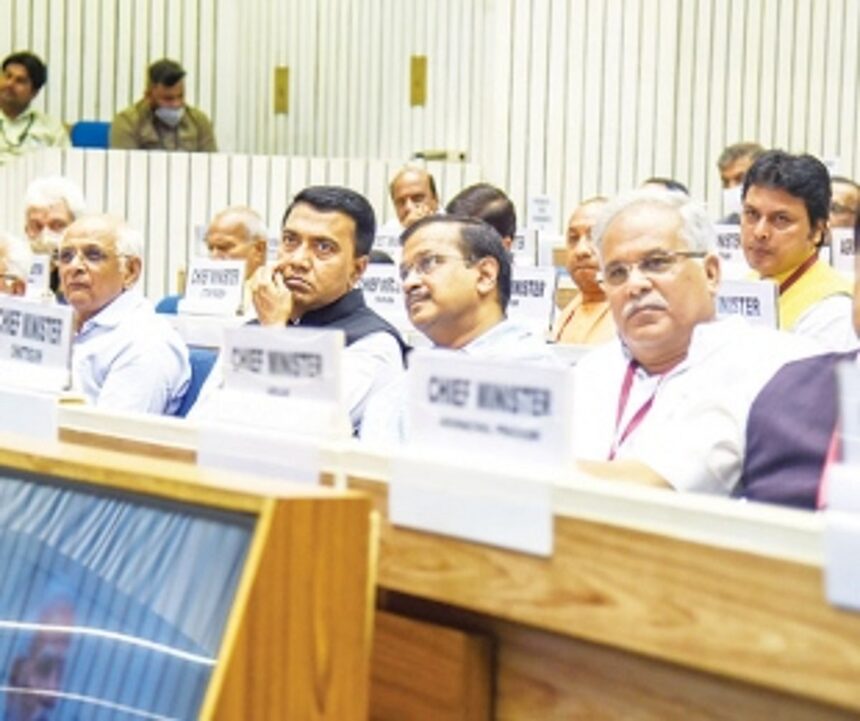
The remarks by Modi and the CJI against the backdrop of a debate over using regional language in judicial proceedings came in their speeches at the inaugural session of the joint conference of chief ministers and chief justices of high courts. The event held after a gap of six years also saw the CJI asserting one should be mindful of ‘Lakshman Rekha’ while discharging duty, noting the Constitution provides separation of power among the three organs of the state.
Modi appealed to chief ministers and chief justices of high courts to give priority to cases related to undertrial prisoners languishing in jails and release them, as per law, based on human sensitivities, adding judicial reform is not merely a policy matter. He also urged chief ministers to repeal outdated laws to make delivery of justice easier.
In his address, the CJI minced no words while terming governments as the “biggest litigants”, accounting for nearly 50 per cent of pending cases, and said the “docket explosion” is due to non-performance of various wings of the executive and the legislature not realising its full potential.
While dealing with the reasons for docket explosion, the CJI referred to a growing number of contempt cases arising out of defiance of judicial orders by the executive, and said that “deliberate inactions by governments, despite judicial pronouncements, are not good for the health of democracy”.
Modi said he had constituted a group to examine the possibility whether laws can be drafted in legal language as well as in terms easily understood by the common man.
“I have set up a group that is examining whether both versions can be passed by the assembly or parliament.”
He said it is in practice in various countries and both the formats are considered as legally acceptable.
“Even our scriptures state that justice is the basis of good governance. It is for this reason that justice should be linked to the people, it should be in the language. Unless the common man understands the basis of justice, for him there will be no difference between justice and executive order,” the prime minister said.
Modi told the assembled audience that as India celebrates the 75th anniversary of Independence, focus should be on creation of a judicial system where justice is easily available, is quick and for everyone.
On the issue of court proceedings, Modi said, “We need to encourage local languages in courts. This will not only increase the confidence of common citizens in the justice system but they will feel more connected to it.”
Before the prime minister spoke, the CJI said there was a need for the legal system to introduce local languages in courts.
Referring to the CJI’s remarks, Modi said newspapers have got a positive headline.
Justice Ramana said the practice of law before Constitutional courts should be based on one’s intelligence and understanding of law, and not mere proficiency in language.
“The judiciary, as well as every other institution of our democracy, must mirror the social and geographical diversity of the country. I am receiving many representations for introducing local languages in proceedings before high courts,” he said.
“I think the time has come now to revisit the demand and take it to a logical conclusion. The practice of law before Constitutional courts should be based on one’s intelligence and understanding of law and not mere proficiency in language.”