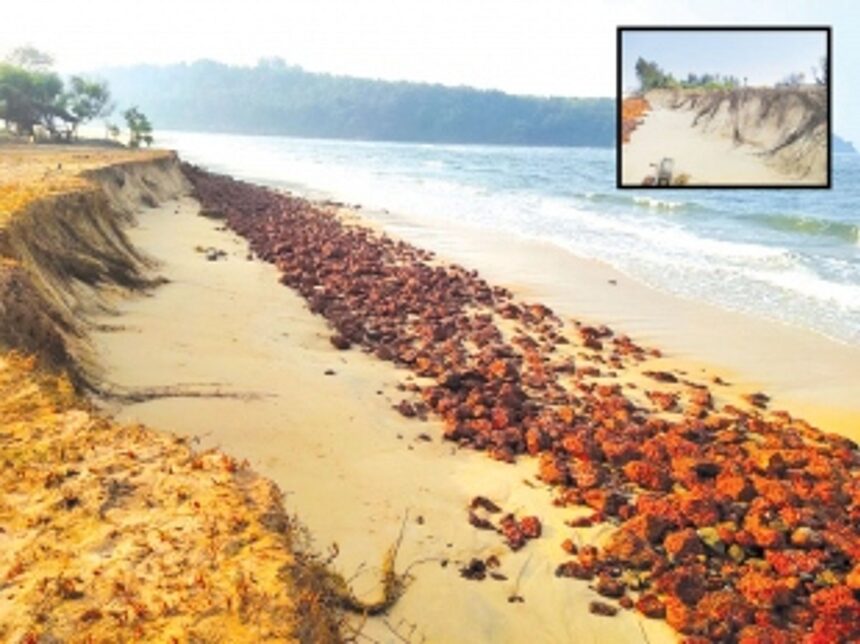
MARGAO: Coastal communities, especially the fishermen, have called on the authorities to assess the beaches of Salcete taluka, which have been ravaged by rampant sand erosion.
From a receding shoreline to the uprooting of trees that used to dot the beaches, there have been concerns that in the near future, damage would be irreversible.
While this issue was even raised in the Assembly, the State government has tied up with a Netherlands-based company called Deltares, to carry out a study to evaluate the causes of erosion on Goa’s beaches in relation to local wave-driven currents, storm/cyclone erosion, and discharge at river mouths.
Furthermore, under the aegis of the State’s Environment Department, the Goa Coastal and Environment Management Society will implement the ambitious project to rejuvenate the beach stretches from Majorda to Betalbatim in South Goa.
This pilot project involves the implementation of the innovative Sand Motor experiment, developed by Deltares.
The approach involves depositing an immense volume of sand extracted offshore along the coastline in a single operation, resulting in the creation of a strategically shaped peninsula. Over time, natural processes redistribute the sand, forming a buffer against sea level rise, storm surges and coastal flooding.
For the pan-Goa study to be carried out by Deltares, the Environment Department received a detailed proposal from the Dutch company, which will support local agencies in their studies on the local coastal morphology and their knowledge-basis for decision-making on mitigation measures.
Deltares will support the modelling of the morphological system via collaborative efforts with the aim of obtaining a quantification of the sediment transport rates.
A three-day visit has been planned to the area with two Deltares employees.
“We will assess the local situation from literature and in-house data. The aim is to provide a conceptual overview of the functioning of the local morphological system, create a joint understanding of the causes of erosion, confirm the approach and perform first capacity building on the relevant coastal processes. We can check the site characteristics and meet local authorities and stakeholders,” read the proposal.
“We will guide them with the setup of a wave model and support their coastal morphological analysis. We will provide capacity building on coastline modelling and follow this up, through email and video, for the assessment/modelling of the case study by the local agency. Depending on the capacities of the local agency, we will take up some of the technical tasks,” the proposal added.