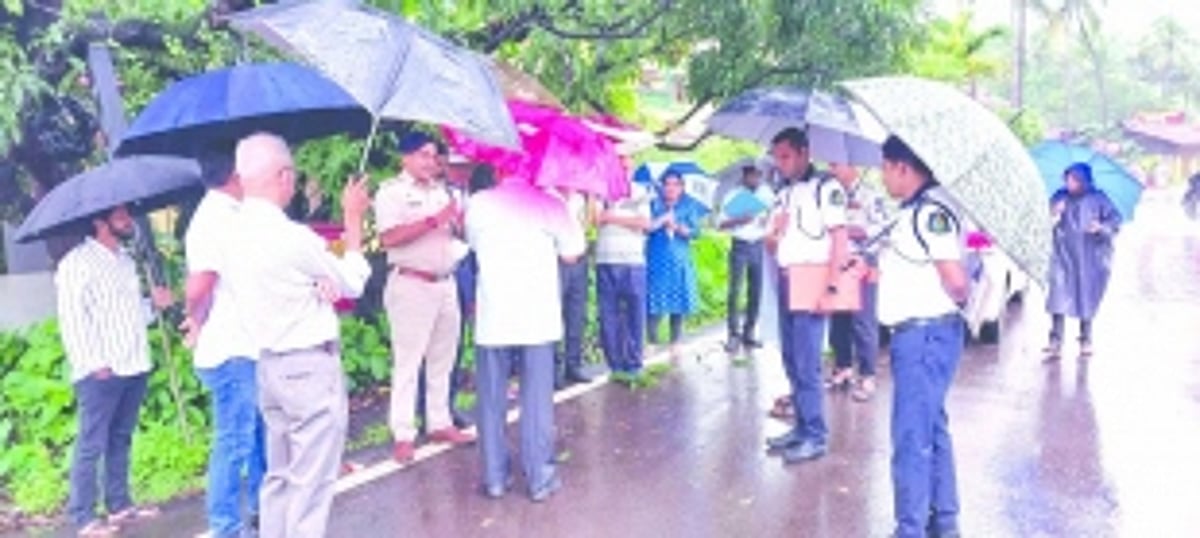
BENAULIM: Benaulim and Seraulim villagers experienced a sense of déjà vu during a joint inspection with authorities, as the Water Resources Department (WRD) once again recommended that the Western Bypass passing through Benaulim should be built on stilts to address the recurring flood-like situation during the monsoon.
The villagers recalled that a similar recommendation was made by the WRD last July during heavy rainfall. This time, WRD officials, along with representatives from the Public Works Department (PWD) and the Salcete Deputy Collector, confirmed the need for stilts after assessing the site, witnessing water catchments at full capacity, high tide conditions, and anticipating further rainfall.
Salcete Deputy Collector Uday Prabhudesai clarified that the WRD and PWD, as technical authorities, are responsible for officially submitting this recommendation in writing.
The WRD officials assured that all statements made during the inspection, including the views of the Deputy Collector, PWD’s Executive Engineer, and WRD’s Executive Engineer, will be documented to support the need for stilts in the area.
Benaulim MLA Venzy Viegas highlighted flaws in the WRD’s original study, which suggested that embankments could be used for the Western Bypass. Viegas criticized the use of incorrect data from the Rational and Ryve’s formulae, emphasizing that they did not reflect the ground reality.
Notably, the Benaulim panchayat has challenged the WRD’s study in the High Court. Sarpanch Xavier Pereira questioned how many times low lying areas like Tolleabundh need to flood, for the government to reconsider its decision.
Farmers, locals blast officials over water logging woes, blame faulty bypass plan
BENAULIM: Outraged farmers, fishermen, and residents in Benaulim and Seraulim cornered officials from the Water Resources Department (WRD), PWD, and the Salcete Deputy Collector, questioning them about the alleged ‘faulty’ construction of the Western Bypass, which has triggered severe water logging issues in their villages.
In an unexpected spectacle during the inspection, water sports operators from Benaulim zoomed across the submerged low-lying parts of Tolleabundh on jet skis, while fishermen measured water depth with sticks and equipment.
The Deputy Collector was briefed about the vulnerable settlements nearby, where residents faced the nightmare of evacuations due to water spillage onto roads and homes, reminiscent of last year’s ordeal. The Benaulim panchayat vowed to provide temporary shelter in the panchayat hall for those affected.
Meanwhile, furious farmers from Seraulim lashed out at the authorities, shocked by the damage to their fields despite the Western Bypass being built on stilts here.
Reiterating their demand for stilts instead of embankments in the Benaulim portion, blame was squarely placed on the government’s botched culverts and water management measures.
The Sarpanch exposed areas grappling with water logging, pinpointing the narrow size of recently installed culverts and raised heights of new bandharas near the wholesale fish market junction as the root cause, choking the natural water flow.
The WRD officials were also taken to task about new culverts installed near Tolleabandh, which weren’t in the original plan, when WRD had initially said no flooding would take place there.
Velsao locals aghast as fields inundated, blame RVNL for destroying storm drains
MARGAO: In response to numerous complaints filed by locals and farmers of Velsao regarding severe waterlogging in various parts of the village, a joint inspection involving Railway officials and the Velsao panchayat was conducted on Wednesday.
During the inspection, members of the Village Development Committee (VDC) emphasized that the obstruction of water flow has resulted in the accumulation of water in fields and low-lying areas. Farmers expressed their frustration, stating that they are unable to carry out essential agricultural activities, including transplanting, due to the flooded fields.
While the Railway officials attributed the situation to heavy rains and assured steps would be taken to address the issue, some villagers countered that they had never witnessed water levels reaching such heights before and speculated that the ongoing railway works may have contributed to the current scenario.
The villagers called for a thorough investigation into the problem, particularly concerning the natural flow of water throughout the village, once the rainfall subsides. Sarpanch Maria Diana Goveia stated that the purpose of the inspection was to raise objections and address the concerns voiced by the villagers. She also stressed the necessity of desilting work.
Subsequently, Goencho Ekvott (GE) blamed the destruction of longstanding stormwater drains.
“The recent inspection report by Goa Coastal Zone Management Authority (GCZMA) clearly stated that the mud and construction debris filled in the stormwater canals must be removed immediately before the monsoon. Have the Railways complied with the inspection report? Was a social impact assessment conducted for such a major railway project? The answer is no,” said Orville Dourado Rodrigues, of GE.