PANJIM: In a first-of-its-kind study conducted on the basis of isotope chemistry and satellite imagery by the CSIR-National Institute of Oceanography (NIO), Goa, scientists have found that the dust particles collected over the Arabian Sea due to dust storms, is enhancing its productivity and also the ocean in general.
“Dust particles carried by the wind over the deserts are an essential contributor of nutrients and trace metals to the microscopic surface-dwelling plants — the phytoplankton — in the global ocean, which in turn naturally helps in enhancing marine productivity and removes atmospheric carbon dioxide (CO2),” Director of CSIR-NIO Sunil Kumar Singh told O Heraldo.
According to him, the dust contains nutrients and micro-nutrients like iron, cobalt, zinc etc.
“CO2 gets converted into organic matter through photosynthesis for marine plants, which consume nutrients and micro-nutrients for metabolic reactions (biochemical reactions that maintain plant life). This will also help the economy of coastal States like Goa, since fish availability will increase,” NIO director said.
“If we do artificial dust fertilisation in the areas of the ocean devoid of micronutrients, then it will help in reducing the CO2 introduced in the atmosphere. This can have a direct bearing on the global warming scenario” Singh said.
The southern region of the Antarctic Ocean, which is around 30% of the global ocean, is called the desert of the ocean because it has low productivity. “Dust comes from land and doesn’t reach this region. Scientists are planning to do iron fertilisation through spraying tonnes of desert dust into the ocean to help increase productivity and carbon sequestration,” Singh said.
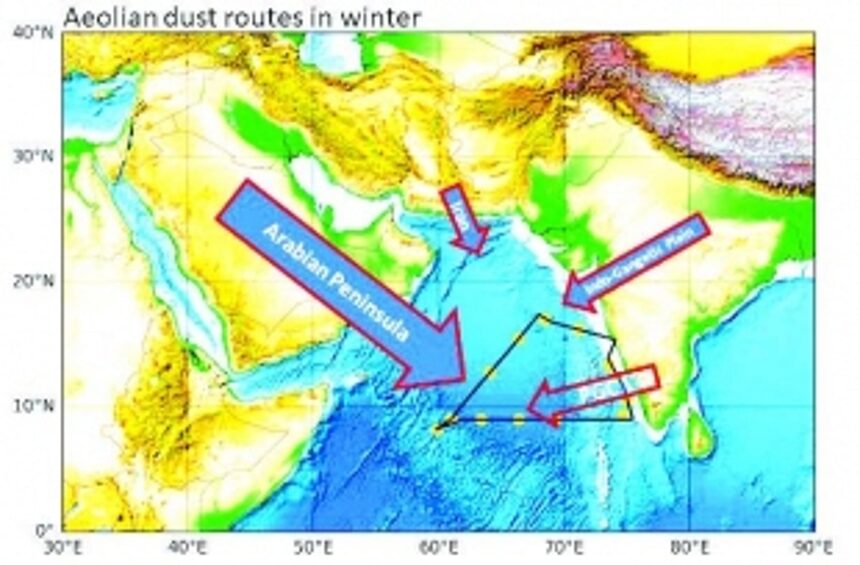
He said that despite its significance, the overall impact of dust deposition on the Arabian Sea is not well understood and the biogeochemical modellers often rely upon qualitative parameterisation of dust source regions — from Saudi Arabia, Iran to Thar Desert (in Rajasthan) — based on satellite remote sensing products.
“Although surrounded by several arid land masses, it was not clear which dust source is most likely contributing to mineral aerosols over the Arabian Sea during winter. It was during one of our expeditions onboard Research Vessel Sindhu Sadhana, as part of the Indian effort towards the GEOTRACES Programme that the NIO researchers encountered two specific dust storm events over the Arabian Sea, suggesting the dominance of dust from Middle East,” Singh said.