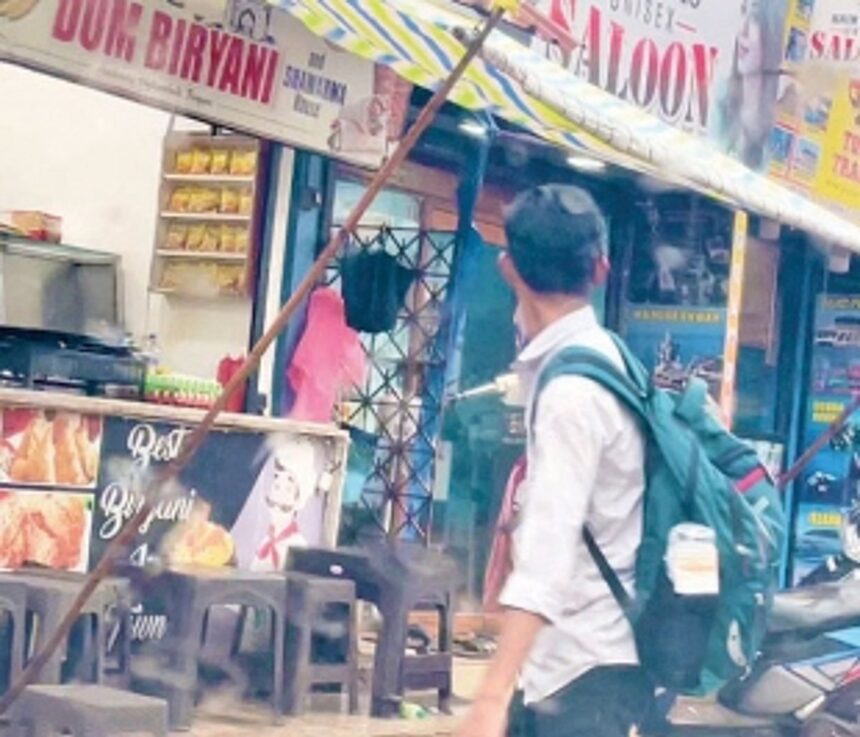
Calangute/Panjim: If rules are rules, do they apply only to Goan law-abiding established hotels and restaurants doing their business legally, and yet get harassed, and raided for the minutest of transgressions?
A the same time, new entrants from across the country have descended in droves, mainly in the concrete jungle that the tourist belt of Baga and Calangute are called, to “set up roadside and footpath grabbing eateries promising to bring Rajasthan to Assam, Kashmir to Kerala on a plate. The point is and ground reports and conversations have borne out, that a vast majority seem to be outside the universe of regulations and licenses.
Their names are a kaleidoscope of regions in the country and even outside like – Punjab, Nawab, Rajasthan, China Kailash Matrka Halwai Mumbai. And how do they get their confidence? Let’s find out
Over the past several days there were many complaints about the roadside eateries doing business without any permission, especially in Calangute. Today team Herald visited the area and took a stock of the situation. We also spoke to some restaurants and local Sarpanch to know whether they have all the permissions and if other restaurants are affected by the same.
There are eateries & food joints after every 20 steps. Early some locals & tourist took social media to criticise these number of joint and their quality. It was also learnt that most of these joints and eateries like dum biryani, quick snacks & quick food are run by non Goans.
When Team Herald approached nearly seven such joints asking them about their business and whether they have all the necessary permission, they retorted sharply “ we are doing our business and happy about this don’t question us, we are paying our rent & taxes”.
Interestingly the Calangute Sarpanch Shawn Martins did not seem to raise any red flags and actually said the equivalent of “All is well”:
“There are several eateries that are operating within the jurisdiction of the panchayat but there are no illegal joints operating, several homes & families who run their small carts along the designated spot are registered and have all the legal documents and permission” , Martins said
He may well be right, Goan families indeed would have taken all permissions as they are law-abiding. The issue is do all the tourist cum hotel owners setting up roadside joints with no visible signs of basic hygiene have even the mandatory hygiene test certificate, without mentioning all other licenses
Later, Team Herald met 3 restaurant owners and asked them about what they had to say about this.
The owner of arguably the most well-known traditional Goan shack in Baga said “Yes I agree there are several such eateries who have started their business, especially post Covid. Whoever wants to enjoy the best & quality authentic food and with good class will come over and have the best experience with us. I am not saying that their (roadside stalls) food is bad or unhealthy but it’s the people’s choice. We must accept the kind of tourist & people coming to Goa and especially to any restaurant”
That’s begs the question. Do Goans have to accept that some of these outsider run businesses get away with committing illegalities, while local restaurants have to keep on paying fees and taxes., whether or not they make money or not
Meanwhile, Benny D’Souza from Candolim another restaurant owner said there was a time when such food joints started operating just outside his restaurant. He was forced to call the authorities and seal their business.
He also added that he is not against such people, but they shouldn’t come and try to kill someone else’s business. One should respect and help each in what they do. When questioned about non Goans operating in go, he said “I don’t want to comment. if leaders are allowing this to happen, what can we do.
The Travel and Tourism Authority of Goa (TTAG) president Nilesh Shah said “ease of doing business is important. It should also make an effort in increasing awareness among those who want to open new places, about all rules and regulations” He remarked that street-side food has its uniqueness like in Mumbai, but everything is done in a defined and legal framework.
In Goa, regulations seem to be applicable only to sons of the soil and not on outsiders who say they are “happy to do their business”.