SHASHWAT GUPTA RAY
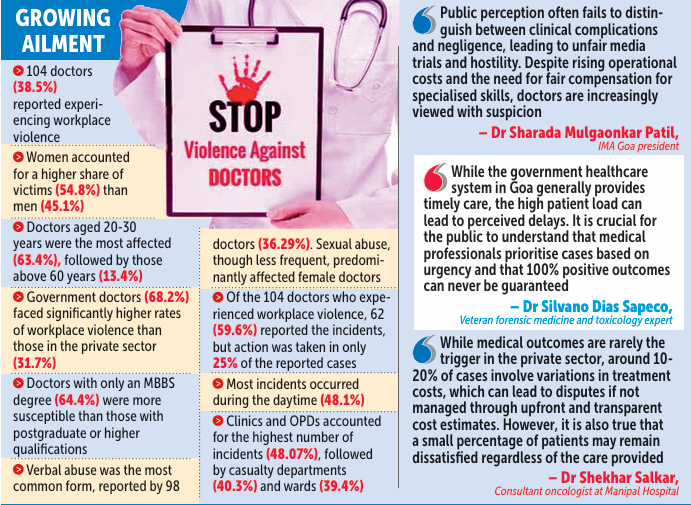
Historically, phy sicians enjoyed a near demi-god status, with pa tients placing unquestion ing trust in their medical decisions. But today, that bond has eroded drasti cally, with doctors increas ingly being subjected to physical and verbal abuse, largely due to growing mis trust between patients and doctors caused by commu nication gaps. According to a 2015 re port by the Indian Medical Association (IMA), 75% of doctors in India experience workplace violence at least once during their careers. More recently, a cross-sec tional study conducted by the Goa Medical Col lege and Hospital (GMCH) found that 38.5% of allo pathic doctors in Goa with a minimum qualification of an MBBS have experienced workplace violence. The study, titled ‘A Cross-sectional Study on Workplace Violence (WPV) against Doctors in Goa: A Growing Threat?’, was authored by Dr Jagadish A Cacodcar, Professor and Head of the Department of Community Medicine at GMCH, and Nadia Godinho, a postgraduate student in the department. Conducted in 2023, the study involved 270 allopathic doc tors who had been practising in Goa for at least one year.

It assessed the psychosocial impact of workplace violence and evaluated its influence on the quality of patient care. “The prevalence of WPV among doctors was 38.5%, with the highest occurrence in the 20-30 years age group (63.4%). Verbal abuse (36.2%) and threats (7.03%) were the most frequent forms of violence. Government-sector doctors (68.2%) faced a higher incidence of WPV compared to their private-sector counterparts,” the study stated. Half of the participants who experienced workplace vi olence reported a negative impact on their personal and mental well-being. Female doctors (54.8%) and those in the 20-30 age group (63.4%) were the most affected. Violence was more prevalent in the government sector (68.2%) and urban areas (64.4%) than in the private sec tor and rural areas. Doctors holding only an MBBS degree (64.4%) were more susceptible to workplace violence than those with higher qualifications. Verbal abuse was the most common form of violence (36.29%), followed by verbal threats (7.03%).
Physical vio lence, property damage and sexual abuse were each report ed by 2.2% of participants, with sexual abuse predominantly affecting female doctors. Nearly 30% of victims experienced multiple forms of violence. Most incidents occurred during the day (48.1%) and typ ically took place in clinics and OPDs (48.07%), followed by casualty departments (40.3%) and wards (39.4%). “However, nearly all respondents stated that WPV did not compromise the quality of care they provided to patients,” the study noted. Asked about the reasons behind this disturbing trend, IMA Goa president Dr Sharada Mulgaonkar Patil said the medical profession is facing a growing crisis of trust, fuelled by the disappearance of family physicians and the rise of misinformation on social media. “Public perception often fails to distinguish between clin ical complications and negligence, leading to unfair media trials and hostility. Despite rising operational costs and the need for fair compensation for specialised skills, doctors are increasingly viewed with suspicion,” Dr Patil said. While the profession has “a few rotten apples”, the entire medical community should not be judged by the actions of a few, she said. “In Goa, this intolerance is manifesting as verbal and physical abuse, particularly against resident doctors in gov ernment hospitals. These issues are further exacerbated by poor communication and political interference,” she said.
Dr Patil stressed the need to improve doctor-patient com munication at healthcare facilities. “We need to appoint PROs in public hospitals and enact stricter laws against workplace violence. Doctors must re main united, and society must recognise that doctors are human professionals. Keeping a ‘sword of Damocles’ hang ing over the profession only encourages defensive medicine, which ultimately harms patient care,” she said. Dr Silvano Dias Sapeco, a veteran forensic medicine and toxicology expert and former Head of the Department at GMC, said communication gaps between healthcare provid ers and patients’ relatives are a primary trigger for such un fortunate incidents. “While the government healthcare system in Goa gener ally provides timely care, the high patient load can lead to perceived delays. It is crucial for the public to understand that medical professionals prioritise cases based on urgency and that 100% positive outcomes can never be guaranteed,” Dr Sapeco said. He further said that private hospitals transferring criti cally ill patients to GMC at the terminal stage often leads to misplaced grievances against government doctors. “Strengthening the role of PROs and improving the flow of information to families could significantly reduce these mis understandings and prevent aggressive behaviour towards hospital staff and damage to hospital property,” he added.
Consultant oncologist at Manipal Hospital, Dr Shekhar Salkar, underscored the importance of communication and empathy while dealing with already stressed patients and their relatives. He said that, in private hospitals, friction is often caused by billing issues. “While medical outcomes are rarely the trigger in the pri vate sector, around 10-20% of cases involve variations in treatment costs, which can lead to disputes if not managed through upfront and transparent cost estimates. However, it is also true that a small percentage of patients may remain dissatisfied regardless of the care provided,” Dr Salkar said.