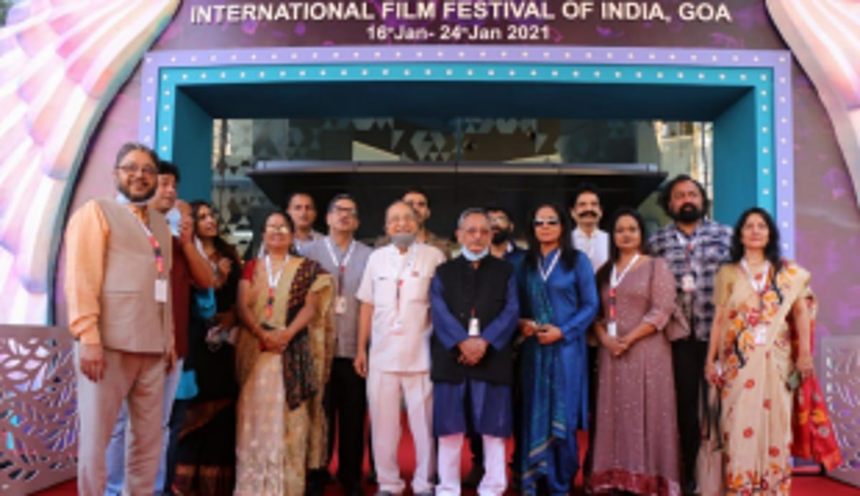
PANJIM: Insisting that documentaries are very important, Haobam Paban Kumar, chairperson of Non-Feature Films said there were very few documentaries and more short films and suggested to change the “Non-Feature Film” category to “Documentary and Short Films”.
He said 60-70 people were new filmmakers which is a good sign.
John Mathew, Chairperson of Indian Panorama section said the all films were selected unanimously without any dispute.
When asked about choosing “Saand Ki Aankh” as the opening film of the Indian Panorama, the jury members said the film had a number of aspects which touched the heart of the jury. The members appreciated the music, cinematography, editing and also the script. In addition, the film is set in the backdrop of a village, where women are restricted, who eventually broke all barriers to achieve big in life.
Ankit Kothari and his wife Shreya Kapadia’s Gujarati film “Paanchika” was the opening film in the Non-Feature Film section.
Speaking to the Herald, he said, “The 14-minute film hits hard at caste-based separation. The film is about a game of five pebbles and the two girls were selected after auditioning 200 girls. Shot over 20 days, the film was adapted from a short story from the 1950s by Marathi writer Vyankatesh Madgulkar into his own language and landscape, that is, Gujarat and the Rann of Kutch.”
He said, “I am telling a story of friendship in my world in an interesting way”.
On working with child actors, he said, “There were no incapable children, but only incapable directors. On the set, I played a bad cop, while Shreya provided them with chocolates and refreshments after a good shot to inspire them.”
Tushar Hiranandani, director of ‘Saandh Ki Aankh’ said his movie was an inspiring tale and it highlighted the fact that one could achieve much even at 60 years when most people give up.
He said he wanted to tell this story on a socially significant issue in a fun way, rather than sounding preachy.
He intended to focus on making biopics since there were so many hidden stories that needed to be told.
He said the real-life characters of the film, Chandro and Prakashi were not even known in their town of Meerut.
Later, Dritiman Chatterjee, who was part of many Satyajit Ray’s films, was present as a retrospective and commenced highlighting the works of the master.
Five of the movies namely “Charulata”, “Ghare Baire”, “Pather Panchali”, “Shatranj Ke Khiladi” and “Sonar Kella” will be screened.
He said, “Three aspects stand out about Satyajit Ray’s films. One, he was a master of all crafts. Secondly, was his simplicity, meaning he never had huge budgets to work with and hence he had to use whatever money he had to make world-class films. And last, his ability to look at human and political situations with a lot of simplicity and grace.”
On “Pather Panchali”, he said, “The film you are going to watch is more than 60 years old, but you will still find it is as contemporary and relevant as ever. The other films, you’ll find a common trend that irrespective of the time these films were made, how contemporary these films are.”