Elsa Angel Rose
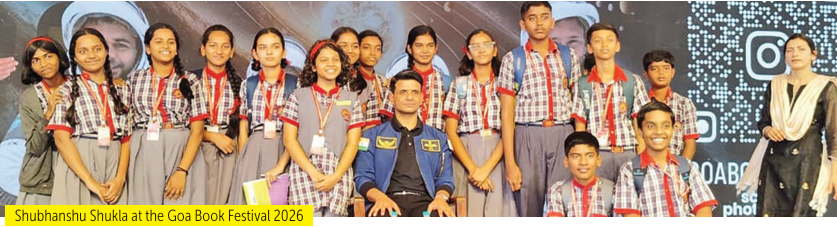
My advice would be first to dream that the sky is not the limit. Now go beyond, have a much bigger dream, and then once you have that, the idea would be to never stop trying, never give up. That is what my message is,” the first Indian astronaut to land on International Space Station (ISS), Shubhanshu Shukla shared. The Indian Air Force group captain reached Goa to speak at the first edition of the Goa Book Festival 2026, organised by the Ministry of Education, National Book Trust of India, and Lokmanya Cultural Foundation. He spoke extensively about his life in space, the future of India’s space programme, challenges, discipline, and life beyond Earth in his session, “When dreams defy gravity”, moderated by Yuvraj Malik, Director of National Book Trust, India. Not just young minds, but anyone with a dream should aim for the highest point possible and understand that even the sky is not the limit. The astronaut shared, “There can be 10-20 different ways of how you reach there, but the core principle, the bottom line is you will navigate failures, you will navigate setbacks, irrespective of that, you have to keep moving until the time you get there.” Being the first Indian astronaut to visit the International Space Station (ISS) as part of the historic AXIOM-4 mission and the second Indian to have gone to space, he has bright hopes for the future of Indian space progress. When asked about the diverse learnings from his 18-day Odyssey at the orbit, which can be implemented in India, or could be adopted in our country, he replied, “All the science that we did in my mission was created or curated with an aim that we want to do human space flight missions in the future, long-duration space flight missions. So all these scientific experiments were with that thought process.” He keenly stated that his team have conducted scientific experiments, has relevant data and that scientists are evaluating the same. Shubhanshu added, “The process takes time. Soon enough, we will see papers coming out based on this research that we have done. But more than that, I would say that the learning that has been there for us has been to learn the ecosystem of how you enable science in space. That is, in itself, a huge field.” A two per cent rise in the allocation for the Department of Space in the recently tabled Union Budget reflected strong leadership backing for India’s space ambitions. Regarding the same, the astronaut shared, “So we are going to set up the processes in place because we want to have these mechanisms in place when our space station goes up, because we also want to have access to it.” In his which address to an audience of over 1200 school students, the captain brought the life in space closer to the children. He spoke openly about the sheer physical toll of launch, reflecting on the mental challenge of being separated from his family. The astronaut said, “I am very happy to come to Goa. There were almost over 1000 kids who were there interacting with me, and it was just a super fascinating experience. Astronomy is a science that inherently has the capability of exciting and generating curiosity in kids.” He also recounted several memorable experiences from space, from improvising a game of basketball in zero gravity by using a fellow astronaut in place of a ball, to walking along the ceiling, and accidentally dropping his laptop after returning to Earth because he briefly forgot that gravity was back. Turning to India’s growing space programme, he spoke about the ‘Gaganyaan’ mission and the vision for an indigenous space station. In his closing remarks, Group Captain Shukla called upon students to work towards India’s ambitions in space, reminding them that discipline and courage can turn dreams into forces that overcome gravity.