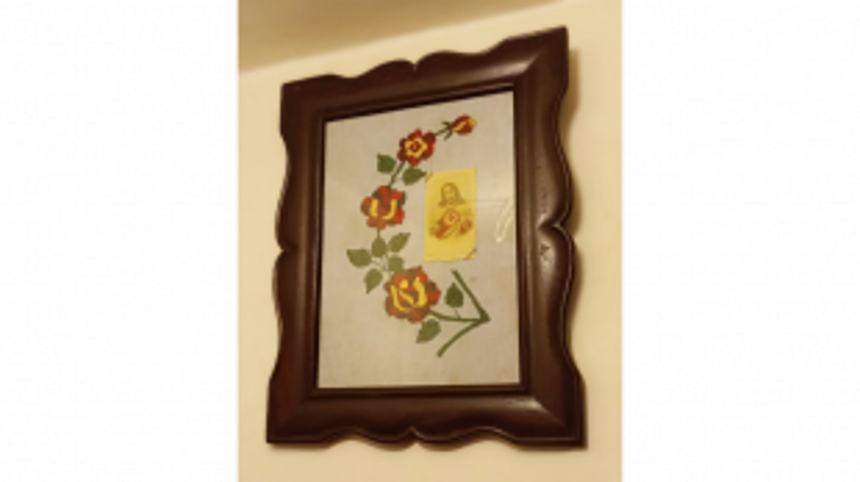
The devotion to the Sacred Heart began in the 1670s, when Jesus appeared multiple times to St. Margaret Mary Alacoque, a Visitation nun in France. Through these visions, He told her how He wished to be honored with the symbol of His heart, asking for the faithful to make amends for any wrongdoing they had done, frequently receive Communion and observe the Holy Hour. In 1856, the devotion was added to the church calendar by Pope Pius IX.
In the Late19th Century and the beginning of the 20th century Goa, several households took to consecrating their homes to the Sacred heart of Jesus. When this was done, ‘a Painel do Sagrado Coração de Jesus’ (a panel showing a representation of Sacred Heart of Jesus) or a Quadro do Sagrado Coração de Jesus (a frame with a picture of the sacred Heart of Jesus) was installed in a prominent location within the house. The space where the frame was put up, may or may not have been in the same room as that of the family oratory. Here, the family annually sings the Ladainha do Sagrado Coração de Jesus, commemorating the day, the house was consecrated to it. This day is referred to as the ‘Dia de Consagração’ and was generally the feast day of the Sacred Heart. Sadly, owing to various reasons, today’s times have witnessed the discontinuation of this lovely tradition in many Goan homes.
Back in the day, stitching, in addition to embroidery (bordação), crochet and other works associated with the needle and thread was a compulsory skill every Kshatriya and Brahmin spinster had to master. Among Shudras, stitching was rare. At the time of the wedding proposal, the girl being proposed was asked to present her ‘amostra da bordação’ (a square or a rectangular piece of cloth of about 1.5-meter width, on which the young girl had learnt the different types of stitches and embroideries, which were taught to her during her embroidery classes), to the groom’s family. The groom’s family would then choose a random embroidery style from the sample cloth presented. The ‘bride to be’ would then be asked to make decorative wall hanging on cloth, bearing a portrait of the Sacred Heart of Jesus/ The Immaculate heart of Mary or simply a floral decorative design. The piece was entirely made using the type of stitches/embroidery styles requested by the groom’s family. The completed wall hanging was then framed and presented to the groom by the bride as part of her wedding trousseau. The groom’s family would evaluate it and, in this manner, judge the young girl on her stitching and embroidering skills.