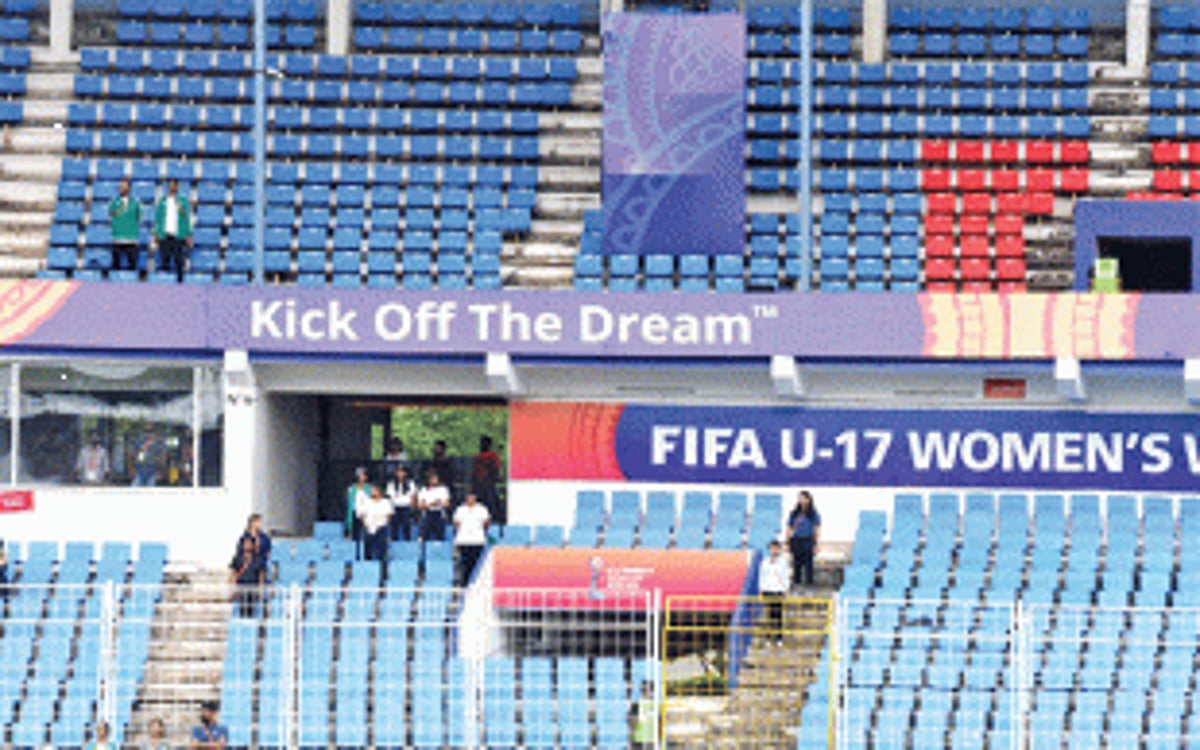
MARGAO: The State government promised attendance of at least 6,000 per match at the Pandit Jawaharlal Nehru Stadium, Fatorda, a venue of the FIFA U-17 Women’s World Cup jointly hosted by Bhubaneswar and Navi Mumbai.
That figure would comprise school children, the government said, who would be transported to the venue thereby ensuring the event the support and atmosphere it deserves.
However, a week into the event in Goa which hosts Group B and D of the 16-nation event, the stadium, capacity of 16,000, makes for a depressing sight at matches held so far.
The average attendance hovers around a mere 3,500 and, as the young players give it their all with nifty skills and boundless energy, the background reveals large empty stands.
This is a far cry from a FIFA event which normally conjures up images of crowds milling at the gates, traffic snarls en route to the venue, and stadium staff and security hard-pressed to control enthusiastic fans eager to get inside and watch the action unfold.
So why haven’t the crowds turned up? What of the government’s grand plan of drawing children to the stadium?
Ajay Gaude, Director of Sports and Youth Affairs, said, “Under the stadium-filling program, the focus was on getting kids from various schools from all over the State.”
“Transportation to and fro would be provided free of cost by the government and it was made very clear that this effort wasn’t for the general public,” he said.
“School children would be given wristbands to wear while entering the stadium,” he added.
“We also made it clear that for matches on October 11, 12, 14, 15, and 18, one would not see school children at the venue because of examinations.”
However, he assured, “I have already confirmed that schools like Cujira Educational Complex is bringing in 6,000 students for the 4.30 pm match after October 18.”
Going by Gaude’s assurance, there would be three remaining match days after that – October 21, 22 and 26 (two quarterfinals and both semi-finals) – on which there would be increased attendance.
Ticket purchases, according to Gaude, can be made easily. Bookmyshow.com is the official body from which fans may book tickets for the matches.
“Tickets are nominally priced at Rs 99 and Rs 199 each and may be purchased online or offline at the venue,” Gaude said.
For all that, fans have stayed away, lending credence to the fact that the event hasn’t been adequately promoted and publicised.
Carnivals were held at various locations in the State, hoardings were erected and various displays depicting young female footballers were installed as well. However, it still hasn’t appeared to catch the fancy of football lovers.
Bruno Coutinho, former international and Arjuna awardee, said, “In my days, I loved playing in front of a large crowd. Any player would. Here, it’s school exams that have been the main reason for the poor attendance at the stadium.”
Point accepted. But what about the multitude of fans apart from schoolchildren? After all, football was declared the State Sport during the tenure of the late CM Manohar Parrikar and boasts of a legacy matched by few others in the country.
For Goans working in the corporate sector, reasons were quite varied when asked why they were not making it to the stands to cheer the girls on the pitch.
Kevin Fernandes said he would consider going for the matches but the timing was just not right for him.
He said, “I work in a 9-5 job but am usually done with work by 7 pm. It’s not possible to make it to the stadium for the 8 o clock kick-off. I work in Ponda and you can imagine the time it would take to reach the stadium. I love football and have watched ISL matches there but I can’t make it for this event.”
Alan (name changed) was blunt in his reaction. He said, “Schoolgirls are not interested in going over to watch the matches. People are not interested in watching girls play football. Remember, even the 2017 FIFA U-17 Men’s World Cup evoked poor response. If there was a senior match with noted players, there would be a crowd but not for this.”
He went on to say that football attendance dropped the day Bruno Coutinho retired. “We are different here in Goa. We need personalities in the team. Can you give me one name that stands out in this World Cup?” Alan said.
Then there were those like Cruz Sequeira who attended the first game and intend to watch the quarterfinals and semi-finals. He said, “I watched the first match and want to watch more. I however feel the advertising should have been much more aggressive. Look at the ISL which goes along with posters, hoardings, and ads on television… there’s nothing much here. The charm of a World Cup is missing.”
“Besides, it would have been better if the matches were held at 5 pm and 7.30pm. Going home at 10 pm can be quite tedious.”
The talented players on the pitch are giving it their all. Teams and coaches are looking to the higher age group, and full internationals that these youngsters, not quite adults, aspire to play.
The loss, then, is that of fans in Goa who prefer to stay away from the action, which casts aspersions on the celebrated status of football being the “State Sport.”
Maybe, just maybe, this week may just about restoring Goan fans’ faith in the Beautiful Game, starting with the presence of stands full of cheering schoolchildren at the iconic stadium.
Meanwhile, Sports Minister Govind Gaude on Sunday attributed the low turnout at the U-17 Women’s World Cup to the ongoing examinations and exuded confidence of drawing a good number of football enthusiasts for the remaining four games.
When asked about the reasons for poor attendance for the matches played at Fatorda Stadium despite government taking various measures to draw huge crowd mostly students for these games, Gaude said, “Students are busy answering their first unit test exams and it’s not possible for them to watch matches. The exams are ending on Monday and we expect good attendance from Tuesday onwards. We have also devised a strategy for course correction.”
According to Gaude, FIFA has allotted passes to the Department of Sports and Youth Affairs but the latter has to follow its rules and regulations. “We have been allotted 5,064 passes out of which 2,000 passes have been given to Goa Football Association (GFA). We are trying our best to distribute these passes judiciously. A pass holder is entitled to watch two games per day,” he said adding that preference is given to schools from Salcete, where football has a strong following.