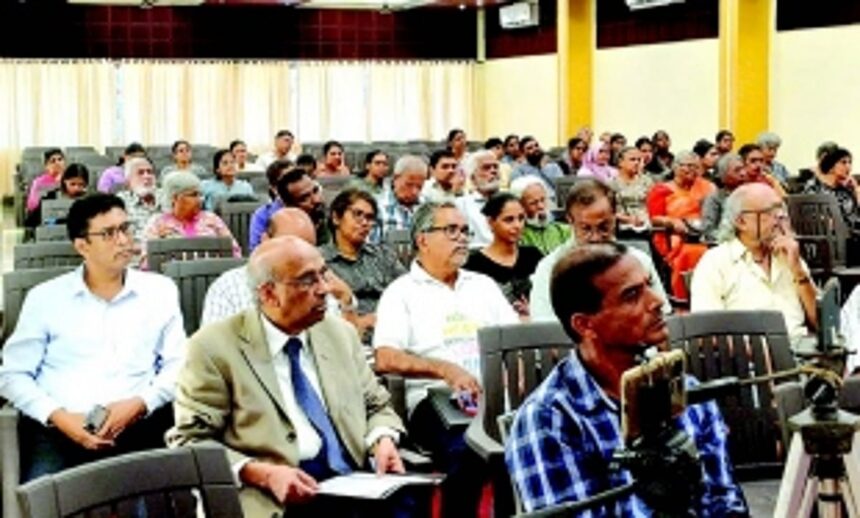
MARGAO: Any kind of damage to the environment has a direct bearing on the lives of women and hence proper mitigation measures are needed to address this issue, experts said at an environmental symposium organised by the Goyche Fudle Pilge Khatir (GFPK).
The symposium was held at the Padre Conceicao Engineering College (PCCE), Verna on Saturday, February 17, to showcase the doctoral dissertation of Dr Shweta Dilip Singh Sinha, PhD, Multisector Communication, St John’s University, New York.
The study examined various Bourdieusian juridical practices including acts of symbolic violence committed in the process of ‘naming’ or ‘defining’ environmental toponyms, such as, ‘forest’, ‘CRZ’, ‘wildlife sanctuary’, ‘national park’ and ‘ESZ’ in Goa. The study further used an “eco-feminist lens” to examine the gendered nature of India’s environmental laws and practices.
The research explored environmental issues in Goa as disproportionately impacting the feminine gender. Mining, tourism and infrastructure development were the contexts undertaken in the analysis of 17 case judgements, where Goa Foundation (GF) was the common petitioner.
The experts observed that wherever the environment is affected, the feminine gender is affected differentially and disproportionately. In this regard, there should be a conscious effort to acknowledge these disproportional impacts and thereafter to adopt equitable measures to mitigate the upset.
Dr Basilio Monteiro, St John University, New York, who guided Dr Sinha’s
doctoral work, provided the opening remarks at
the event.
Adding to Dr Sinha’s talk, Adv (Dr) Albertina Almeida provided on ground examples of how environmental cases in Goa tend to overlook the gendered aspect and the ways in which marginalised women in Goa tend to be at the forefront of fighting for environmental justice.
Goa Foundation Director, Dr Claude Alvares was the chief guest and provided his views on the legal system in the context of Goa Foundation’s experience within the field, and expressed that the Courts in India have to have a higher representation of women judges, which is not the case presently.
Architect Elsa Fernandes provided the closing remarks on the research being a guiding light for dealing with the environmental issues in Goa and expressed the need for equitable corrective approach. V M Salgaoncar College of Law, were the co-organisers for the event.
“GFPK acknowledges the need for environmental protection in view of safeguarding the future generations and especially the women, who are the health anchors of future life,” said GFPK President Jack Mascarenhas.