PANJIM: The students of BITS Pilani, in Goa, have lent a hand, for the armless to do wonders with their feet.
They have developed a life-changing innovation in a foot-operated page-turning machine developed by the students of BITS Pilani Goa Campus, inspired by the difficulties faced by leprosy patients in reading books.
It is an arduous task to turn the pages of books while reading them without having arms. To enable such people to read the books without much difficulty, the students of BITS Pilani Goa campus have developed the prototype of a foot-operated machine that can turn the pages, without needing hands.
“There are hundreds of physically challenged persons who don’t have both arms. It is extremely difficult for them to read books as they struggle to turn the pages. To resolve this problem, my students have developed the model of a foot-operated page-turning machine. The inspiration to develop such a machine came after visiting a leprosy centre,” Prof Pravin Singru, Professor at the Department of Mechanical Engineering, BITS Pilani Goa told Herald.
During the visit to the leprosy centre, the students saw that while patients were interested in reading books but unable to turn the pages since they were crippled in their hands.
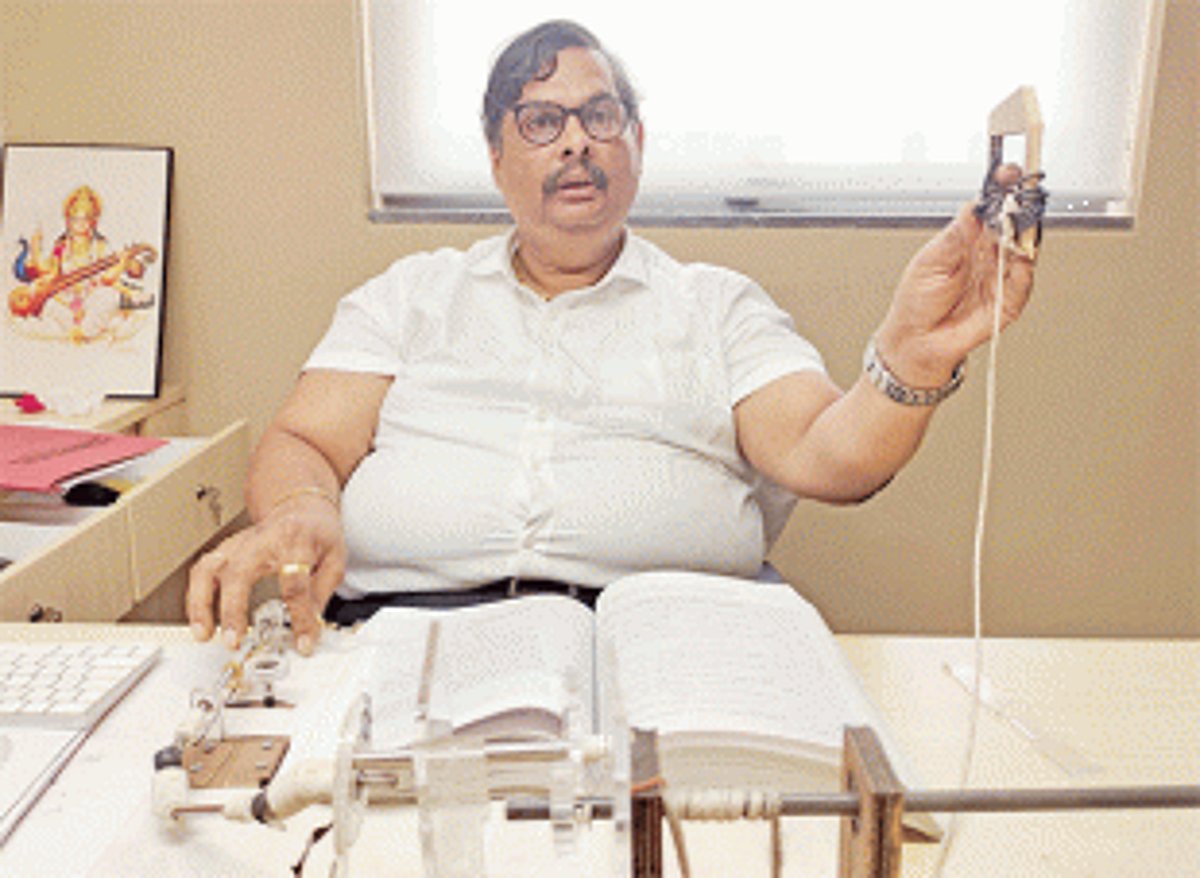
“These patients had lost their fingers due to the disease. After their summer term was over, these students asked if we could do something for these patients. As I agreed, these students started designing the machine. The motion is very simple. One needs to just operate the machine with the help of your foot, like a sewing machine,” Prof Singru said.
“This is a three-dimensional mechanism which is used to turn the pages. Now, the beauty of this mechanism is it can adjust to the height of the book having 300-500 pages. When the feet are lowered down, the linear motion gets transmitted through a set of gears and that gets converted into rotary motion. It is a portable machine that can be placed on any table. There is a lever, which is attached to a thread and spring. So, when we lower the lever, the thread transmits the motion through the backup spring to a gear pair,” the Mechanical Engineering professor said
“This motion then gets converted through a series of rack and pinion arrangements and then passes on the motion to another lever in a circular motion in the form of an arc. We mimic the human finger movement. This leads to the movement of the page. The drawback of this technique is you can’t push back a page. It can only take you forward,” he said.
“The aim now is to develop a fully functional model, which would be tested by the leprosy patients and depending upon their feedback, the final product will be made with necessary modifications,” he added.