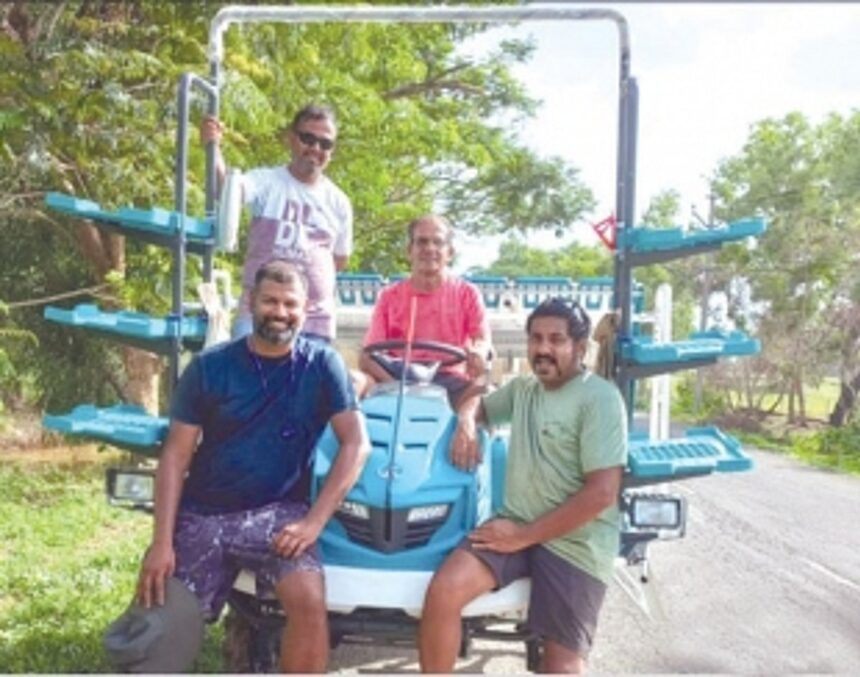
PANJIM: In the lush fields of Goa, three professionals, Kenneth Lopes, Neville Lewis, and Stanley Fernandes, have embarked on an extraordinary journey that is transforming traditional farming practices and redefining their own life paths.
The former aircraft engineer, geologist and telecom professional left their lucrative careers behind to establish ‘Goencho Xetkar’, to offer traditional farmers end-to-end mechanised farming solutions.
The story began during the challenging times of the Covid-19 pandemic when these three friends, driven by their individual dreams and a shared passion for farming, decided to foray into agriculture. Neville, who worked on an MNC’s oil rig in Australia, was grounded at home. “Work had come to a standstill. Agriculture has always been the dream, as I have fond memories of my grandmother taking me to the fields as a little boy,” he reminisces. He first attempted manual farming on a leased field in Aldona. “This was in 2020, we did everything manually-tilled the soil, sowed the seeds- it was back-breaking. Then, in August, we had a deluge that destroyed the crop, forcing us to start all over again, leading to significant losses,” says Kenneth. This setback however prompted them to explore a modern and efficient alternative – mechanised farming.
In their quest to learn the ropes of mechanised farming, they sought guidance from the ‘Paddy Priest of Goa’, Fr George Quadros, who has single-handedly inspired a new crop of young farmers’ intent on ‘Regreening Goa’. Initially sceptical, Fr George was taken aback by the determination of these city boys to learn and contribute to farming. “He thought the hard work and long hours would put us off, he really put us through the grind,” laughs Kenneth. Impressed by their dedication, Fr Quadros mentored them, and they spent two seasons working in the fields of Raia alongside him, gaining valuable insights and expertise.
Kenneth used to be an aircraft engineer and has worked with Jet Airways and Air India, while Stanley Fernandes was the Area Manager for Vodafone, combined their technical knowledge and work ethic to complement Neville’s farming vision.
“Mechanised farming brings a plethora of benefits to the farmers. Not only does it reduce labour and time required for cultivation, but it also resulted in higher yields and halved the farmer’s costs,” says Stanley, adding that from a single transplanter machine in 2021, the trio has now purchased service vehicles, an electric rickshaw to minimise their carbon footprint, a harvester and even an aerial agri drone to spray fertiliser and also protect the precious grain from pests, enabling Goencho Xetkar to offer the farmer a complete range of services from tilling to harvesting. “We grow whatever the farmer wants to grow- it’s usually Jaya or Jyothi rice varieties, but we have also transplanted the salt-resistant Goa Dhaan rice as well as Black Rice and Karjat,” says Stanley.
“It takes a lot of burden off traditional farmers, who we still see doubled over in their fields, or watching their crops all day, banging thaalis. In their sunset years, many of them have bent backs,” Kenneth points out. The trio points out that farmers can afford to outsource their work to companies like theirs thanks to the 50% subsidy provided by the Agriculture Department. “If the farmers’ cost is around Rs 3.50 per square metre for transplantation, the government pays Rs 1.75,” explains Kenneth.
The goal, they say, is to bring abandoned fields back to life, ensuring food security for the region and leaving something behind for future generations to enjoy. “Nine million people around the world die of starvation every year- 25,000 people die each day, because they do not have access to food. Farming fallow land and helping struggling farmers grow more food is our attempt to reduce these figures,” they add.
Their sudden shift from well-paying corporate jobs to farming, often an unpredictable avenue, did worry their families. “Yes, not just our relatives, many people thought we were bonkers to do this. But just being well-educated and well-employed wasn’t enough for us. Even with talent and hard work and technical know-how, you need something to drive you, to fuel determination. This ingredient, for us, is our innate passion for farming,” explains Kenneth.