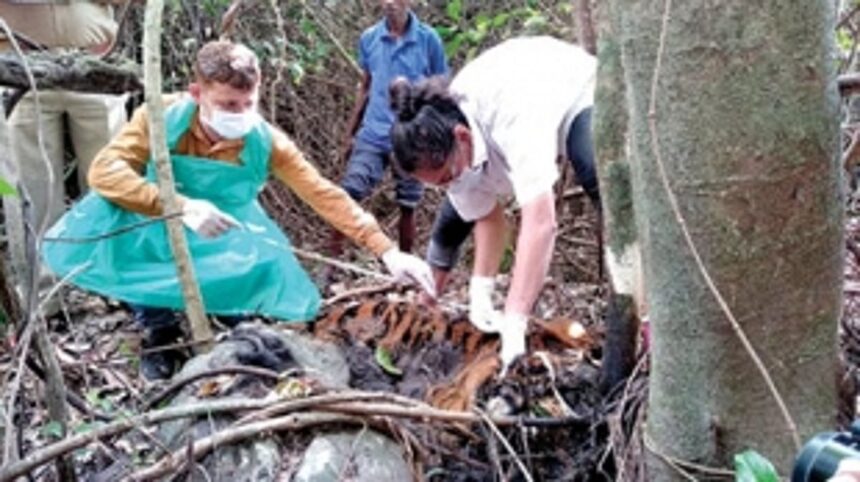
* The first tiger death was reported by villagers of Golaulim, who had gone inside the sanctuary for offering prayers for the folk deity. If not for these villagers, probably the death of first tiger (Tiger 1) would not have been known
* Based on the confession statements of accused, circumstantial evidence and materials seized so far, it is suspected that the death of all the four tigers might have happened due to consumption of poisoned meat from buffalo carcass. Further, it is also suspected that the buffalo carcass was poisoned by the accused for taking revenge against the loss of milking buffalo cow
* The unfortunate death of four tigers has also revealed that not all is well with the management of Mhadei Wildlife Sanctuary (WLS). According to wildlife activists who prefer to be anonymous, presence of tigers inside Mhadei WLS is a well known and documented fact which is reluctantly accepted by the Goa Forest Department. They allege that over the years, the Forest Department has not taken any serious and sincere steps for protection and conservation of tigers
* The team during the field visit observed that there exists no proper protection mechanism inside the sanctuary like network of well connected Anti-Poaching Camps (APC) at strategic locations manned by Forest Guard/ Watchers round the clock and year, which is a very common feature of well managed PA (Protected Area)/Tiger Reserve. As per the information provided to the team, there are only four camps at Codal, Nagargoa, Valpoi and Caranzol for a sanctuary spread over an area of more than 200 sq km!
* In the absence of any organized APC network and regular patrolling, It is highly possible that tigers, their prey base and other flora, fauna might be subjected to varying degrees of poaching pressure but there is no way to know unless a good protection and information network is put in place
* The wireless communication network, a basic and an important requirement for exchanging information inside a PA was found to be lacking in the sanctuary. For example, there is wireless room at Valpoi but without any wireless equipment in it! No wireless network in place timely exchange of information becomes very difficult
* Unfortunately even after more than two decade of declaring Mhadei as Wildlife Sanctuary; it is managed on completely ad-hoc basis as there exists no management plan for such an important sanctuary of Western Ghat. It gives an impression that wildlife management appears to be a subject which is of least priority for the Goa Forest Department
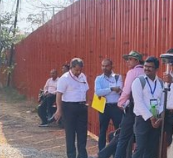
* While visiting the tiger carcass locations inside the sanctuary, near Dhangarwadi the team came across a patch of forest whose undergrowth was cleared by somebody probably for establishing cashew nut plantation. When the team asked the DCF (Deputy Conservator of Forests) about undergrowth clearing, he had no idea about who had cleared the land and whether it was inside the sanctuary or outside
* Though Working Plan division has prepared the GIS shape file of the sanctuary but it appears that no systematic and sincere efforts have been made on the ground for delineating the boundary of the sanctuary
* According to news reports, villagers (particularly from Dhangar- Gouly community) allege that there have been several instances of cattle depredation by the tigers/ leopards in the past but hardly any compensation was given by the Forest Department officials oraction is taken. There appears to be some truth in these allegations because when the team had asked sanctuary officials to furnish the details of livestock depredation of last 3 years, the officials replied that there were no incidents of livestock depredation
* Though the State government has put in place a mechanism to compensate people for loss suffered on account of wild animals, the local communities feel that the procedure is very cumbersome
* Therefore, if a villager living inside the sanctuary loses his cattle to depredation by tiger/ leopard, he may have to wait for a minimum of 90-100 days to receive the compensation
* With respect to monitoring initiatives taken so far, it appears that no systematic efforts have been made so far by the State Forest Department for estimating the tiger population size of the sanctuary using camera trap based monitoring protocols. As part of recently concluded All India Tiger Estimation (AITE)– 2018, the Goa Forest Department had carried out sign survey activities (phase I) in the month of May, 2018 and the summary report ‘Status of Tigers in India – 2018’ released last year by Prime Minister of India, puts the tiger population size of Goa at ‘3’ individuals. Considering the fact that only opportunistic camera trapping was done by the Forest Department inside the sanctuary without following a properly designed survey protocol, it is highly possible that the projected tiger population size of Goa may be an understatement
* According to Status of Tigers in India, 2014 report, Goa has a persistent tiger presence with a conservative estimate of 3-5 tigers but possess high potential to serve as home for breeding tigers. The said report recommended that the Protected Areas of Goa along with protected forests of Karnataka should be brought under Tiger Reserve network at the earliest for facilitating tiger recovery and for conserving the rich biodiversity of this biodiversity hot-spot which will also enhance the value of Western Ghats as a World Heritage Site
* The latest proof regarding connectivity of tiger populations in the Western Ghat is that of a tiger photo capture obtained on January 11, 2020 in a camera trap installed at Derodem, Goa after the tiger had killed a cow of a farmer. Upon comparison of the tiger picture obtained at Derodem with that of the tiger photo-database of Tiger cell, Karnataka Forest Department, it was observed that the image was that of 6-7 year male tiger from neighbouring Kali Tiger Reserve. The said tiger was first captured in Kali Tiger Reserve in 2016. Without up-grading the legal status of Goa’s Protected Areas to that of tiger reserve and putting in place a strong protection regime in place, the state may become death trap for tigers dispersing in this landscape.
* The issue of declaring Mhadei Wildlife Sanctuary as a ‘Tiger Reserve’ is a long pending one with central government initiating steps way back in the year 2012 by requesting the Goa state for submission of proposal. As per the news reports, on October 12, 2016, the Goa State Board for Wildlife had a serious discussion on the issue of bringing all the protected areas of state into tiger reserve network
* In a recent study conducted by ‘Vermaet al 2017’, an attempt was made to estimate the economic valuation of tiger reserves for various ecosystem services such as employment generation, agriculture, fishing, fuel wood, fodder/grazing, timber, Non Wood Forest Produce (NWFP), gene pool protection, carbon storage, water provisioning, water purification, recreation, research & education, waste assimilation etc. For this study, the selected tiger reserves were Corbett, Kanha, Kaziranga, Periyar, Ranthambore and Sundarbans. The findings indicate that the annual flow of benefits derived from tiger reserves range from 128 million to 271 million USD. Contrary to the claims of certain vested interests that declaration of tiger reserves will stall the development of the state, this economic evaluation study by NTCA and Indian Institute of Forest Management (IIFM) clearly establishes that tiger reserves make significant contribution to the state economy by providing various ecosystem services
* This move will not only secure the habitat for mega carnivores and the associated floral & faunal diversity at the state level but also contribute towards conservation of Western Ghats, a biodiversity hot- spot and a ‘World Heritage Site’
—
RECOMMENDATIONS
In view of the circumstances leading to the unfortunate death of tigers and the prevailing conditions inside the sanctuary, the team recommends the following actionable points for consideration.
* Declaration of Mhadei Wildlife Sanctuary as Tiger Reserve: In view of the unfortunate death of tigers, the State government may take immediate steps for enhancing the legal status of ‘Mhadei Wildlife Sanctuary’ to that of a tiger reserve. Declaring the sanctuary as Tiger Reserve will provide much needed access to technical, financial and monitoring support from NTCA for safeguarding the conservation values of the sanctuary. It will also empower the local communities residing inside the sanctuary by giving access to development opportunities as they will be able to utilize the voluntary resettlement scheme for joining the mainstream society. Further, after conducting a scientific assessment of remaining protected areas of the state by Wildlife Institute of India, the state government may consider bringing the potential tiger habitat of Goa within tiger reserve network of Western Ghats
* Setting up of Anti-poaching Camps: While the process of tiger reserve declaration is on Anti-Poaching Camps should be set up at strategic locations inside all protected areas of Goa and and intensive patrolling regime should be put in place under the direct supervision of CWLW, Goa (Chief Wildlife Warden)
* Delineation of sanctuary boundary: Steps may be taken to for delineation of sanctuary boundary using technological Settlement of right of villagers residing inside WLS
* Systematic survey of sanctuary for estimating the extent of encroachment, if any, and the change in land-cover since the declaration of sanctuary may be undertaken
* Constituting State level Task Force: The State government may consider setting up a committee under the chairmanship of Chief Secretary for conducting detailed inquiry into the management of Protected Areas of Goa and also that of Wildlife Wing for identifying strengths, weaknesses and to suggest organizational changes for better management of protected areas of the State
* Deployment of M-STrIPES: At present there exists to mechanism to monitor the patrolling activities performed by the field staff in their respective beat/ round areas. Therefore, it is suggested that for proper documentation of patrolling activities, the Monitoring System for Tigers Intensive Patrolling and Ecological Status (M-STrIPES) developed by NTCA – WII may be deployed in all protected areas and territorial forest divisions
* Developing an informer network: The department may take steps for developing a network of informers for gathering information on illegal activities and individuals involved in such activities
* Setting up of a wireless network: For enhancing the effectiveness of protection system of PA a communication network is very crucial. The department should set up wireless towers, repeater stations, base stations in all protected areas and procure sufficient number of hand held wireless handsets for use by field staff.
* Appointment of dedicated Forest Settlement Officer: According to senior officials of the department, the rights of large number of villagers residing inside the sanctuary have not been settled due to lack of dedicated ‘Forest Settlement Officer’ (FSO). In view of this, the State government may appointment a full time FSO so that the rights of individuals residing inside the WLS may be settled at the earliest
* Capacity Building: The department in association with Wildlife Crime Control Bureau (WCCB), NTCA, WII may organize training programs on subjects like wildlife crime investigation, intelligence gathering, monitoring tigers and prey base, anti-poaching operations at regular intervals
* Awareness campaigns: The Forest Department has to initiate extensive campaigns for sensitizing the local communities and for creating awareness on various conservation issues such as importance of protecting forest & wildlife, necessity of protected areas, legal provisions related to illegal activities like hunting/ poaching
* Simplifying compensation payment mechanism: A poor farmer/ villager who has lost his milk-producing cow cannot be expected to make multiple rounds to various government offices and wait for a minimum of 90 days to get compensation. The existing compensation payment system needs to be further simplified so that payment is made within a month or so.
* Preparation of a Management plan: The management plan for the sanctuary should be prepared expeditiously within a time frame of 3 months.
* Shifting headquarter of Wildlife Division: Considering the location of Mhadei Wildlife Sanctuary and other Protected Areas of Goa, the headquarter of DCF, Wildlife & Ecotourism (North) from Panjim to Valpoi or other suitable places nearer to the sanctuary/ PA for better supervision and management.
* Posting young, energetic and trained forest officers for the sanctuary: The current sad state of affairs in Mhadei WLS appears to be the result of apathy and inaction of officials at DCF and RFO (Range Forest Officer) level and they needs to be transferred out after inquiring into the lapses. In their place, there is an urgent need to post wildlife trained, young and energetic forest officials for improving the overall protection status of the sanctuary.
* State level monitoring of tigers: A full fledged camera trap based study needs to be undertaken preferably by Wildlife Institute of India, Dehradun and the financial assistance for the monitoring program by NTCA.
* Planning voluntary village relocation: For providing better opportunities in terms of education, employment and health care facilities to local communities residing deep inside the sanctuary, steps may be initiated for voluntary rehabilitation of families.