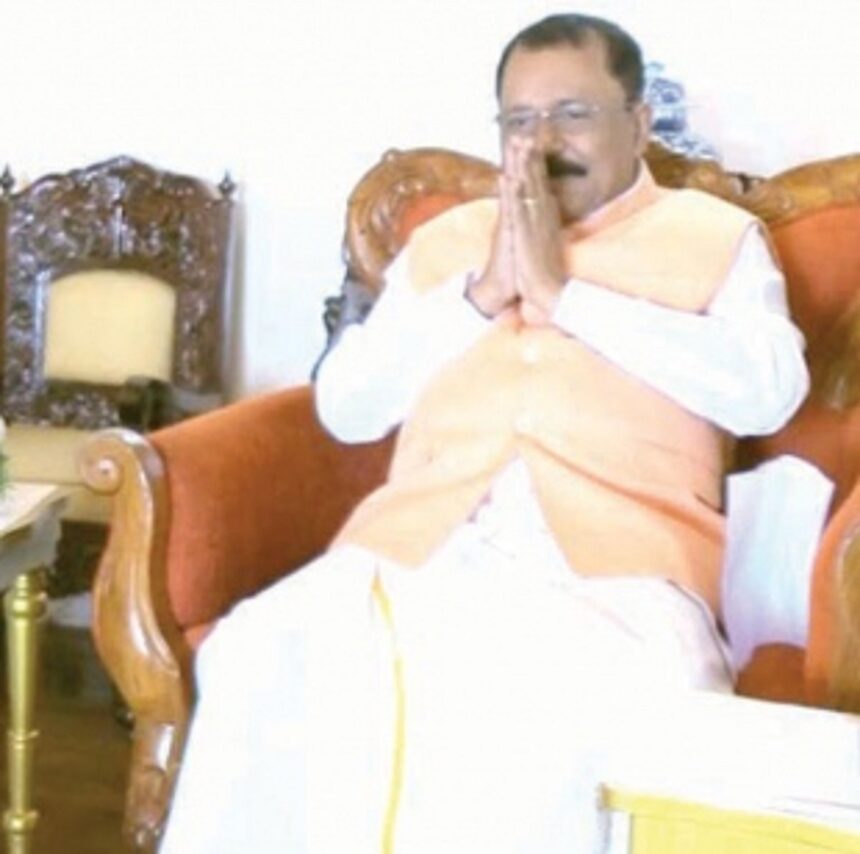
Herald: Gram Swaraj and self-reliance as envisaged by Mahatma Gandhi is the key to the 25-year plan for Goa. You had proposed that the Goa Government should undertake a 25-year development plan for Goa, during your speech to the Goa Assembly, which was constituted recently. Please tell us more about it.
Governor P. S. Sreedharan Pillai: Before the British East India Company came, India’s contribution to world trade was 25% and when the British left India in 1947, our contribution was only 2%. India is a rich country. In this context, Mahatma Gandhi’s concept of Gram Swaraj and self-reliant India are there before us for introspection. Considering this, our government wants to have a self-reliant India. In Goa, also the same thing is declared by the present govt. Self-reliant India and self-reliant Goa is our slogan. This slogan is behind my policy declaration speech about the vision and 25 years of growth, which has been placed before the Goa Assembly and we will seriously think about it.
Herald: But will this lead to devolution of powers for local bodies so that there’s no overlapping of work?
Governor: When Gandhiji undertook the task of India’s freedom struggle, he focused on three types of freedom – political, social and economic. India attained political freedom in 1947 and Goa in 1961. Gandhiji gave maximum importance to economic and social freedom. Social freedom was the removal of caste-based discrimination and untouchability. Economic freedom was self-reliance like making khadi, and promoting local production in villages.
In 1946 Gandhiji appointed a committee for the implementation of his economic concepts which revolved around economic freedom. We committed a mistake by making the USSR’s economic model the base of our economic system. After the first five-year plan, India achieved only 50% of the target. The USSR system collapsed. Now we have the USA’s capitalist system. Both have failed in toto. In the USA, schoolchildren carry pistols and are killing each other. But if you look at Japan’s system, it lays a lot of emphasis on moral education. The system propagated by our freedom struggle leadership was not focused on filling the stomach alone. They also spoke about the importance of ‘dharma’.
Our physical needs are important but at the same time ‘dharma’ is also important. This is the apt time to implement it.
Herald: What has been your experience in Goa? What have you gained and what have you felt being here?
Governor: The Goa Golden Jubilee development council declared the Goa 2035 vision and the road map. I think the most important aspect stated in the document is how to achieve financial prosperity. But I feel the happiness index should come first. This is a very important aspect. If you look at Mizoram, economically it is a very poor State. Yet, it continues to be on the top of the Happiness Index. Goa should also strive to be on the top of the Happiness Index. By taking everything into consideration, the decision to revive mining is good. Chief Minister has declared that within one month the (mining) corporation will be formed and activities may be started. I am not getting into the details.
Herald: So, you are satisfied with the motive…
Governor: Yes, I am satisfied with the motive. But there must be strict compliance with environmental regulations only then it should start. Another aspect is tourism. We are seeing that both tourism and mining have issues. I’m currently visiting the villages of Goa and within one month I have completed the touring of almost all the villages. Already I have covered 90 villages. I’ve covered Canacona taluka fully. I’m very happy to see that there’s much more scope for tourism in our villages. The villages in Goa have an incredible scope to boost tourism while also keeping the present scenario of tourism intact. If we go to villages without defacing the present tourism sector, we can protect the cultural and heritage ethos of Goa.
When I visited the villages, I saw there were a lot of opportunities to attract foreign and domestic tourists. In Canacona, there’s a temple of Lord Parashurama. All South Indian people (flock there)–Parashurama is the concept behind their States and villages. Similarly, Lord Brahma’s original temple can be found in only two places -Pushkar in Rajasthan and Goa. I’m from another state and when I see this, I get very much interested. I will come out with books on each of these villages.
On my visit to Divar, I was quite impressed by the people’s demand for the preservation of the present system of crossing from the mainland to the island by ferry. In most places, the people demand a bridge, but I am quite happy with the people of Divar, they do not want their culture to be tampered with, they have specifically voiced their demands against a bridge. Here you will find beautiful churches and temples. People of different faiths coexist in harmony. The people of Divar living cordially is a classic example that should be presented to the rest of the country as people not only live in peace not only culturally but also religiously. When it comes to social harmony, Goa is a super State.
Goa is the only state having a Uniform Civil Code. Before 1961 Goa was following the Continental legal system. Now we follow the Accusatory system. The difference is that in the former, in a criminal case the accused had to prove his or her innocence. But in the latter, the onus is on the prosecution to plead and prove the guilt of the accused beyond reasonable doubt.
During the Portuguese rule, exceptional circumstances existed (I don’t want to go into details) here where (there was) Christian propaganda. In other parts of the country, there were no such incidents but those are part of the history, and conducting a postmortem over that and blaming anybody is not good for the country. I don’t believe in it.
Herald: As chancellor of Goa University, how do you see the severe faculty crunch affecting the varsity? There was a scheme called Confirmed Advancement Scheme for all faculty, where they would get promoted because of which talent was not coming from outside. Do you feel that some system should be put in place so that the best teachers come from outside to enhance the standard of teaching in Goa University?
Governor: This is the question more regarding the policy of the government than the University. There is an Executive committee of the University, which has discussed the matter but it has not arrived at any conclusions so far. Let them first make a decision and then I will look into it.
In the meantime, the Education Department and if possible, the Opposition should also discuss it. Constitutionally, except for matters pertaining to Articles 355 and 356 (dismissal of State government by Centre and imposition of Central rule), the Governor can’t independently make a decision. The advice of the Cabinet is a must. I don’t want two powers to get into the same issue. Let the elected government and the Legislative Assembly decide the way forward.