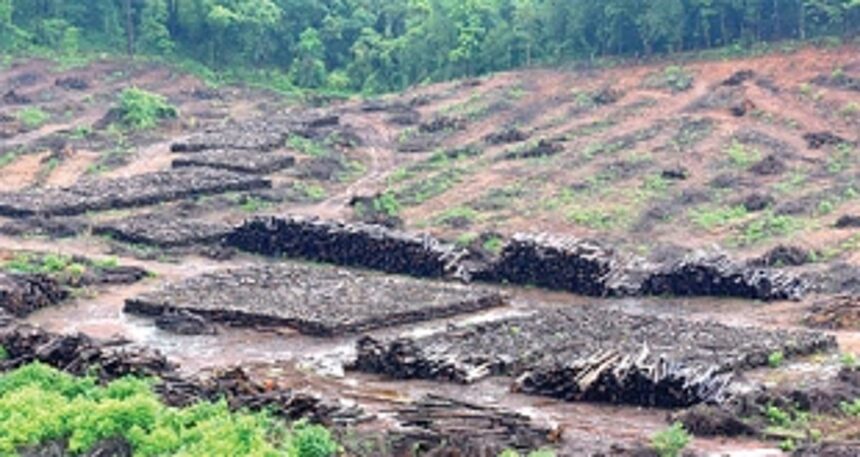
PANJIM: The Goa Foundation (GF) in a report submitted to the Supreme Court, claimed that the afforestation carried out by the Goa Tamnar Transmission Project Ltd (GTPPL) to compensate for the 2,670 trees felled by it at Sangod village in Mollem in 2020, has almost failed.
It may be recalled that for accommodating its electrical substation at Sangod in connection with the Tamnar 400 kV high tension line from Dharwad to Xeldem, Tamnar obtained a licence for felling the trees under the Goa Preservation of Trees Act, when it was required to obtain prior clearance under the Forest Conservation Act, 1980.
The Goa Foundation had filed a contempt petition in the Supreme Court against GTPPL and several Forest department officers for the mass illegal slaughter of forest trees.
The Goa Forest Department in its defence attempted to file an affidavit to claim that 90 per cent of the saplings since planted by the Tamnar agency to compensate for the mass felling had survived.
The Goa Foundation accordingly commissioned a site visit and study of three of the biggest plots on which the Tamnar agency claimed to have planted the saplings at Sangod and Usgao. It asked Farai Patel, an independent researcher and wildlife expert, to head a team of two botanists and four ecologists to visit the three plots and submit a report.
The survey report – copy of which was submitted to the Supreme Court on May 15 – reported some startling findings: The first plot located at Usgao was actually afforested by the forest department in April 2010.
The entire project using Compensatory Afforestation Fund Management and Planning Authority (CAMPA) funds turned out to be a total failure and there was no explanation why the same survey number – which actually belongs to the forest department – was handed over to Tamnar for afforestation a second time.
The Tamnar claimed to have planted 4,199 trees on the plot. The survey report found more than 40% of the trees had died. Of the 4,199 trees planted, the team was able to find only 752 dead and surviving saplings on the plot.
On the second major plot at Sangod, Tamnar claimed to have planted 2,812 trees. However the survey showed that the same survey number was also planted by the forest department in March 2011 and the plantation was also a failure.
The Tamnar was given the plot for reforestation in December 2022 for what appears to be a second try. Of the 2,812 trees, 662 both dead and alive saplings were found. Most of them were not more than 1.2 metre high after three years.
On another survey No. 21 at Sangod – where the agency had felled 2,670 trees – the team examined the claim of the GTPPL that it had planted 600 trees. It could not locate more than 30 trees. The entire site was now infested with a large population of difficult-to-remove weeds.
The survey team established that the reasons for the failure of the plantation at Survey No. 87 at Sangod and Survey No. 244 at Usgao was related to the fact that both sites were completely hostile for planting of trees as these are lateritic plateaus and traditionally host a different type of plants, mostly annual shrubs and herbaceous plants, which are highly endemic to these plateaus.
This unique plateau (or sada) vegetation is biodiversity rich. Attempting to use these plateaus for planting trees was a wrong policy having no ecological sense since it attempted to replace the natural growing vegetation which could survive there with trees which would never thrive on this kind of soil.
Thus the report established that not only had Tamnar destroyed more than 2,670 fully grown trees, but it had also destroyed hundreds of seedlings since these were planted in the wrong place.
“As far as reforestation of the original Sangod plot is concerned, we are still fairly close to achieving almost nothing,” the Goa Foundation stated.
Based on the highlights of the survey report, the Supreme Court directed the forest department and GTTPL to produce a proper rehabilitation plan by Friday, May 17, when the contempt petition is once again to be taken up.
In the meanwhile, the forest department has notified three plots, including Sangod Survey No. 21 as a reserved forest under the provisions of the Indian Forest Act, 1927. This was done after Tamnar handed over possession of the plot, originally purchased by them from private parties for over Rs 8 crore, to the forest department. It also added two other adjacent plots, taking the total to 17 ha. The total forest diversion for the Tamnar project in Goa is nearly 80 ha.
The Goa Foundation has welcomed the notification of the land as a reserved forest. But there is still a long way to go, for both the forest department and the Tamnar agency, if they are to make up for the environmental damage the 400 kV HTL project is causing the State of Goa.