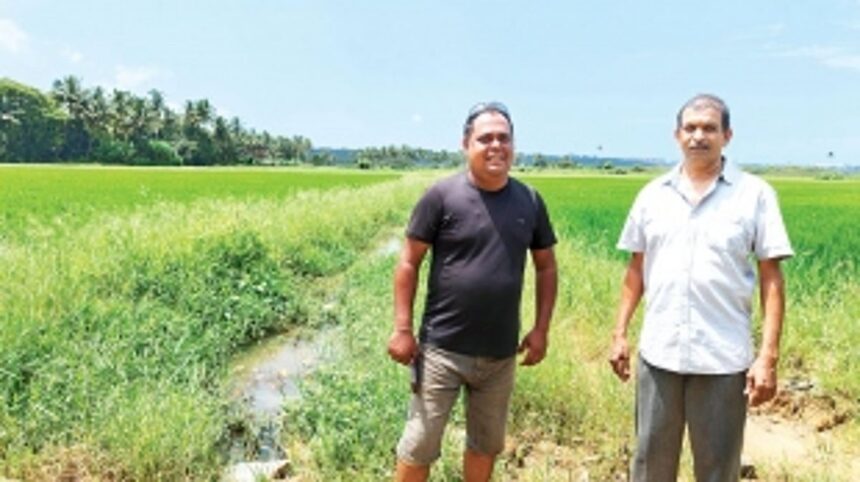
PANJIM: Two farmers from St Cruz, Servito Dias Juliao and Pedru Dias, were heartbroken when their freshly transplanted paddy saplings began to shrivel up and die, due to the unexpected dry spell in August.
Determined to save their crop and unafraid of back-breaking labour, the two managed to unearth old, forgotten irrigation networks and channel water from Bondvol Lake near Taleigao, several kilometres away, to irrigate their fields, breathing life into their paddy crop again.
The erratic monsoon this year has left farmers baffled and struggling– the late onset of the rains, followed by the unprecedented deluge in July, made it impossible for them to plant their Kharif crop at the right time.
“Planting of paddy this year got delayed due to late onset of monsoon and just after transplanting around the first week of August, the rain stopped,” explained Servito, who along with Pedru and a few others, has cultivated 45,000 sq mtr of Comunidade fields, just ahead of the St Cruz football ground.
They were at their wit’s end, and while most other farmers gave up, Servito and Pedru could not watch their precious crop waste away.
“I remember when I was a child, there were traditional water channels bringing water to these fields from Bondvol Lake, but they had been abandoned for decades. En route from the water body, a few houses have also been built, whose occupants had blocked the channels to prevent water from entering their yards and flooding their cattle thoroughfare,” said Pedru.
The task involved clearing out years of silt and removing obstructions to channel the water all the way from the wetland located close to Dr Shyama Prasad Mukherjee Stadium, as well as coaxing and negotiating with the occupants of the houses along the channel, but through sheer grit, the two managed to rejuvenate their drying fields.
“We managed to save more than 70 per cent of our crop. Now, we pray for rain,” said Pedru.
“If there is no rain for another week, the fields will dry up again. We will again open the gate at Bondava wetland and irrigate our fields. We are determined to see this season through,” said Servito, adding that they would also be able to grow a Rabi crop if the government helps restore these abandoned irrigation channels.
“These age-old irrigation channels fell into disuse because the fields in the area had been left fallow for 18-20 years. Back in the day, this stretch was famous for the sweetest watermelons. People used to stop and buy melons freshly picked from the fields,” reminisced Olavio Fernandes, former Assistant Director of Goa’s Agriculture Department and St Cruz resident who advises and supports
local farmers.
“The issue of houses cropping up alongside these canals, and obstructing these traditional water channels, is something the local administration needs to investigate,” he added.
These fields, a swathe of striking green as far as the eye can see, were abandoned for decades, until Servito and Pedru took up paddy farming during the Covid-19 lockdown in 2020. “We started with cultivating 25,000 sq mtrs because the situation was quite bleak, and this way, we would at least have rice to eat,” said Servito.
Today, they have scaled up to 45,000 sq mtrs, and after the paddy harvest, they plan to grow alasande beans, a Goan delicacy.
“These farmers have shown tremendous initiative; they serve as an inspiration to other agriculturists who may give up in such impossible situations,” said Kenneth Lopes of Goencho Xetkar, the mechanised farming company that transplanted the paddy crop for Servito and Pedru.
“We were worried about the survival of the crop when the rains stopped, but their quick thinking saved the day,” he said.